Chapter 2: The Inventory of Absences
The Santa Fe morning light filled my studio with its usual clean, sharp clarity, but the room felt different. The smell of linseed oil and turpentine, usually a comfort, felt thick in my lungs.
I made coffee, sat on the stool by the window, and laid Megan’s text message next to the mug.
*He said you couldn't make it.*
Last spring. I remembered that week vividly. I had been finishing a series of gouache illustrations for a children's book about the Rio Grande. I hadn't left town. I hadn't had an out-of-town client. In fact, that was the week Mom had asked me to bring over a casserole because she was recovering from a minor dental procedure. I had driven thirty minutes to their house, dropped the food in the kitchen, and left while Dad and Jason were out back tossing a football.
Nobody had mentioned a photographer. Nobody had asked if I was free on Thursday afternoon.
By noon, the fallout from the banquet hall had taken tangible form.
My phone had four voicemails from Jason, ranging from frustrated to exhausted. *“Becca, Mom has been crying since six in the morning. Gary’s wife called her to ask if you were having a breakdown. Did you really have to do it like that? You couldn't just talk to us privately?”*
He had forgotten, of course, the Sunday phone call where I begged Mom to stop the joke. He had forgotten my question at the restaurant. In Jason’s version of history, things only existed if they caused a public disturbance.
There was nothing from Mom. Nothing from Dad.
At two o'clock, the small brass bell above my studio door chimed.
I stepped out from behind the canvas rack expecting a client or a delivery. Instead, Megan stood on the hardwood floor, wearing her track jacket and jeans, her gym bag slung over one shoulder. She looked smaller than she did on the softball field, her blond hair pulled back in an untidy ponytail.
She didn't look angry. She looked disoriented.
""You didn't answer my text,"" she said.
""I didn't know what to say,"" I replied honestly.
Megan walked slowly into the center of the studio. In twenty-eight years, this was the second time she had ever set foot in my workspace. The first had been two years ago, when she needed to borrow my utility dolly to move an apartment couch.
Her eyes drifted across the walls—the working sketches of local fauna, the color studies, the framed prints from the children's books.
""Did you really think we did that on purpose?"" she asked, stopping in front of a watercolor of an adobe wall. ""The photo?""
""Megan, you were there,"" I said, leaning against my workbench. ""You put on matching navy sweaters. You brought the golden retriever. You stood in the backyard with a professional lighting rig. Did nobody ask, 'Where's Rebecca?'""
She flinched. The color rose in her neck.
""Dad said you had a deadline,"" she muttered, looking down at her sneakers. ""He said you told him you couldn't be interrupted for two days. He said... he said we'd photoshop you in later if we needed to, but the photographer was already paid for.""
""Did anybody ever ask me for a photo to photoshop in?""
Silence settled between us, heavy and dry.
""No,"" she whispered.
""And when it was framed in the lobby of Miller Roofing?"" I asked. ""You work there two days a week doing payroll. You walk past that reception desk every Tuesday morning.""
""I thought you knew,"" she said, her voice cracking slightly. ""I swear to God, Becca, I thought it was just one of those things where you didn't care about family stuff. Dad always said you lived in your own world. He said artists don't like practical routines. I didn't think about it.""
""That's the point, Meg,"" I said gently, without malice. ""Nobody thought about it. It was so easy to leave me out that it didn't even feel like an event.""
She wrapped her arms around herself, staring at a small landscape leaning against the baseboard. It was the painting Ruth had bought at my gallery show—she had left it with me to be re-varnished.
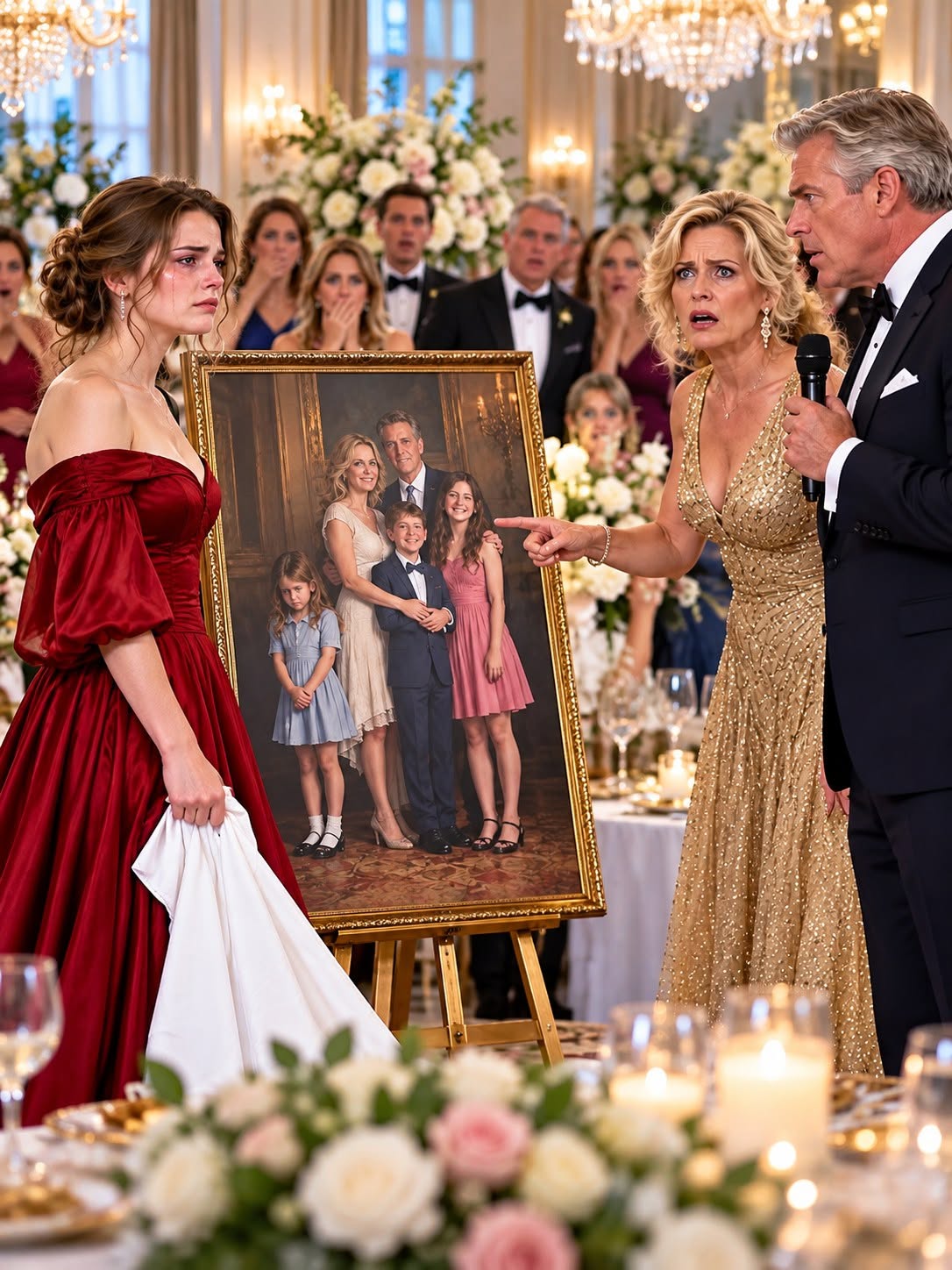
""Dad took the painting down last night,"" Megan said.
""Which one?""
""Yours. From the easel. Before the catering staff even cleared the coffee cups, he shoved it into the back of his SUV. Mom wanted to leave it for the venue to throw out, but Dad took it.""
""Why?""
""He didn't say. He hasn't spoken three sentences since we got home."" She hesitated, shifting her weight from one foot to the other. ""Jason wants you to come to Sunday dinner. He thinks if you apologize for the timing, Mom will let it go.""
""I'm not apologizing for telling the truth.""
""Even if it means Dad cuts you off?""
""Cuts me off from what, Megan?"" I asked, looking her dead in the eye. ""Sunday dinners where I'm the butt of a joke? Phone calls where nobody asks about my life? Being airbrushed out of existence so the family looks neat for the neighbors?""
Megan took a step back, as though the air near the workbench had suddenly grown too hot. She opened her mouth to argue, but the words withered. She wasn't used to seeing me with edges. For twenty-one years, I had been the soft, pliable cushion that absorbed the household's awkward angles.
""You're different,"" she said, almost to herself.
""No,"" I told her. ""I'm just visible now.""
She lingered for another minute, uncomfortable in the quiet, before turning toward the door. Just before she pressed the handle, she stopped.
""Aunt Ruth called me this morning,"" Megan said without turning around.
""What did she want?""
""She told me to ask Dad about the blue chest in the basement storage room. The one with the brass padlock behind the holiday decorations."" Megan turned her head slightly. ""She said if Dad wouldn't open it, I should tell you to ask him.""
""What's in the chest?""
""I don't know,"" Megan said, opening the door. ""When I asked Dad about it at breakfast, he told me to mind my own business and slammed the pantry door.""
The bell chimed as she stepped out into the bright afternoon glare.
I stood in the center of the studio, the smell of paint around me, listening to the hum of the traffic on Paseo de Peralta.
*The blue chest.*
I hadn't thought about that box in fifteen years. It had sat behind the artificial Christmas trees for as long as I could remember, covered in dust, the brass padlock green with age. When Jason and I were kids, we used to pretend it held pirate gold. Once, when I was ten, I had tried to pry the latch with a butter knife, and Dad had caught me by the wrist, his grip so tight it left red finger marks for an hour.
*Nobody touches that,* he had roared. *Never touch what isn't yours.*
I wiped my hands on an old cotton rag, picked up my phone, and dialed Aunt Ruth.
---
Related Stories