Chapter 5: The Line on the Floor
The fluorescent light hummed above us, steady and cold.
""Scared you?"" I repeated. The word sounded ridiculous in the basement of a man who had built a multi-million-dollar company out of sheer stubbornness. ""A crayon drawing of a horse scared you?""
""You didn't just draw it, Rebecca,"" Dad said. He sat down heavily on the folding chair in front of the easel, resting his elbows on his knees, his hands clasped between them. ""You sat on that driveway for three hours in ninety-degree heat. Jason wanted ice cream. Megan was crying about a scraped elbow. Your mother was telling me the burgers were burning.""
He looked at the concrete floor between his boots.
""And you were just... gone,"" he continued, his voice rough. ""You were completely inside that piece of chalk. I watched your hands. You were blending the dust with your thumb to make the horse's flank look round. Nobody taught you that. You were seven years old, and you already had the sickness.""
""The sickness?"" My voice rose, sharp and incredulous. ""You think being an artist is a sickness?""
""It eats everything else,"" he said, looking up at me. There was no mockery in his face now. There was only a deep, calcified dread. ""It doesn't leave room for a normal life. It makes you selfish. It makes you look at people like they're just shapes and colors instead of family. My father told me that when I was eighteen, and I thought he was an ignorant bastard.""
He pointed a blunt, calloused finger toward the blue chest.
""I thought I could do both,"" he said. ""I thought I could go to Chicago, paint my pictures, and still be the son he wanted. You know what he did when I showed him my acceptance letter? He took his pocketknife and cut every single button off my good suit. He told me if I went to art school, I was leaving with nothing he paid for.""
""So you quit,"" I said.
""I enlisted,"" he corrected flatly. ""I went to Germany. I drove supply trucks. And when I came back, I bought three used ladders and started patching roofs. I made something solid. Something people have to pay for whether they like your personality or not.""
""And when I was born?""
Dad stood up from the chair. He walked over to the blue chest, his large hand resting on the rim of the lid. He looked down at the sketchbooks—at the years of his own youth locked beneath the dust.
""When you were little, you used to look at me like you knew,"" he murmured. ""You'd watch me measure a roof line or sketch a truss on a napkin, and you'd ask why I didn't use blue for the shadow. You were ten years old, telling me about complementary colors while Jason was asking for a new bat.""
""So you made me into a joke,"" I said. ""To keep me away from you?""
""To keep you from thinking it was worth anything!"" he snapped, the old defensive fire finally flaring in his eyes. ""I thought if I made it look ridiculous—if the family laughed at it—you'd grow out of it! I thought you'd pick up something practical. Accounting. Graphic design for real companies. Something that wouldn't break your heart when the world didn't give a damn about your pretty pictures!""
""The world does care about my pictures, Dad,"" I said, stepping toward him until the easel stood between us like a fence. ""I pay my rent. I illustrate books that kids read every night before bed. I have murals in three cities. I didn't break. You did.""
The words landed like physical blows. He flinched, his jaw tightening until the muscle twitched beneath his skin.
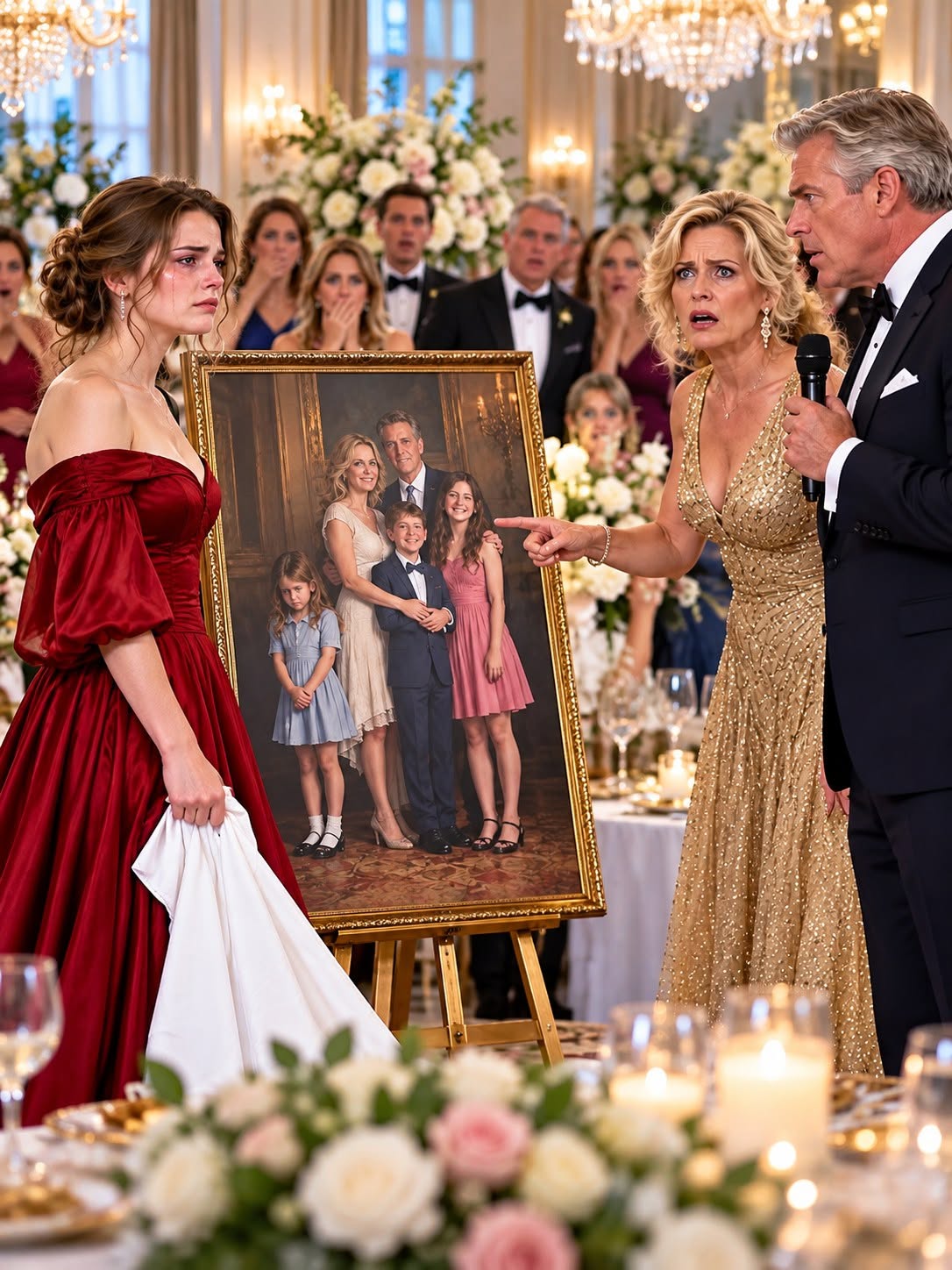
""And the portrait?"" I asked, refusing to let him retreat into his old silence. ""In the lobby? Megan told me you said I had a deadline. Did that scare you too?""
Dad didn't answer immediately. He reached into his flannel shirt pocket, pulled out his reading glasses, and put them on, though there was nothing to read. It was an old habit—something to put between his eyes and the world.
""Your mother wanted that picture,"" he said quietly. ""For the thirty-year brochure. The marketing firm said customers like to see family continuity. Jason's taking over the commercial division next year. Megan’s handling the operations.""
""And me?""
""You're not part of the business, Rebecca.""
""I'm part of the family, Dad!""
""Are you?"" he asked, his voice suddenly dropping into a register that made my blood run cold.
He reached into the back pocket of his trousers, pulled out a folded white envelope, and laid it on top of the blue chest, right beside the German pastels.
The envelope was addressed to me, in care of Miller Roofing. The return address was a law firm in Denver.
""That came to the office on Tuesday morning,"" Dad said. ""The day before the anniversary. Before you stood up in front of a hundred people and put me on trial.""
I stared at the envelope. ""What is it?""
""Open it,"" he said.
I picked it up. The paper was crisp, expensive linen stock. I slid my finger under the flap, pulled out the single typed page, and unfolded it.
It wasn't a cease-and-desist. It wasn't a business inquiry.
It was an estate notification from the Colorado Department of Public Health and Environment, accompanied by an explanatory letter from an executor named Marcus Vance.
*Re: The Estate of Arthur Miller (Deceased 1998) and Helena Vance Miller (Deceased 2026).*
My grandfather Arthur. The man who had cut the buttons off Dad's suit.
I scanned the formal paragraphs, my eyes jumping over the legal jargon until they hit the third clause:
*...pursuant to the conditional trust established under Section 4 of the testamentary declaration, the distribution of the mineral and land holdings in Rio Arriba County was held in abeyance pending verification of issue demonstrating lineal professional qualification in the fine arts, as stipulated by the late Helena Miller...*
My breath hitched.
*...said holdings, valued at the date of probate at $1.4 million, were specifically designated to bypass the primary heirs (David Miller, Ruth Miller) in the event that any grandchild achieved professional standing in fine arts prior to their thirtieth year, failing which the entire asset class was to merge into the general commercial holdings of Miller Roofing Inc.*
I looked up from the paper, the words swimming before my eyes.
""Grandma Helena,"" I whispered. ""She was an artist.""
""She was a schoolteacher who painted teacups,"" Dad said, his voice flat, dead, completely devoid of warmth. ""Arthur hated it. When he died, he let her put that stupid clause in the will because he thought it was a joke. He knew I’d never let any kid of mine waste their time on paint. He thought it was an impossible condition.""
He pointed at the letter in my shaking hands.
""If you turned thirty next spring without an accredited gallery representation, that land became mine,"" Dad said. ""It was going to fund the expansion into Albuquerque. Jason’s entire five-year plan is built on that capital.""
The room seemed to tilt on its axis.
The jokes.
The Fourth of July on the driveway.
The gallery show they missed to watch Megan’s recreational softball game.
The missing high school awards.
The family portrait in the lobby.
It hadn't just been his repressed trauma. It hadn't just been his fear of my sensitivity or his lingering shame over his own buried talent.
Every time I picked up a brush, every time I sold a painting, every time I took another step toward being recognized as a professional artist, I wasn't just reminding him of the boy he had buried in gray primer.
I was twenty-four months away from taking the foundation out from under his company.
""You knew,"" I whispered.
Dad stood beside the open blue trunk, his face shadowed in the fluorescent light, looking down at the little crayon drawing of the horse.
""I didn't think you'd actually make it,"" he said.
Related Stories