Chapter 1: The Weight of an Audience
The microphone caught my breath as a low, metallic hum.
For four or five seconds, the only movement in the banquet hall was the flicker of votive candles against the linen tablecloths. Nobody reached for their wine. Nobody whispered to the person beside them. More than a hundred people who had just spent two decades laughing on cue were trapped under the glare of their own collective silence.
Mom’s phone was still raised at chest level. Her elbow wavered, then dipped, the screen casting a pale blue rectangle across her silk blouse before she finally lowered it to her lap. Her mouth opened, shut, and opened again, but nothing came out.
Beside her, Dad looked as though he had stepped off a curb he hadn't seen. The wide, gregarious grin that usually commanded regional sales conferences had collapsed into a rigid line. His knuckles went white against the edge of the head table.
Gary cleared his throat near the podium. It sounded like paper tearing in an empty room.
""Rebecca,"" Dad said. He wasn't using the microphone, but his voice carried anyway. It was the low, warned tone he had used when I was twelve and refused to apologize for staying late in the school art room. ""That's enough.""
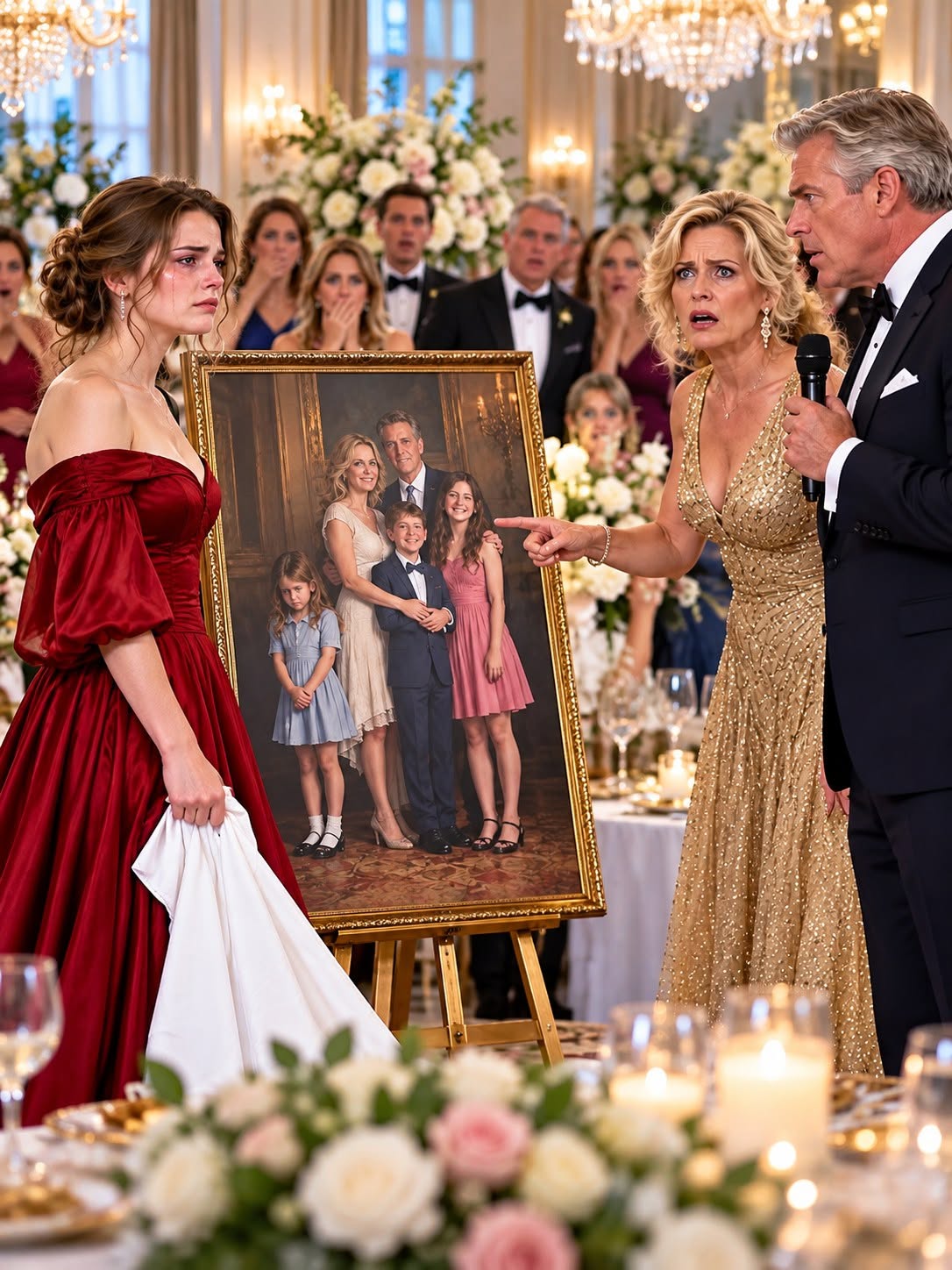
I looked down at the brass plate at the bottom of the frame: *The Millers at Home. Artist Outside the Frame.*
""Happy anniversary,"" I said into the microphone.
I set the mic down on the small table next to the easel. The base gave a sharp, thumping pop through the hall's sound system. I didn't rush. I smoothed the front of my dress, turned my back on the dais, and stepped down from the platform.
A murmur began behind me, spreading from table to table like water finding cracks in concrete.
""Rebecca, wait,"" Jason called. He half-rose from his seat, his napkin tumbling from his knees to the floor. His face was flushed, caught somewhere between embarrassment for our parents and sheer disbelief that his orderly little sister had broken formation.
Megan didn't move at all. She was staring at the window in the painting—at the small, dark figure standing out in the rain while the rest of them bathed in amber parlor light. Her eyes were wide, her lower lip pulled in between her teeth.
I didn't stop. I walked down the center aisle, past Great-Aunt Clara, past the neighbors who had sat on those hot lawn chairs with folded towels twenty-one years ago, past the clients who gave Dad their commercial roofing contracts because he was such a solid family man.
Near the double exit doors, Ethan stood waiting. He didn't ask if I was okay. He didn't offer a platitude. He simply held the heavy brass door open with one arm, his keys already resting in his palm.
Behind us, Aunt Ruth remained in her seat at table four. She wasn't looking at my parents, and she wasn't looking at me. She was looking squarely at the painting, her chin resting on her steepled fingers, her turquoise earrings catching the light. As I passed, she caught my eye and gave a single, deliberate nod.
We reached the parking lot before the doors banged open behind us.
""Rebecca!""
It was Dad. The cool night air hit us, smelling of dry pine and asphalt. He was walking fast, his suit jacket unbuttoned, his tie slightly crooked. The hall lights spilled behind him, silhouetting his broad shoulders.
""You had no right to do that,"" he said, stopping five feet from the bumper of Ethan's truck. His breathing was heavy, uneven. ""In front of our friends. In front of my associates. You turned a celebration into a personal vendetta.""
""It wasn't a vendetta,"" I said, turning to face him. My voice was steady, which surprised me. My hands were shaking inside my coat pockets, but my voice didn't waver. ""You asked for a tribute painting. I painted what was there.""
""You made us look cruel.""
""No, Dad,"" I said softly. ""You made the joke. I just stopped providing the punch line.""
He stared at me, his jaw working as if chewing on words he couldn't spit out. For a moment, the old fury flickered in his eyes—the irritation of a man whose authority had been challenged by someone who was supposed to be easy to manage.
""After everything we gave you,"" he muttered, shaking his head. ""A roof over your head. Food. An education—""
""You didn't pay for art school,"" I interrupted. ""I worked thirty hours a week at the framing shop and took out federal loans. You paid for Jason's business degree and Megan's travel teams. You told me my school was a hobby.""
His eyes shifted, darting toward the banquet hall entrance where several guests were beginning to trickle out, pretending to look for their cars while watching the scene. He hated being observed. He had always hated anyone seeing the mortar between the bricks.
""Go home, Rebecca,"" he said, his voice dropping into that flat, cold register I knew too well. ""Just go home. Don't come by the house tomorrow. Don't call your mother until you're ready to apologize to her.""
""I'm not going to apologize, Dad.""
He let out a short, harsh breath through his nose. ""Then you really don't belong in this family, do you?""
He turned on his heel and walked back toward the warm light of the banquet hall.
Ethan opened the passenger door. I climbed in, pulled the seatbelt across my chest, and stared straight ahead through the windshield. We backed out of the space and turned onto the road toward Santa Fe, leaving the banquet hall glowing behind us.
Ten miles down the highway, my phone buzzed in my bag.
It wasn't Mom. It wasn't Jason.
It was Megan.
*I didn't know about the lobby portrait,* the text read. *Dad told us you were busy with a client when the photographer came to the house last spring. He said you couldn't make it.*
I stared at the screen as the dashed white lines of the highway blurred beneath our headlights.
---
Related Stories