Chapter 4: The Open Padlock
The key was where it had always been: under the third brick of the decorative retaining wall behind my parents' garage.
I arrived at five in the afternoon on Friday. Dad's truck was absent from the driveway; he was always at the commercial yard on Friday afternoons closing the weekly manifests. Mom’s sedan wasn't there either—Friday was her bridge club at the community center.
The house sat large, silent, and beige in the suburban subdivision.
I let myself in through the side door by the laundry room. The house smelled faintly of lemon wax and clean carpet, an airtight scent that had never changed since I was in high school. The silence was oppressive, broken only by the refrigerator compressor cycling on in the kitchen.
I walked down the hallway toward the basement stairs. On the wall hung the polished frames: Jason’s collegiate golf ribbons, Megan’s state softball plaques, a framed newspaper clipping of Dad receiving the Chamber of Commerce Citizen of the Year award.
My high school art award was nowhere to be found. I already knew where it was—in that cardboard box in the garage, underneath the wool blankets.
I pulled open the basement door and switched on the light.
The wooden stairs creaked beneath my flats as I descended into the cool, concrete air below. The basement had been finished years ago into a game room with a pool table and a wet bar, but the back storage room remained raw concrete, smelling of damp earth and cardboard.
I pushed open the hollow-core door to the storage area.
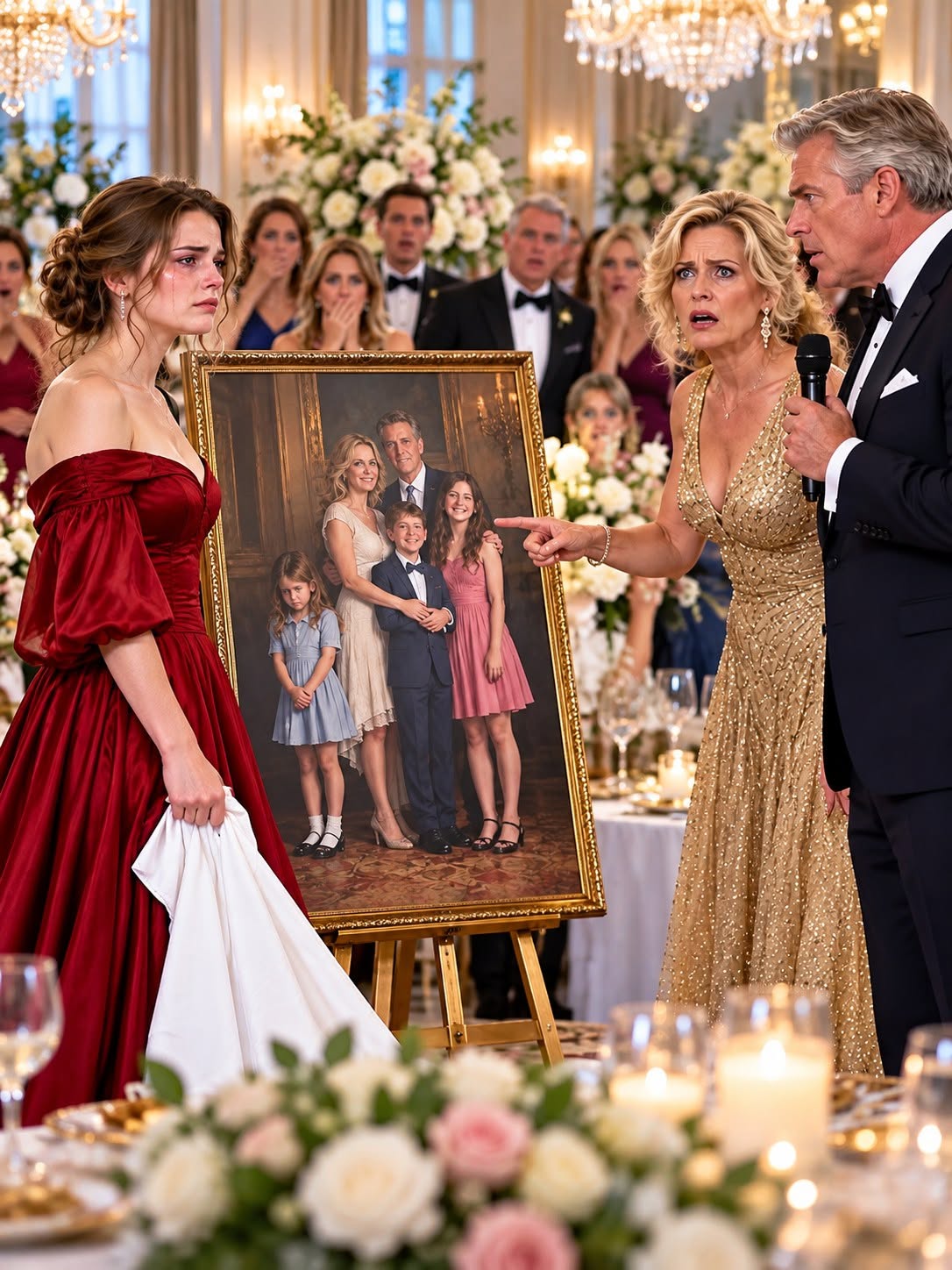
There, leaning against an upright freezer, was my four-foot tribute painting.
The white cloth lay crumpled on the concrete floor beside it. In the stark fluorescent glare from the single overhead tube, the painting looked even more severe than it had in the banquet hall. The warm, amber parlor dinner of the Miller family glowed on the canvas, while outside in the dark, rainy pane, my smaller self stood watching.
Directly in front of the easel sat an old folding metal chair.
And beside the chair, resting on a pair of wooden pallets, was the blue trunk.
The heavy brass padlock was hanging open from the hasp, unclasped for the first time in my living memory.
My throat went dry.
I stepped across the cold concrete, my heart thumping against my ribs. The lid of the trunk was slightly ajar, propped open by an inch. I reached out, my fingers trembling as they touched the scratched blue enamel, and lifted the heavy lid.
It didn't smell like mold. It smelled like dried cedar chips, linseed oil, and old paper.
Inside, stacked with obsessive neatness, were five thick sketchbooks bound in black cloth. Beside them lay several wooden boxes of oil pastels, their labels written in German, the pigments worn down to rounded stubs.
I reached for the top sketchbook. The paper was heavy, slightly yellowed at the deckled edges, but perfectly preserved.
I turned the cover.
On the title page, written in a bold, confident hand that looked almost nothing like the cramped signatures on Dad’s roofing invoices, was the name: *David Miller, 1974.*
I flipped through the pages.
Sketches of the Sandia Mountains at sunrise, captured with fierce, aggressive charcoal strokes. Studies of hands—calloused hands holding hammers, weathered hands resting on knees. There was a drawing of a stray dog curled up by a fence, rendered with such tenderness in the crosshatching that it made my chest ache.
He had been good. He had been astonishingly good.
I turned more pages, my breath shallow. Then I reached the back of the first book.
Tucked between the final two leaves was a loose piece of cheap, lined notebook paper. It wasn't a drawing from 1974.
It was a piece of drawing paper torn from a child’s spiral pad. The edges were perforated and uneven.
Drawn on the sheet in blue and red Crayola was a clumsy, lopsided horse standing under a giant yellow sun with smiling eyes. In the bottom corner, written in the large, uneven block letters of a seven-year-old learning to write, was:
*FOR DADDY. FROM REBECCA.*
I stared at it.
The July Fourth barbecue. The day he had told the neighbors the hospital must have sent them home with the wrong baby.
He hadn't thrown it away. He hadn't put it in the garage box with the school awards and the mother's day cards that Mom had packed away. He had brought it down here, unlocked the chest he had hidden from the world, and slipped it into the pages of the work he had buried.
""What are you doing down here?""
The voice cracked like a gunshot in the basement quiet.
I spun around, dropping the child's drawing back onto the open sketchbook.
Dad was standing at the entrance of the storage room.
He wasn't wearing his suit, and he wasn't at the roofing yard. He wore an old flannel shirt with the cuffs rolled up, his hair uncombed, his face lined with an exhaustion that made him look ten years older than the man who had held the microphone on Wednesday night.
He looked at me, then at the open blue trunk, then at my hands.
""I told you never to touch that,"" he said, but the anger was missing from his voice. It sounded hollow, like an echo in an empty cistern.
""You kept it,"" I whispered, pointing down at the crayon drawing. ""You told everyone I was a mistake, and you kept it.""
Dad didn't answer. He walked slowly into the room, his boots scuffing against the concrete, and stopped on the other side of the easel. He looked at my tribute painting—at the little girl outside in the rain.
""I didn't keep it to be sentimental,"" he said, staring at the canvas.
""Then why did you keep it, Dad?""
He looked up from the painting, his eyes raw and bloodshot, and for the first time in my life, I saw my father look entirely defenseless.
""Because it scared the hell out of me,"" he said.
---
Related Stories