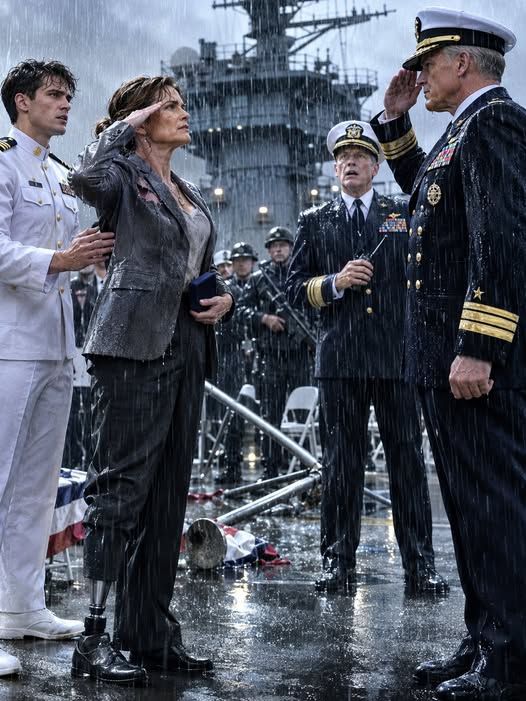
Chapter 1: The Forged Foundation

The echo of my mother’s trembling voice over the phone still lingered in my ears long after the call ended. *“Leah, your brother showed us the discharge papers.”*
If Grant had manufactured official-looking discharge documents and fabricated messages from me, it wasn’t just a cruel prank or a family misunderstanding. It was calculated fraud. But why would my brother go to such extreme lengths to convince our parents that I had washed out of the Navy in disgrace?
The answer didn't become clear until three months later, when an investigator from the Naval Criminal Investigative Service (NCIS) requested a confidential meeting during one of my shore leaves.
Special Agent Thomas sat across from me in a quiet diner booth near the base, sliding a manila folder across the worn laminate table.
“Lieutenant Moore, have you ever heard of a corporate entity called Harbor Shield Recovery?” Agent Thomas asked.
“No,” I replied, opening the folder. Inside were corporate registration filings, federal defense logistics subcontractor bids, and financial audits.
“It’s a mid-sized maritime logistics and asset recovery firm based out of our home district,” Agent Thomas explained, tapping a finger on a document. “For the past four years, they’ve been securing lucrative no-bid contracts with the Department of Defense, claiming specialized compliance credentials and priority veteran-status staffing.”
I scanned the pages, my eyes catching a familiar name listed as the primary founder and CEO: *Grant Moore*.
“What does Harbor Shield have to do with me?” I asked, looking up.
“To qualify for those priority federal defense set-asides and small-business veteran grants, a primary contractor must either be a service-disabled veteran or have immediate family members whose military service history grants specific clearance privileges under targeted procurement acts,” Agent Thomas said evenly. “When Grant Moore incorporated Harbor Shield, he needed a clean, verifiable military background to attach to the family LLC profile to unlock Tier-1 federal bidding status.”
A cold realization began to form in my chest. “He used my enlistment.”
“Worse than that,” Agent Thomas corrected. “When federal auditors started poking around six months ago to verify active-duty dependents and family service records for compliance checks, Grant needed to explain why an active-duty Navy officer was linked to his corporate filings without raising red flags of identity misuse. So, he submitted fraudulent administrative separation paperwork—stating that you had received a medical and disciplinary discharge years prior.”
He looked at me with steady, professional sympathy. “According to your brother’s corporate paperwork, you weren't just a failure, Lieutenant. You were an ex-sailor whose military credentials were legally abandoned, allowing him to claim sole proprietary stewardship over your service record for federal contracting benefits.”
I stared at the financial printouts. Grant hadn't just lied to hurt my feelings or keep me out of the family dynamic. He had monetized my uniform. Every expensive suit he wore, every corporate lawyer he hired, and every milestone of his respectable businessman persona had been built on a foundation of stolen valor and federal fraud.
“What happens next?” I asked quietly.
“Federal prosecutors are moving to indict him on multiple counts of wire fraud, falsification of government documents, and misuse of federal defense contracts,” Agent Thomas said. “And Lieutenant... the U.S. Attorney’s office is going to require your direct testimony in open court to establish the baseline identity fraud.”
---
Related Stories