Chapter 2: The Anteroom Reckoning
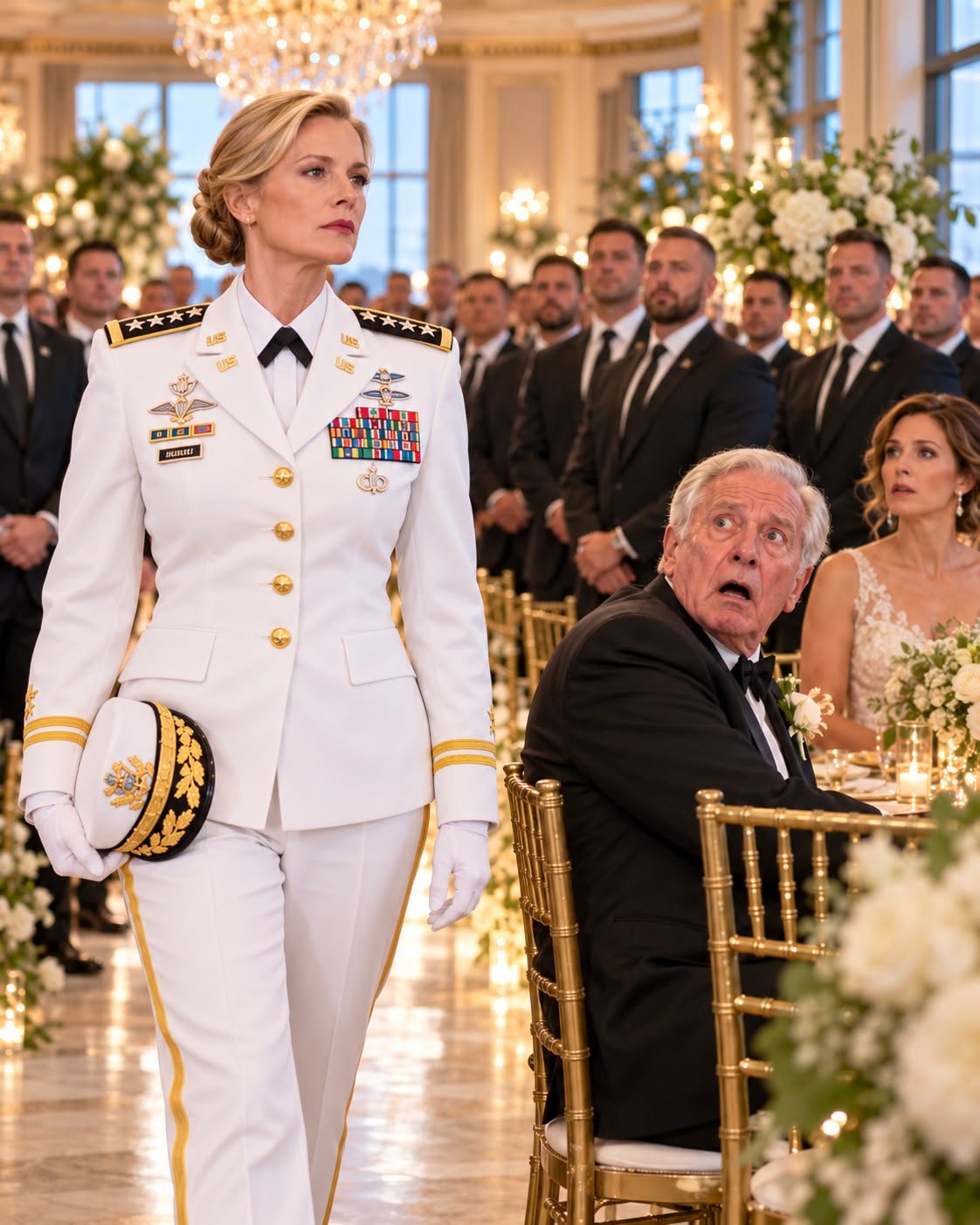
The heavy double doors of the private bridal anteroom closed with a heavy, pneumatic click, sealing out the stunned murmur of the two hundred veterans and the terrified silence of my father’s Charleston social circle. The room smelled of expensive gardenia blossoms, hairspray, and the sharp, sour tang of adrenaline.
Melanie stood near the arched window overlooking the harbor, her ivory lace train pooled around her feet like foam against a breakwater. She had her back to the room, her hands pressed flat against the cool glass, her veil trembling with every ragged breath that tore through her lungs. Beside the mahogany dressing table, Eleanor sat in a tufted armchair, clutching her gold evening clutch to her stomach as if it were a shield against an incoming mortar round.
“You ruined it,” Eleanor whimpered, her voice muffled behind her lace handkerchief, her mascara running in dark gray streaks down her powdered cheeks. “You had thirty-six years to play the soldier, Quinn. Thirty-six years of tearing your father’s heart out, refusing to come home for debuts, refusing to marry into a decent family on the battery. And now, on the one day that was supposed to belong to your sister, you march in here with an army of hooligans to turn us into a laughingstock.”
I stood by the doorway, my white gloves folded neatly in my left hand, my cap resting under my arm. “Those hooligans are the command cadre of the United States Special Operations Command, Mother. The man standing at the altar was awarded the Medal of Honor in 2008 for pulling twelve wounded soldiers out of a burning valley in Nuristan. If you find his presence humiliating, I suggest you take it up with the President of the United States, who personally pinned the ribbon around his neck.”
Melanie turned around.
The sister I had remembered from Christmas photographs—the woman who smiled with porcelain perfection, whose hair was always set in immaculate Southern waves, whose voice never rose above a cultured drawl—was completely gone. Her cheeks were pale and hollow, her eyes red-rimmed and swollen from hours of crying, her diamond earrings catching the pale light from the window like ice. She looked at my uniform, her gaze lingering on the four silver stars gleaming against the dark green fabric of my shoulder boards, and then she let out a broken, shuddering gasp that sounded like something dying in her throat.
“He told me you wouldn't come,” Melanie whispered, her voice barely carrying across the rug. “Dad told me you laughed at the invitation. He said you texted him from Fort Bragg and told him that you had more important things to do than watch your baby sister marry a retired non-commissioned officer who runs a private security firm.”
A cold, dead stillness settled behind my ribs, heavier than any body armor I had ever worn. I reached into the breast pocket of my dress jacket, pulled out my personal phone, and unlocked the screen.
I tapped open the message thread, walked across the Aubusson carpet, and laid the phone flat on the glass top of the dressing table between us. The screen glowed with the nine words Thomas had sent forty-eight hours ago: *No one gives a damn about your Army career.* Right above it was the timestamp showing I had forwarded my retirement announcement to the family chat at fourteen-hundred hours, followed by his immediate, venomous reply.
Melanie looked down at the screen. She didn't touch it. She didn't have to.
“He intercepted your mail, Quinn,” Melanie choked out, tears finally breaking past her lower lids, carving pale paths through her bridal makeup. “For twenty years. Every promotion notice, every change-of-command invitation, every commendation letter that was delivered to the house on Tradd Street—Dad took them from the mailbox before Mom could see them. He kept them in the iron safe in the library carriage house. He told us you were just an administrative staff officer shuffling papers in logistics. He told us that you were ashamed of the family, that you were deliberately avoiding us because you thought you were better than Charleston.”
“Melanie, be quiet!” Eleanor snapped, rising from her chair with sudden, frantic energy, her Southern charm completely replaced by a cornered, feral panic. “You don't know what you’re talking about! Your father did what was necessary to keep this family respectable! A woman in combat boots is not what the Braddocks represent! We have two hundred years of heritage in this city!”
“Our heritage is a lie, Mom!” Melanie screamed, rounding on our mother with a ferocity that made Eleanor recoil against the dressing table, knocking a crystal perfume bottle onto the floor, where it shattered with a sharp, fragrant crack. “Dad didn't hide Quinn’s career because he was ashamed of her uniform! He hid it because he was terrified of what would happen if anyone in this town found out why Mick Garrity came to Charleston in the first place!”
I stepped forward, my boots crunching softly on the broken glass, my gaze locking onto my sister’s shaking hands. “Melanie. What did Mick come here for?”
Melanie reached down into the hidden silk pocket of her bridal gown and pulled out a folded, legal-sized carbon document stamped with the blue seal of the South Carolina State Ports Authority.
“Mick didn't meet me at a charity gala by accident, Quinn,” Melanie whispered, holding the paper toward me with trembling fingers. “He’s been investigating Dad’s commercial maritime contracts for eighteen months on behalf of the Department of Defense Inspector General. And yesterday morning, Mick discovered that Dad has been using your forged signature on federal defense shipping waivers to smuggle unmanifested commercial freight through the Charleston naval terminal since 2019.”
Related Stories