Chapter 1: The Salute at the Altar
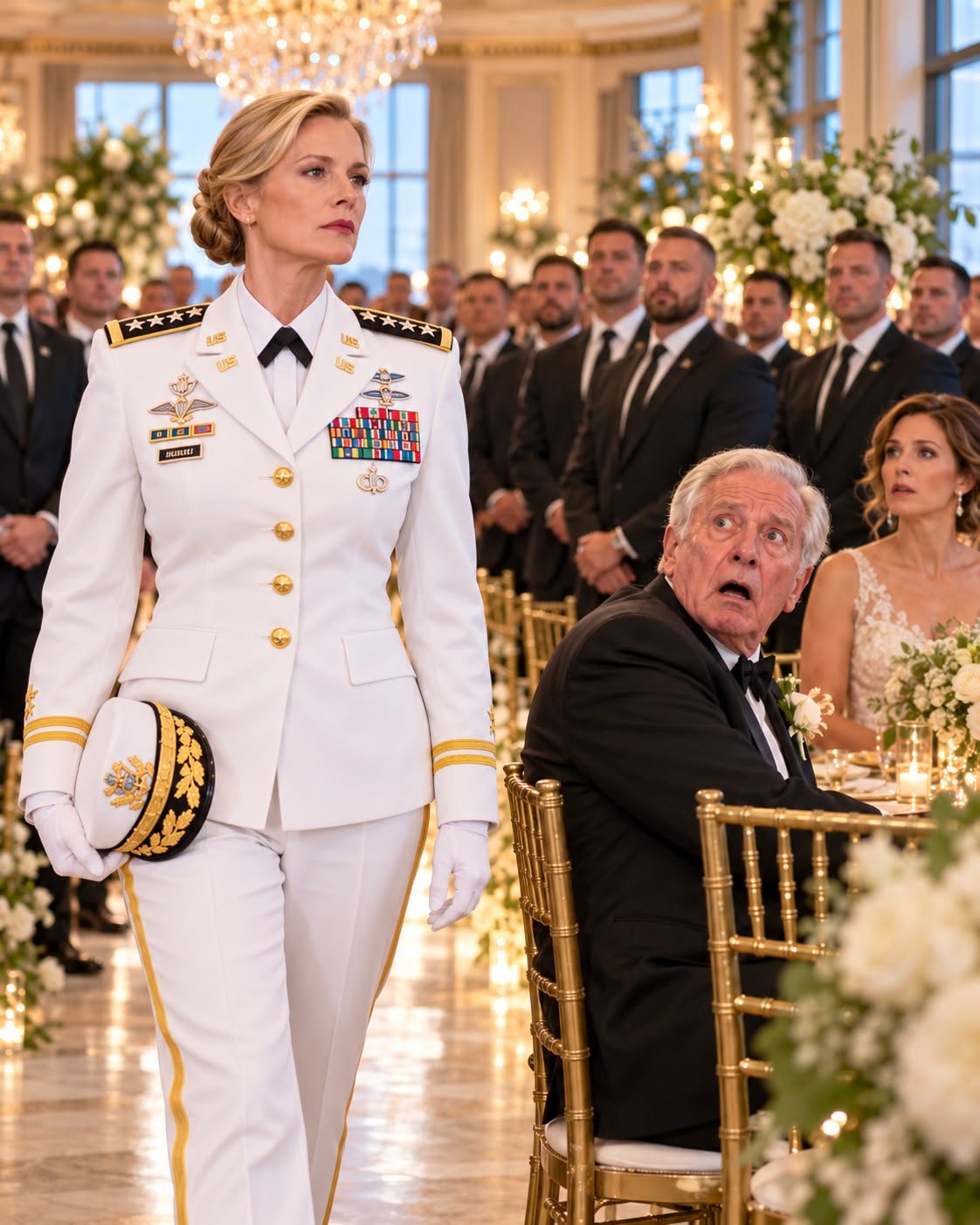
The silence in the ballroom was not the polite quiet of a Southern wedding; it was the concussive, pressurized vacuum of a tactical operations center right before a strike package hits the beach. Two hundred pairs of eyes remained fixed on the center aisle, their gazes level, weathered, and unblinking. These were men who had spent their twenties and thirties in the jagged valleys of the Hindu Kush, the dust of the Euphrates, and the damp green heat of the Philippine jungles. Standing shoulder-to-shoulder in dark charcoal and black suits, their broad frames formed an unbroken wall of dark wool against the delicate backdrop of white silk drapes, pale hydrangea arrangements, and gold Chiavari chairs.
At the front of the room, standing beside the floral arch, the man in Army dress blues lowered his hand from his brow. His gray hair was clipped down to the skin at the temples, his chest covered in five rows of ribbons anchored by the Combat Infantryman Badge with two stars and the Distinguished Service Cross. Mick Garrity was fifty-two years old, with scar tissue tracing a thin white line across his right cheekbone and a posture that looked as though it had been poured from liquid iron. He did not look at the guests in the pews, nor did he look at the trembling minister clutching a leather-bound prayer book. He looked only at me, his jaw set in a line of absolute, immovable deference.
“General on deck,” Mick said, his gravelly voice dropping an octave, carrying through the vaulted ballroom without the slightest need for a microphone.
Beside him, Ramon Ibarra stepped out from behind the altar, wearing a tailored three-piece suit that failed to hide the broad, sloping shoulders of a master breacher. Ramon met my eyes across forty feet of ivory runner, giving me a microscopic, solemn nod that signaled the perimeter was secure. Between the altar and the heavy double doors where I stood, my father, Thomas Braddock, sat frozen in the front-row family pew. His hands, spotted with liver marks and stiff with eighty years of Charleston pedigree, gripped the polished mahogany armrest so hard that the pale knuckles looked ready to split the skin. His tailored linen suit, pressed that morning with meticulous precision by his private valet, suddenly looked loose on his frame, as if the shock of the room had shrunk him inside his own clothes.
I did not break my stride. Thirty-six years of military service teaches a woman how to walk across any room on earth: shoulders back, spine straight as an artillery rod, heels clicking against the hardwood with the rhythmic, measured precision of a metronome. The weight of the four silver stars pinned to each shoulder strap pressed into my collarbone, a familiar and comforting anchor. Pinned over my left breast pocket, my own miniature ribbons caught the warm amber light of the chandeliers, a lifetime of desert dirt, midnight briefings, and blood-soaked triage tents laid out in miniature rows of silk and enamel.
As I drew even with the third row, Thomas began to rise, his mouth working frantically like a landed fish gasping for oxygen in the salt marshes. “Quinn,” he whispered, his voice cracking into a dry, reedy rattle that only reached the ears of the men standing directly beside him. “Quinn, what in God’s name is this? What have you brought into your sister’s wedding?”
I did not stop, and I did not look down at him. I kept my chin level, staring straight ahead at the man my sister had chosen to marry. “As you were, gentlemen,” I announced, the command voice slipping from my throat with the effortless authority that had once directed fifty thousand troops across three combat theaters.
Simultaneously, two hundred men snapped their heads back to the front, their posture shifting from rigid parade attention to the disciplined readiness of troops at ease. The rustle of their suits moving in perfect unison sounded like the wind sweeping through a pine forest before an artillery barrage. My mother, Eleanor, sitting beside Thomas in a pale lavender dress that had cost more than an enlisted soldier’s monthly housing allowance, buried her face in her lace handkerchief, her shoulders shaking with silent, terrified sobs as she realized that the high-society Charleston registry she had cultivated for fifty years had been completely swept off the board.
Mick Garrity stepped down from the raised platform, his polished black shoes striking the floorboards with deliberate slowness. He stopped three paces from where I stood, snapped his heels together with a sharp, mechanical click, and brought his right hand to his temple in a salute so crisp it cut the humid air between us. “Permission to speak freely, General Braddock?”
“Granted, Sergeant Major,” I said, returning the salute with white-gloved precision before dropping my hand to my side.
Mick lowered his arm, a faint, razor-sharp smile touching the corner of his scarred mouth. He glanced past my shoulder toward the front row, where Thomas was still clinging to the pew like a man caught in an undertow. “I believe your father informed you that no one in this room gives a damn about your career, ma'am. We thought it was only proper that the men of the First, Third, and Seventh Special Forces Groups came down to Charleston to cast their votes in person.”
Related Stories