Chapter 1: The Door at the End of the Dark
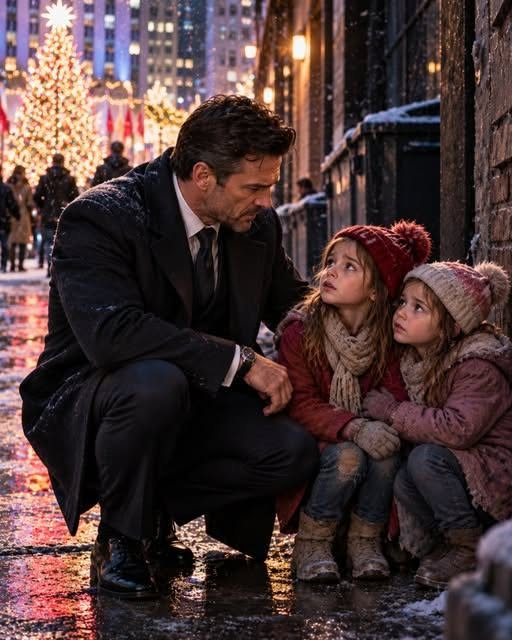
The alley narrowed until the brick walls squeezed out the sky.
Snow didn’t fall here with the postcard perfection of the plaza; it drifted down in sullen flurries, catching on rusted fire escapes, air conditioning units draped in black plastic, and mounds of wet cardboard. Every ten steps, the brilliant lights of Rockefeller Center shrank behind us, muffled by masonry and iron, until the city felt like another continent entirely.
Hazel’s small, knitted mitten remained locked inside my bare fingers. Her grip was startlingly tight, the kind of fierce clutch children only developed when they were used to holding onto things they were afraid of losing. Nora trailed half a pace behind, her hand tucked into the oversized sleeve of Hazel’s faded coat, her big, round eyes darting across the shadows.
""Almost there, mister,"" Hazel whispered, her breath puffing like smoke against the brick. ""Past the green door with the scratch marks.""
My instincts, honed by fifteen years of surviving New York’s underworld, took inventory of the ground. No luxury midtown high-rise backed into this dead space. This was the service spine of an old pre-war annex—structures the city had slated for commercial rezoning three administrations ago, now caught in legal limbo between developers and bankruptcy courts.
I had signed foreclosure notices on half a dozen buildings just like it.
We reached a dented metal fire door propped open with an iron wedge. Beyond it, a concrete staircase descended into subterranean darkness. The air rising from the stairwell smelled of damp mortar, stale radiator steam, and scorched soup.
""Down here?"" I asked, stopping at the threshold.
Nora nodded once, clutching Hazel’s elbow. ""Mommy says it keeps the wind outside.""
I looked at the steps, slick with gray slush tracked in by small boots. If any of my capos—men who had seen me order territorial purges without shifting my posture—had seen me standing at the mouth of an abandoned utility basement on Christmas Eve, they would have assumed I had suffered a psychotic break.
Two years ago, my wife, Clara, and my four-year-old son, Leo, were taken by a fire that swept through our country estate in upstate New York while I was in Manhattan settling a logistics dispute. The police ruled it faulty electrical wiring. My own investigators found traces of accelerant, but the men who might have ordered it had vanished into European shell corporations before I could put a gun to their temples. Since that night, my world had consisted of stone, balance sheets, and silence.
I didn't believe in miracles. I didn't believe in Santa. And I certainly didn't believe in coincidences.
""Stay behind me,"" I told the girls, stepping onto the top tread.
The stairs ended in a low-ceilinged corridor lit by a single naked bulb buzzing against the concrete. Water dripped steadily into an empty paint bucket at the far corner, counting the seconds like an uneven metronome. At the end of the hall stood an old wooden maintenance door, its surface painted over in faded industrial gray.
Hazel pulled her hand from mine and ran forward, tapping her knuckles against the wood in a specific rhythm: three light knocks, a pause, then two heavy thuds.
""Mommy!"" she called through the crack beneath the door. ""We're back! And we brought someone who knows Santa!""
A sudden, sharp scuffle sounded inside. The metallic click of a deadbolt sliding back made the hairs on my neck stand up. That wasn't a standard residential lock. It was a reinforced brass cylinder—the kind installed by people who expected someone to kick the hinges off.
The door jerked open four inches, caught on a heavy steel security chain.
""Hazel? Nora? What have I told you about going up to the—""
The voice died instantly.
Through the narrow opening, a pair of wide, terrified eyes locked onto mine.
The woman behind the chain was young—perhaps late twenties—with high, sharp cheekbones and dark hair pulled into a messy knot that exposed the hollows of her collarbones. She wore an oversized men's flannel shirt frayed at the cuffs, her knuckles white around the iron frame of an antique butcher knife held low at her hip.
She was exhausted. Her skin carried the translucent pallor of someone who lived on tea and whatever food her children left on their plates.
Then her eyes moved from my face down to the lapel of my charcoal overcoat.
Her breath hitched in a sharp, jagged gasp that sounded almost like a sob.
""You,"" she whispered.
I didn't recognize her. In my line of work, you memorized hundreds of faces—corrupt aldermen, union stewards, warehouse bosses, rivals from the Five Families. Her face was entirely blank to me.
""I found them in the plaza,"" I said, keeping my voice low and even, the flat, measured tone I used to calm panicked lieutenants. ""They were freezing. They asked me for directions.""
""Mommy, he has big pockets!"" Nora piped up, slipping under the woman's arm through the gap. ""He didn't let the wind bite our ears.""
The woman looked down at her daughters, her hand trembling so violently the blade rattled against the wooden jamb. She didn't lower the knife, but her gaze flicked past my shoulder into the empty concrete corridor, scanning the shadows behind me with frantic, desperate precision.
""Did you come alone?"" she asked, her voice cracking.
""Yes.""
""Did anyone see you follow them?""
""I don't get followed,"" I replied.
She stared at me for three agonizing seconds. Then, with a hurried clatter of metal, she unhooked the security chain, caught both girls by their shoulders, and pulled them across the threshold into the room.
""Get inside,"" she breathed, looking up at me. ""Before someone sees you standing there.""
I stepped across the threshold, and the heavy door slammed shut behind me, the deadbolt snapping into place with the finality of a prison gate.
The room was larger than I had anticipated, but utterly hollow. It was an old subterranean blueprint archive for the department of water works. Rows of empty steel shelving lined the perimeter, painted olive drab. In the center sat a single folding table, two mismatched wooden chairs, and a kerosene heater that sputtered blue flame, fighting a losing battle against the damp chill of the subterranean stone.
In the far corner, three army surplus cots were pushed together beneath a pile of wool blankets.
On the folding table sat an aluminum pot containing watery broth with chunks of potato, three plastic spoons, and a single, unlit birthday candle stuck into the heel of a loaf of rye bread.
No tree. No stockings. No ribbons.
""Mommy,"" Hazel said, pulling off her mismatched mittens and setting them neatly on the table. ""Did you show him the drawing? The one for the chimney?""
""Not now, Hazel,"" the woman whispered. She hadn't put the butcher knife down. She kept it on the table near her fingers, her body positioned deliberately between me and the corner where the cots lay. ""Go into the back office and wash your hands with the kettle water. Both of you. Now.""
Nora opened her mouth to complain, but Hazel caught her twin’s hand with that practiced, protective authority and steered her through an archway draped with a faded floral sheet.
Once the sound of their small boots faded, the silence in the room became suffocating.
""You don't know who I am, do you, Mr. Sullivan?"" she said.
The fact that she had my name didn't surprise me. My face had appeared in the business section of the *Times* whenever one of my shipping logistics holding companies bought out a competitor, and in the tabloids whenever a federal grand jury failed to indict me.
""No,"" I said truthfully. ""I don't.""
She let out a short, bitter laugh that carried no humor at all. She walked over to the kerosene heater, holding her red, chapped hands over the metal grate.
""I suppose you wouldn't,"" she murmured. ""Men like you only remember the people who sign the deeds, not the ones who clear the desks. My name is Maya Lin. Four years ago, I was the head bookkeeper for Mercer Maritime.""
The name hit my ears like a cold draft.
Mercer Maritime had been our primary freight corridor along the Brooklyn waterfront until two years ago. It had belonged to Paul Mercer—an old friend of my father’s, and one of the three men who had held honorary keys to my upstate estate.
Paul Mercer had died in a private plane crash in the Adirondacks six months after my wife and son burned to death.
""Paul Mercer closed his accounts two years ago,"" I said, my voice dropping into a dangerous, subterranean rumble. ""His estate was settled. Why are his bookkeepers living in a basement beneath an abandoned water bureau?""
Maya looked at me, her dark eyes hollow with an agony I recognized down to the marrow of my bones. It was the exact look I saw every morning in the mirror above my bathroom sink.
""Because Paul Mercer didn't die in an accident, Mr. Sullivan,"" she said softly, pulling a worn manila envelope from beneath the stack of blankets on the cot. ""And neither did your family.""
---
Related Stories