Chapter 5: The Midpoint Shift
The private library of the hotel smelled of aged Cuban tobacco, polished heart-pine floorboards, and the sweet, cloying aroma of single-malt scotch. Through the tall arched palladian windows, the late afternoon sun was turning the Cooper River into a sheet of hammered brass, the masts of the sailboats at the marina rocking gently against the rising tide.
Thomas Braddock stood beside the brick fireplace, his linen jacket unbuttoned, holding a crystal tumbler of scotch in his left hand. Surrounding him were four elderly men in seersucker suits and club ties—the patriarchs of Charleston maritime commerce, men whose names were carved into the granite pediments of the municipal banks and the historic churches along Meeting Street.
“It’s simply a matter of family discipline, Julian,” Thomas was saying, his voice booming with that easy, aristocratic confidence that had carried him through fifty years of cocktail parties. He took a slow sip of his whisky, chuckling softly. “Quinn has always had a dramatic flair. She spent thirty years around enlisted roughnecks in the barracks, so she forgets that in Charleston, an officer's daughter knows her place. But Mick will handle it. A sergeant major knows how to maintain chain of command in his own parlor.”
The heavy mahogany doors swung open with a slow, deliberate creak that silenced the laughter in the room.
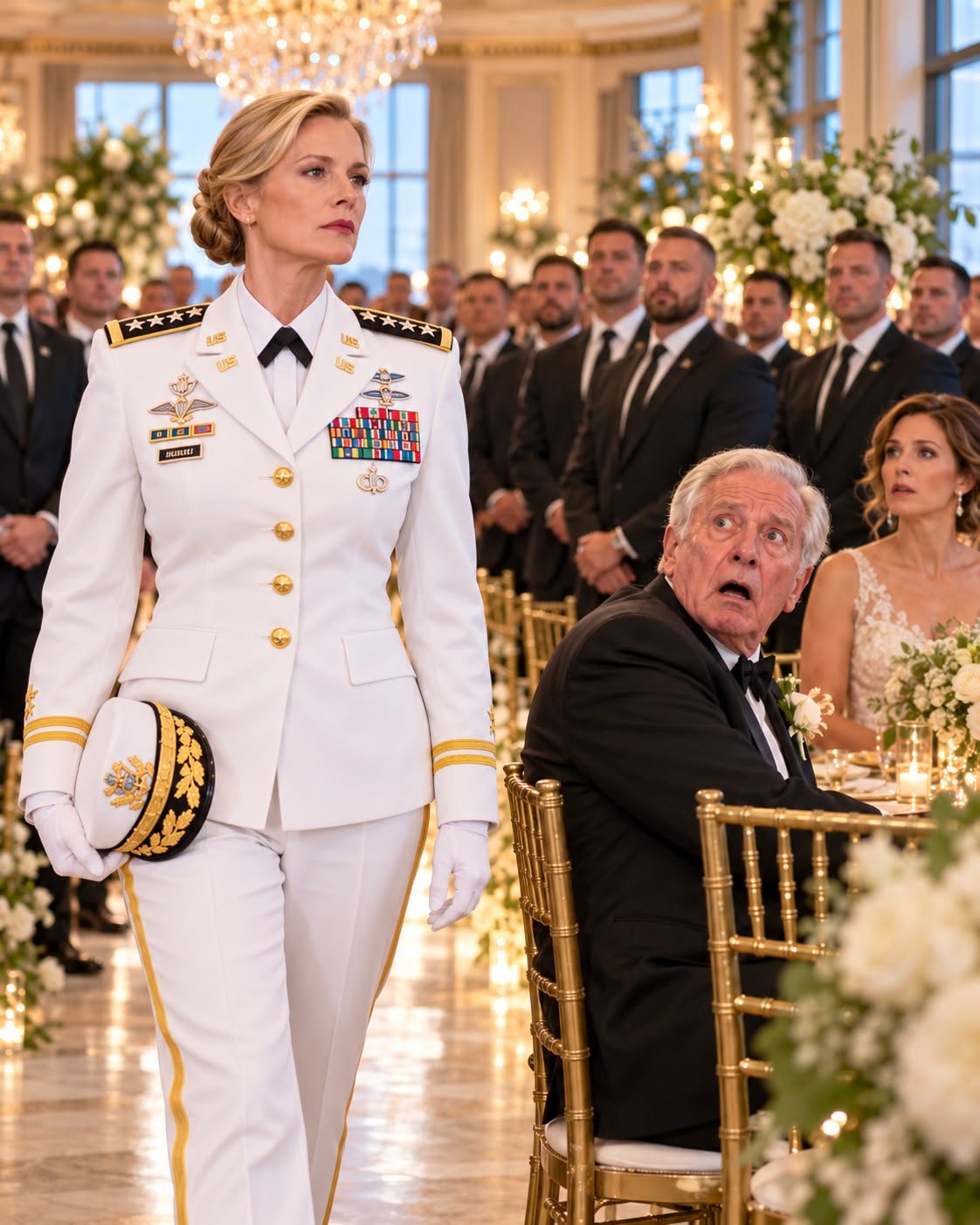
I stepped across the threshold, flanked by Mick Garrity and the two federal special agents. Behind us, filling the narrow corridor with an immovable wall of dark suits and scarred faces, stood eight former Green Beret team sergeants, their arms crossed over their chests, their presence radiating a quiet, lethal gravity that made the four men in seersucker instantly set their glasses down on the sideboard.
Thomas’s smile froze mid-breath. His eyes darted from my four-star shoulder boards to the federal badges displayed on the agents’ lapels, and finally to the manila folder clutched beneath my arm.
“Quinn,” Thomas said, his voice tightening into that familiar, warning tone he had used whenever I spoke out of turn at seventeen. “We are having a private conversation with the commodore of the yacht club. Take your friends out to the reception hall. The minister is waiting for Melanie to finish her preparations.”
“The minister is packing his vestments, Thomas,” I replied, stepping past the club members until I stood three feet from his hearth.
The use of his first name struck him like an open-hand blow across the jaw. He flinched, his glass trembling so violently that amber drops of scotch splashed over the rim, staining the pristine white linen of his trousers.
“What did you say to me?” he hissed, his face mottling with dark, venomous purple.
I didn't answer him. I opened the manila folder, pulled out the certified copy of Judge Arthur Vance’s 1965 testamentary trust, and slapped it flat onto the mantelpiece between two silver candlesticks.
“You have seventy-two hours to vacate the premises at 44 Tradd Street, Thomas,” I said, every word falling like an iron ingot onto the heart-pine floorboards. “Along with the carriage house, the stables, and the Colleton County timber preserve. The Marion County sheriff has been served with the notice of ejectment, and the deed has been restored to its rightful fee-simple owner.”
Thomas stared at the document. The color evacuated from his skin in a sudden, terrifying rush, leaving his face the color of cold tallow. His knees buckled slightly, and he had to catch the edge of the brick mantel to keep from collapsing onto the hearth.
“You... you can’t do this,” he stammered, looking frantically around the room at his four lifelong friends, but the men in seersucker were already edging toward the side doors, their eyes wide with the realization that the empire of Thomas Braddock had just suffered a catastrophic structural failure. “That trust was invalidated thirty years ago! I am the executor of this family’s assets!”
“You are the target of an active federal grand jury indictment, Mr. Braddock,” the senior DCIS agent announced, stepping forward and placing a heavy, blue-backed subpoena directly beside the trust deed. “At fourteen-thirty today, federal agents seized Container Terminal Four at the Port of Charleston. Forty-two shipping containers bearing forged military export waivers signed with General Quinn Braddock’s name have been impounded under the Arms Export Control Act.”
The crystal glass slipped from Thomas’s fingers, shattering against the brick hearth, splashing thirty-year-old scotch and ice cubes across his polished leather shoes.
He didn't look at the federal agents. He didn't look at his fleeing friends.
He looked at me.
The pathetic, trembling old man suddenly vanished, replaced by the cornered predator who had spent half a century surviving by consuming everything in his path. A terrifying, manic sneer curled the corner of his bloody, shaking lips, and his eyes burned with an absolute, unadulterated hatred that had been festering since the day I put on my first pair of combat boots.
“You think you’ve won, Quinn?” Thomas whispered, his voice rising into a ragged, venomous hiss that made the hair on the back of my neck stand up.
He didn't reach for a lawyer. He didn't offer a plea.
He reached into the interior pocket of his linen coat, pulled out a thick, heavy brass key attached to an antique ivory fob, and held it up between us like an executioner’s token.
“You think those forty-two containers are the only things that cleared this harbor under your name?” Thomas laughed—a dry, rattling sound that sounded like autumn leaves scraping over a tombstone.
He pointed the key directly at my chest, his hand steadying with mad, delusional triumph.
“Look at the registration log for the Ashley River Maritime Vault, Quinn!” Thomas snarled, his teeth bared in an ugly, triumphant grin. “For fourteen years, every single unvetted private defense manifest that passed through the Naval Logistics Facility in Goose Creek was registered to a secure corporate bunker under the name of *Braddock & Associates Defense Consulting*!”
The room seemed to drop away beneath my boots, the air turning thin, icy, and sharp as broken glass.
“The primary managing partner listed on that federal corporate charter isn't me, Quinn,” Thomas whispered, leaning across the mantel until I could smell the sour tobacco and fear on his breath. “It’s General Quinn Braddock. Signed with the official power-of-attorney credentials you left in my custody when you deployed to Baghdad in 2003.”
He tapped the ivory fob against the brick.
“Inside that vault are three hundred metric tons of restricted defense guidance systems that were decommissioned from the naval weapons station and reported destroyed in 2018,” Thomas said, his eyes glittering with cold, lethal poison. “The receipt of destruction was certified by your signature. And forty minutes ago, before your little Green Beret circus walked into this hotel, my shipping broker delivered the master inventory file to the United States Attorney for the District of South Carolina.”
He straightened his spine, adjusting his rumpled cuffs with sick, triumphant arrogance.
“You put me in federal prison, Quinn, and you go in the cell right beside me. You won't be retiring next month with four stars and a parade at Fort Bragg. You’ll be sitting in a military supermax facility at Fort Leavenworth while the entire world learns that the great General Quinn Braddock spent the last decade running the most lucrative black-market weapons pipeline on the Eastern Seaboard.”
The grandfather clock in the hallway struck four, its deep, brass chimes tolling like a funeral bell through the absolute silence of the room.
Mick Garrity took half a step forward, his knuckles whitening, his combat ribbons trembling against his chest as he reached for his phone.
I raised my right hand, stopping him in his tracks.
I looked down at the brass key in my father’s trembling fingers.
I looked at the thirty-six years of honor, sacrifice, and blood pinned to my chest, and I realized that the war I had spent my entire life preparing for had never been fought in the mountains of Afghanistan or the sands of Iraq.
It had been waiting for me right here, in the city that gave me my name.
I stepped forward, my white gloves closing around the brass key, ripping it from my father’s grasp with a violent, metallic twist that left him gasping against the mantel.
“Call the Provost Marshal, Mick,” I said quietly.
And for the first time in fifty-eight years, I didn't look away.
```
Related Stories