Chapter 2: The Signature in the Dark
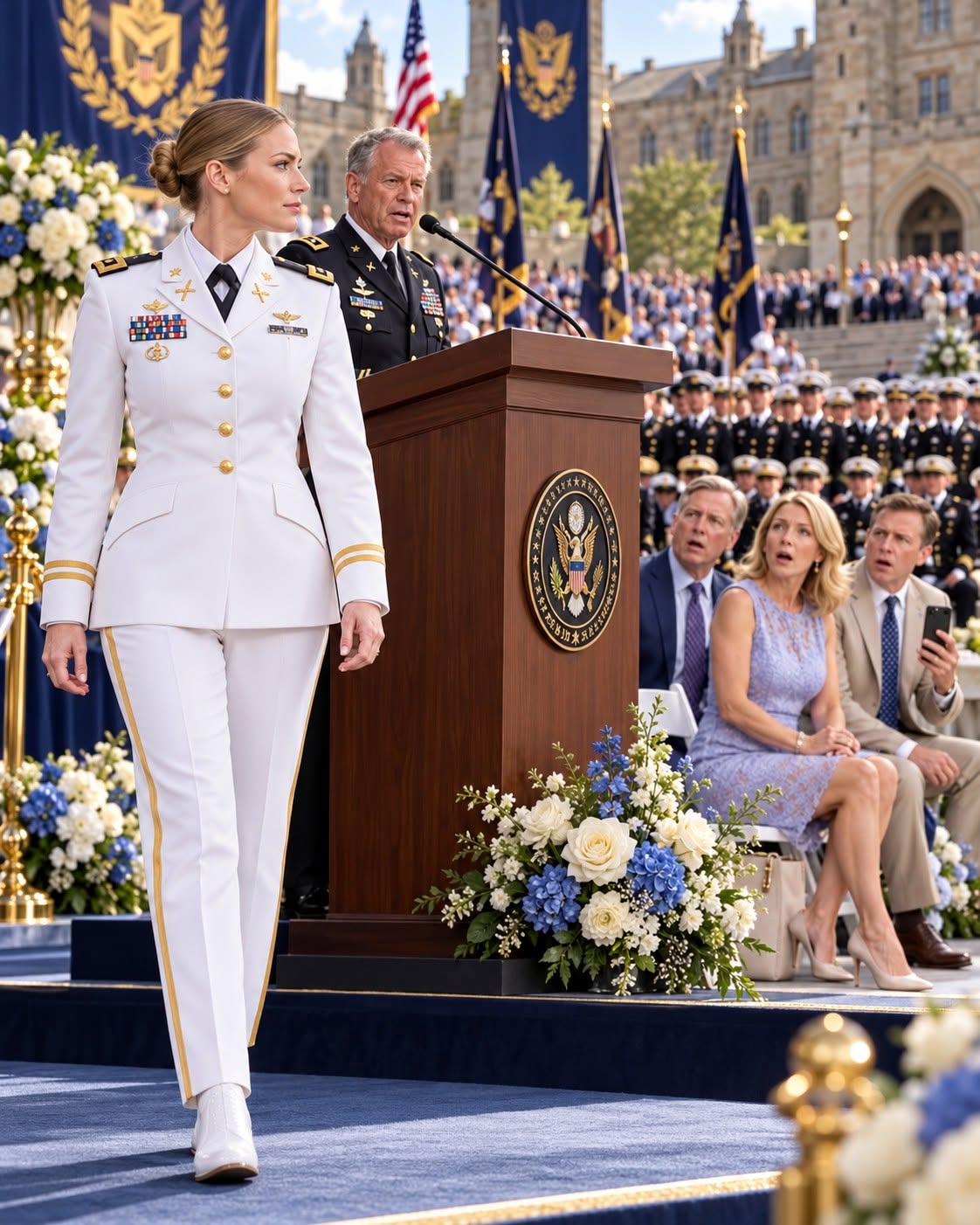
The private conference room inside the academy’s visitor center was dead silent except for the low hum of the air conditioning and the rhythmic tapping of my fountain pen against the oak table.
Major Evelyn Reed, my executive officer, stood near the door with her arms crossed, her eyes locked on Derek where he sat across from me. He had stripped off his black graduation gown, leaving it draped over the back of a metal chair like an empty skin. In his white dress shirt and loosened tie, with the dark circles carved deep beneath his eyes, he looked less like an elite business graduate and more like a man who had spent forty-eight hours in an interrogation cell.
Between us on the table lay the contents of the white envelope he had shoved into my pocket: thirty-four pages of commercial banking records, notarized affidavits, and federal loan disclosures bearing the letterhead of *First Virginia Merchant Bank*.
Across the top of the master credit agreement, stamped in red ink, was an active balance: **$385,000.**
And directly on the primary personal guarantee line—the signature that bound the borrower to full, personal liability under federal banking law—was my name: *Sarah E. Mitchell.*
Beside my name was an embossed notary seal from the Commonwealth of Virginia, dated eighteen months ago. A date when I was leading a multi-national joint task force in Poland.
“Explain this, Derek,” I said. My voice did not rise. It was the voice I used when reviewing collateral damage reports—quiet, flat, and carrying the dangerous pressure of a sealed valve.
Derek buried his face in his hands, his shoulders heaving with a single, dry sob that he swallowed down before looking at me. “Dad’s commercial development firm in Richmond went under three years ago, Sarah. The banks called his notes on the shopping center near Henrico. He was facing personal bankruptcy, but he couldn't stand the thought of anyone at the club finding out. He spent eighteen months borrowing from private lenders to cover the interest payments, telling everyone he was just restructuring his portfolio.”
“And you?” I asked, leaning forward. “Where did this three hundred and eighty-five thousand dollars go?”
“To my tuition,” Derek whispered, the words tearing from his throat like broken glass. “And the apartment in Boston. And the two leased BMWs sitting in their driveway right now.”
The room seemed to drop ten degrees.
Major Reed’s jaw tightened, her gaze shifting to the window, the professional soldier in her bristling at the domestic cruelty laid out on the table.
“When I got accepted into the executive program,” Derek continued, his voice shaking violently, “Dad told me he had set aside an educational trust from Grandpa’s estate. He told me everything was paid for. He told me that my only job was to network with the trustees, get the degree, and secure a partnership at a defense equity fund. I didn't know, Sarah. I swear to God on my life, I didn't know where the money came from until six weeks ago.”
“What happened six weeks ago?”
“A certified courier came to my apartment in Cambridge,” Derek said, pulling a worn tracking receipt from his pocket and laying it beside the loan documents. “The bank was issuing a final notice of acceleration. Dad had missed three consecutive quarterly interest payments. The courier handed me the full file because my name was listed as the secondary beneficiary. When I opened the packet and saw your signature on the guarantee line, I drove straight to Richmond.”
He looked up at me, his eyes rimmed with raw, bloodshot agony.
“I confronted them in the kitchen, Sarah. I asked Dad how he could forge your name on a commercial note while you were deployed overseas. Do you know what Mom said to me?”
I looked at the forged signature on the paper. The slant was identical to mine; the loop of the *S* had been traced from an old signature card.
“Tell me,” I said softly.
“Mom laughed,” Derek whispered. “She stood by the sink, pouring a glass of iced tea, and told me that you had spent twelve years drawing a government paycheck with zero living expenses. She said the military paid for your housing, your food, your healthcare, and your clothes, while this family had to maintain appearances in the real world. She told me that using your military credit profile was your contribution to the family business—a contribution you were too selfish to make willingly.”
The knot behind my ribs, the cold ache I had carried since that Tuesday morning two years ago, suddenly dissolved into an absolute, crystalline stillness.
The text messages.
*“Sarah, your father and I have decided we won’t attend your graduation.”*
*“It’s humiliating telling people our thirty-year-old daughter is still going through military training.”*
They hadn't skipped my graduation because they were embarrassed by my uniform.
They had deliberately engineered a total emotional rupture to keep me from coming home on leave. They needed me alienated, distant, and silent. If I had spent a week in Richmond after graduation, I would have seen the official mail arriving from First Virginia Merchant Bank. I would have checked the credit monitoring alerts on my military financial portal.
They had treated me like garbage to ensure that I would never look at the foundation they were building on my back.
“And the graduation this weekend?” I asked, tapping the bank documents with my finger. “Why the sudden panic?”
“Because the loan note matures on Monday morning, Sarah,” Derek said, his voice cracking into high-pitched panic. “If the three hundred and eighty-five thousand dollars isn't wired to the bank by noon on November second, the default is triggered automatically. The bank’s legal department will file a confession of judgment in the circuit court, freeze all accounts attached to your Social Security number, and notify the Department of the Army’s security clearance adjudication facility.”
He leaned across the table, his fingers clawing at the wood.
“A full Colonel facing an active three-hundred-thousand-dollar fraudulent default judgment loses her clearance within seventy-two hours, Sarah. Dad told Mom in the car on the way here that if you made a scene at Derek’s graduation, they would let the note default and claim that you were the one who authorized the loan to finance your brother’s education.”
Before I could answer, the heavy oak door of the conference room swung open with a concussive bang.
Richard Mitchell stood in the doorway, his overcoat unbuttoned, his face dark with fury. Behind him, Marian stood with her purse clutched in both hands, her eyes burning with an ugly, cornered malice.
“Get away from her, Derek,” Richard commanded, stepping into the room with his finger pointed at his son. “Get your coat and get out to the car. Now.”
Derek didn't move. He sat frozen in his chair, his hands clenched into white knots against his knees.
Richard turned his gaze onto me, his nostrils flaring as he saw the bank documents spread out across the table.
“You think you’re very clever, don't you, Sarah?” Richard sneered, taking two aggressive steps toward the table. “You dragged your brother into this room to play the grand inquisitor? Let me tell you how this ends, Colonel. You sign the debt extension agreement my lawyer drafted, or by Monday afternoon, the Richmond papers will be running a story about an Army officer who abandoned her family’s financial obligations after promising to support her brother’s education.”
I didn't blink. I didn't raise my voice.
I picked up the bank documents, squared the edges against the table with a slow, deliberate tap, and looked my father dead in the eyes.
“You have seventy-two hours to hire a very good criminal defense attorney, Richard,” I said. “Because under Title 18 of the United States Code, Section 1014, making a false statement on a loan application using an active-duty service member’s credentials is a federal felony carrying thirty years in prison.”
Related Stories