Chapter 4: The Stolen Eagle
By midnight, the heavy rain had set in over the Hudson Valley, lashing the gray granite walls of the academy like gravel thrown against armor.
Inside the garrison legal assistance office, the air smelled of stale coffee, industrial floor wax, and the dry, metallic heat of high-speed document scanners running without pause.
Lieutenant Colonel Marcus Hayes, the senior regional trial counsel for the military district, sat behind a metal folding desk surrounded by three junior captains in battle dress uniforms. On the white dry-erase board behind him, a complex organizational diagram had been mapped out in red and black marker, connecting *First Virginia Merchant Bank*, *Mitchell Capital Management*, and an entity I had never heard of until forty minutes ago: *Aegis Defense Infrastructure Partners*.
I sat in a wooden armchair opposite Hayes, my service coat hung over the back of the chair, my sleeves rolled to the elbows, sipping black coffee from a heavy ceramic mug.
Beside me, Derek was fast asleep on a vinyl sofa, wrapped in an olive-drab military wool blanket, his breathing deep and even for the first time in six weeks.
“It’s worse than a simple bank fraud, Sarah,” LTC Hayes said, sliding a thick, red-tabbed administrative file across the desk toward me. “When your father approached First Virginia Merchant Bank eighteen months ago, he didn't just ask for an educational signature line. He applied for a specialized small-business commercial facility under the Department of Defense’s Veteran-Owned Small Business Priority Program.”
I set my mug down with a sharp, ceramic click. “Under my name?”
“Under your name, your rank, and your active security clearance,” Hayes confirmed, his jaw tightening into iron. “Richard Mitchell submitted an altered copy of your Department of Defense personnel record, claiming that you were the fifty-one percent non-managing owner of Mitchell Capital Management. Because of your active duty status and your Ranger qualification, the bank classified the loan as an expedited defense infrastructure credit facility, bypassing standard underwriting audits and waiving the civilian collateral requirements.”
Hayes tapped a highlighted paragraph on page seven.
“And three months after the loan funded,” Hayes continued, “Mitchell Capital Management entered into a secondary joint-venture agreement with Aegis Defense Infrastructure Partners—a private logistics firm headquartered in Reston, Virginia.”
My eyes tracked down the page, scanning the corporate roster of Aegis Partners.
The name of the managing general partner made the blood roar in my ears.
*Arthur Lang.*
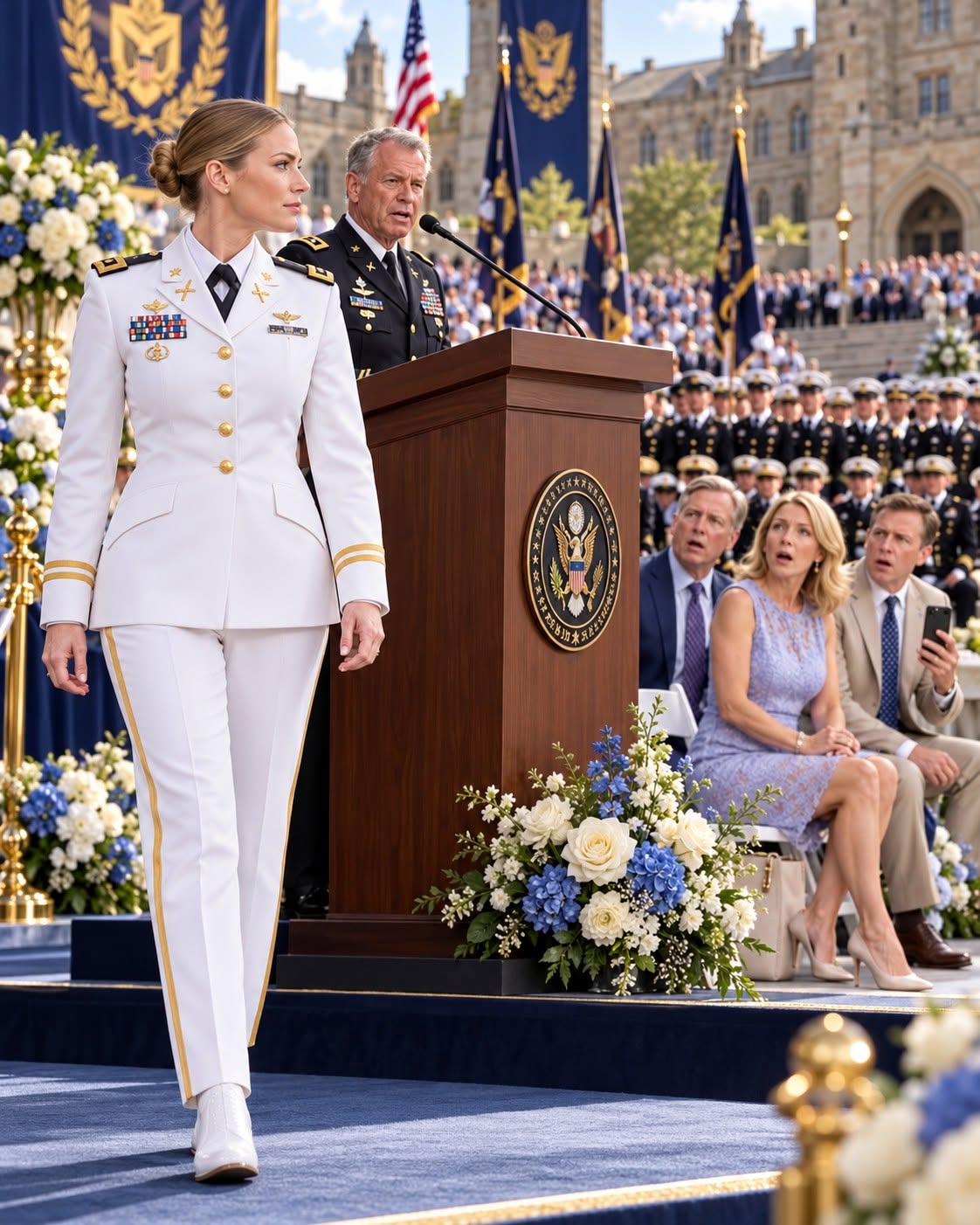
The senior university trustee who had sat on the commencement stage six hours ago. The man who had endowed Derek’s business fellowship, who had arranged Derek’s interviews with the private equity syndicates, and who had shaken my hand in the alumni rotunda with an oily, practiced deference.
“Lang wasn't giving Derek a scholarship out of charity, Sarah,” Hayes explained, his voice dropping into a register of cold, clinical disgust. “Lang’s logistics firm was barred from federal bidding three years ago following an environmental compliance scandal in Norfolk. He needed a certified, service-disabled, combat-decorated officer’s profile to front a forty-million-dollar maritime supply subcontract for the naval base at Earle, New Jersey.”
“And my father provided the front,” I whispered.
“Your father provided the identity, and Lang provided the cash to keep your parents living in luxury,” Hayes said. “Derek was installed as the puppet managing director so that any regulatory paperwork required by the Defense Contract Audit Agency could be signed with the family name. If the Pentagon discovered the shell structure, Lang’s corporate shield would remain untouched, your father would claim senile ignorance, and Derek would take the fall for procurement perjury.”
“Where is the prime contract right now?” I demanded, leaning forward.
“It was certified by the Defense Logistics Agency forty-eight hours ago,” Hayes answered, pointing to the board. “The first logistics convoy under the Aegis-Mitchell contract—carrying high-grade structural components and communications hardware—is scheduled to clear the military terminal at Bayonne, New Jersey, tomorrow afternoon at thirteen-hundred.”
I closed my eyes, drawing a slow, disciplined breath through my nose until the red haze burning behind my eyelids settled into ice-cold tactical clarity.
For two years, my parents had treated my uniform like an embarrassment in public, while privately pimping out my blood, my rank, and my character to a crooked defense speculator who couldn't legally bid on a federal janitorial contract. They had told me I was nothing, while building a forty-million-dollar criminal enterprise on the foundation of my name.
The heavy door to the corridor clicked open.
Major Reed stepped into the room, holding an encrypted digital tablet. “Colonel Mitchell, the provost marshal just completed the field interview with your father at the hotel in West Point.”
“What did he say, Evelyn?”
“He didn't speak to the investigators, ma’am,” Reed said, handing me the tablet. “His civilian attorney, provided by Arthur Lang’s firm forty minutes ago, submitted this statement to the military liaison.”
I looked down at the screen.
The legal memorandum was signed by a high-priced white-collar firm in Manhattan. It stated that Colonel Sarah Mitchell had personally authorized the creation of Mitchell Capital Management in 2022 to provide financial support for her family, and that any subsequent irregularities were the result of an active-duty officer attempting to conceal unauthorized civilian business holdings in violation of Department of Defense ethics regulations.
Attached to the memo was a sworn affidavit signed by Marian Mitchell, swearing that Sarah had promised to pay off the First Virginia note using her combat deployment savings, but had reneged on the agreement out of personal jealousy toward her brother’s civilian success.
They weren't running.
They were digging in. They were using Lang’s corporate legal team to flip the narrative, gambling that the Army would rather quietly separate a young colonel under an administrative cloud than drag a prominent university trustee and a forty-million-dollar defense contract through federal court.
I looked at the clock on the wall.
01:14.
The joint alumni gala—the final, high-visibility dinner where Arthur Lang, the university president, and the academy superintendent would share the head table—was scheduled for seven o'clock that evening at the historic Thayer Hotel.
I stood up, walked over to the sofa, and gently shook Derek’s shoulder.
He woke instantly, his eyes darting around the room before settling on my face.
“Get up, Derek,” I said softly.
He rubbed his eyes, sitting up against the cushions. “Sarah... what time is it? What’s happening?”
“The battle is joined, little brother,” I told him, extending my hand to help him to his feet. “Go wash your face. We’re going to the federal courthouse in White Plains.”
Related Stories