Chapter 1: The Podium and the Pariah
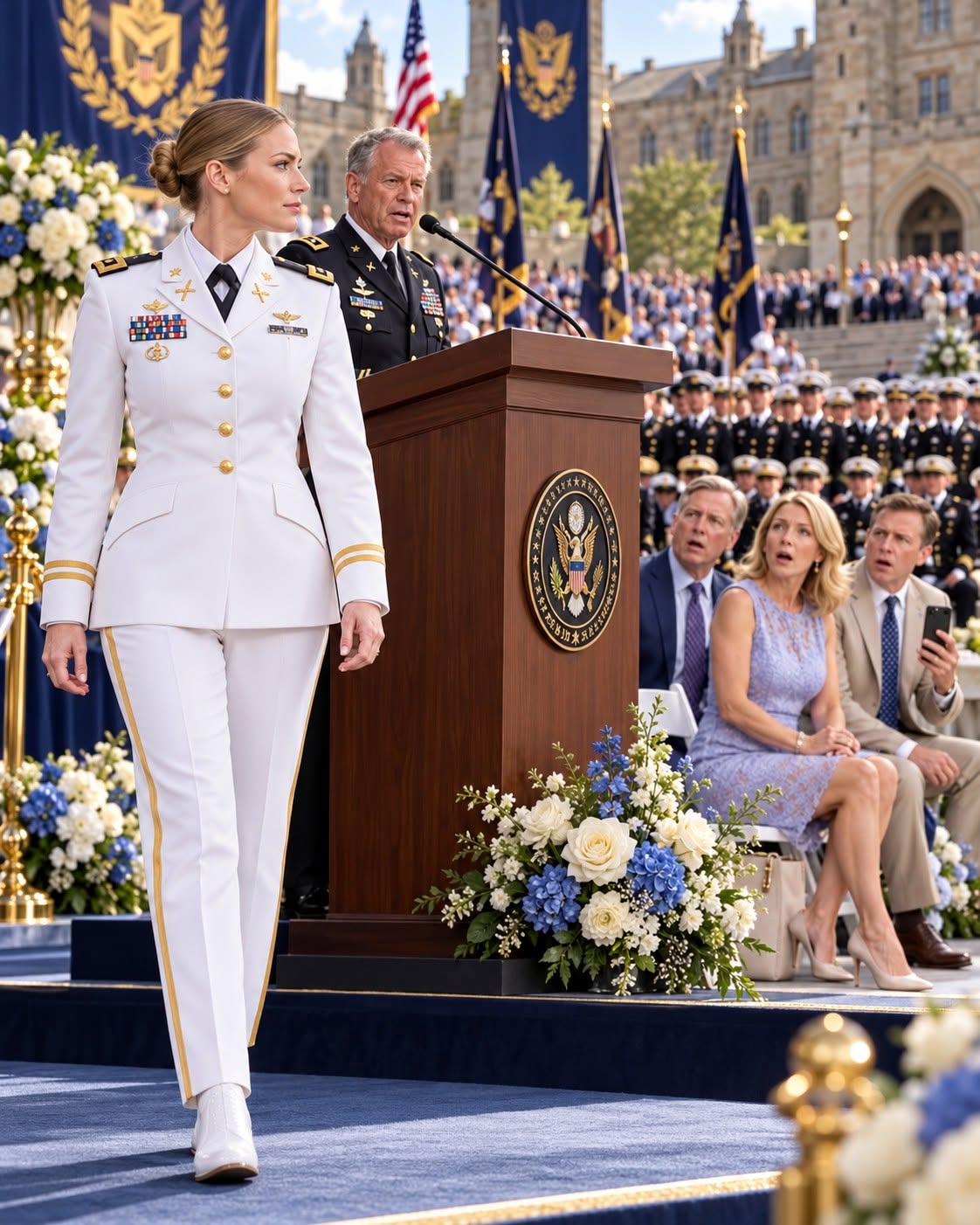
The applause inside the stadium rolled like thunder against the concrete tiers, rising in waves from the five thousand cadets, graduates, and families packing the arena.
I kept my eyes fixed straight ahead, my heels striking the elevated stage with the measured, steady cadence that had carried me across the parade fields of West Point, through the swamp phases of Ranger School, and down the gravel paths of forward operating bases in eastern Syria. The polished oak floor did not give. The gold eagle pinned to the center of my shoulder boards caught the stadium floodlights, cold and sharp.
In the second row of the VIP enclosure, right at the foot of the stage, my mother’s mouth hung slightly open.
The proud, patronizing smile she had worn while recording Derek’s procession had completely shattered. Her manicured fingers, tipped in expensive pink lacquer, hovered motionless against the lapel of her cream blazer. Beside her, my father lowered his smartphone, his arm sinking slowly to his side as if the device had suddenly turned to lead.
And Derek. My younger brother sat rigid in his black master’s gown, the green satin hood of his business degree draped over his shoulders, staring up at me with wide, panicked eyes that looked less like pride and more like terror.
I reached the podium. I rested my white-gloved hands on either side of the seal of the United States Military Academy.
“Superintendent, distinguished faculty, graduates, and families,” I began. My voice came through the stadium speakers low, resonant, and entirely stripped of theatrical vibrato. “Two years ago, I stood on an academy parade field not far from here. When the roll was called, I walked across the grass alone. No one took photographs. No one drove across state lines to watch me receive my commission. The people who raised me had decided that thirty years of my life, spent preparing to defend this nation, were not worth the cost of a domestic airline ticket.”
A soft, collective rustle moved through the five thousand people in the stands.
In the second row, my father’s face flushed a deep, mottled crimson. He shifted in his folding chair, his jaw clenching so hard that the muscles along his neck stood out like cords. My mother pulled her handbag tightly against her stomach, her eyes darting left and right to see if the trustees seated around them had caught my words.
“I tell you this today,” I continued, keeping my gaze level, looking out over the sea of gray cadet jackets and black academic gowns, “not to invite your sympathy. Self-pity is a luxury no officer can afford on the line of departure. I tell you this because leadership begins at the exact moment when external applause stops. When the people you love decide your worth is an inconvenience to their ambitions, you learn whether your spine is made of iron or chalk.”
I paused. The arena was so quiet that the faint hum of the overhead ventilation sounded like a distant aircraft.
“To the newly commissioned lieutenants: your soldiers will not care what your parents think of your career. They will not ask if your family celebrated your promotion. They will ask if you have the moral courage to stand between them and ruin when the night goes dark. Wear your uniform so that the only validation you ever need is the mission accomplished and your people brought home alive.”
When I stepped back from the lectern and brought my hand to the brim of my service cap, the stadium did not just applaud.
The entire corps of cadets stood up as one body, the wooden seats snapping back with a concussive clatter that shook the rafters. The cheering echoed off the steel girders, deafening and prolonged, drowning out the rustle of the platform party rising behind me.
I did not look down at the second row as I left the stage.
Twenty minutes later, the ceremonial reception spilled into the glass-walled alumni rotunda overlooking the river. Champagne glasses clinked, silver trays of canapés floated between faculty members, and three-star generals stood shoulder-to-shoulder with corporate executives from across the Eastern Seaboard.
I stood beside the Superintendent, Lieutenant General Arthur Bradley, holding an untouched glass of sparkling water, nodding as university deans came forward to offer their congratulations.
“Sarah!”
The voice cut through the cultured murmur of the room with the frantic, shrill insistence of a woman trying to claim a winning lottery ticket before the window closed.
My mother pushed through a cluster of university trustees, her silk scarf trailing behind her, her face arranged into an expression of theatrical, tear-filled adoration. Behind her, my father smoothed his tie, puffing out his chest, while Derek trailed ten paces back, his academic gown bunched in his fists, his head down.
“Sarah, darling!” Marian Mitchell cried, opening her arms wide as she reached our circle. “We could barely hear you over the crowd! What an extraordinary speech! General Bradley, I’m Marian Mitchell, Sarah’s mother. And this is her father, Richard. We always knew our girl had this kind of brilliance in her.”
General Bradley did not smile. He looked from my mother’s outstretched hands to my face, then back again, his eyes cool and diagnostic.
“Is that right, Mrs. Mitchell?” Bradley said, his tone carrying the polite, lethal edge of an officer who had read my personnel file. “Because according to the Colonel’s record, she was listed as unaccompanied for every milestone promotion since her accession.”
Marian’s hands dropped three inches, the diamond on her ring catching the chandelier light. “Well... the military schedule is so demanding, General. We try not to crowd her space. But family is family. We wouldn't miss Derek’s big day, and finding out Sarah was the speaker? It was simply providence.”
“Excuse me, General,” I said quietly to Bradley. “I need a moment with my family.”
Bradley nodded once, touching the brim of his cap. “Take your time, Colonel. We have the staff dinner at nineteen-hundred.”
I stepped away from the circle, leading my parents and brother toward a quiet alcove beside the arched floor-to-ceiling windows.
The moment the crowd was out of earshot, the warm, maternal glow on Marian’s face vanished, replaced by a sharp, venomous twitch around her mouth.
“How dare you,” she hissed, taking a step toward me, her voice dropping into a razor-sharp whisper. “How dare you stand on that platform and humiliate your father and me in front of the most influential people in this state? We paid for your boarding school! We gave you a roof over your head! And you tell five thousand strangers that we abandoned you over a plane ticket?”
“You did abandon me over a plane ticket, Marian,” I replied, my voice steady, my hands resting behind my back. “I still have the text message saved on my phone. Nine-forty-seven on a Tuesday morning. You said my career was humiliating to talk about at your bridge club.”
“You were thirty years old, playing soldier while your brother was preparing for real-world leadership!” Richard snarled, stepping up beside his wife, his face purple. “You think because you put eagles on your shoulders that you’re above this family? You’re still our daughter, Sarah. And you owe us an apology before we sit down for Derek’s department dinner.”
I looked at Derek.
He hadn't spoken a single word. He was pale, his breathing shallow, staring at the marble floor with an expression of pure, suffocating misery.
“Congratulations on the MBA, Derek,” I said softly.
Derek flinched as if I had struck him. He looked up, his lips trembling, his throat working in a dry, convulsive swallow. He opened his mouth, but before he could speak, Richard clamped a heavy hand onto Derek’s shoulder, his fingers digging hard into the fabric of the academic gown.
“Derek has interviews with three private equity firms on Monday morning,” Richard said, his voice carrying a strained, warning edge. “He doesn't have time for your theatrics. We’re leaving for the restaurant.”
“Go ahead,” I said. “I have a command briefing.”
My parents turned on their heels, Marian muttering under her breath about ungrateful children as she linked her arm through Richard’s.
They took three strides toward the exit before Derek suddenly wrenched his shoulder out of his father’s grip.
He didn't follow them.
He lunged toward me, grabbed my left forearm with trembling fingers, and shoved a thick, crumpled white envelope into the pocket of my dress jacket.
“Derek, what are you doing?” Richard barked, spinning around in the middle of the rotunda.
Derek ignored him. He leaned close to my ear, his breath hot, shaking, smelling of stale coffee and pure panic.
“Sarah, don't let them leave this town,” Derek whispered, his voice cracking into a ragged plea. “They didn't fly here for my graduation. They came to stop you from checking your credit reports before the fiscal audit on Monday morning.”
Related Stories