Chapter 1: The Memorial on the Table
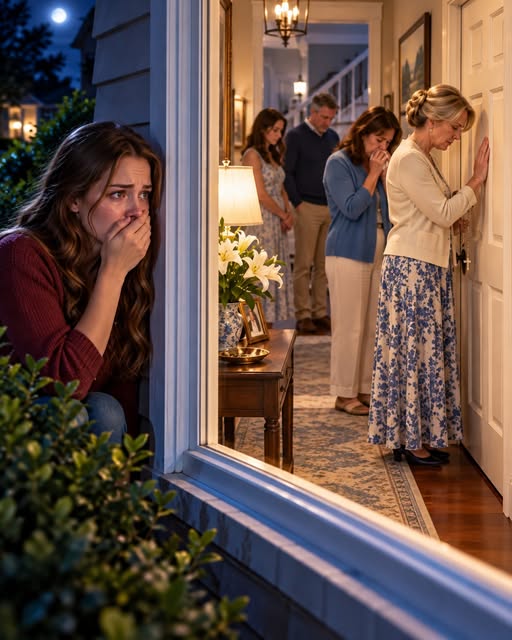
The tissue paper tore beneath my fingers with a dry, papery hiss that sounded deafening in the dark house.
I pulled the wrapping away, my knuckles brushing against cold, heavy glass. The grandfather clock in the foyer ticked with slow, mocking indifference, each mechanical beat echoing through the empty hallway where, just twenty minutes ago, Avery’s mother had pressed her palms to my bedroom door and wept.
The moonlight slanting through the dining room blinds hit the silver-plated frame.
My breath trapped in my throat, turning into a sharp, suffocating ache behind my ribs.
Beneath the glass was a high-resolution, black-and-white photograph of me.
It was my junior year portrait—the one taken two weeks before my eighteen-year-old world collapsed into ambulance sirens and sterile hospital corridors. My dark hair fell across my shoulders, my smile wide and unguarded, before the medication had thinned my skin and hollowed my cheeks. But the photo wasn't what made my vision blur with sudden, violent static.
It was the engraved brass placard mounted beneath the matting.
In Everlasting Memory of Stacey Lynn Miller.June 14, 2000 – April 8, 2018.“A gentle soul called home too soon, whose sacrifice gave life to others.”
Tucked beside the silver frame was a heavy, vellum program embossed with gold foil: The Eighth Annual Stacey Miller Memorial Sunrise Vigil & Foundation Luncheon – Easter Sunday, St. Luke’s Episcopal Church.
I stood in the center of my parents' dining room, staring down at my own gravestone on paper.
Eight years.
For ninety-six months, I had crawled through the dirt at Ruth’s orchard, pruning peach branches until my palms cracked and bled, scraping together four hundred dollars in wrinkled twenties every first of the month to hand to my mother for the privilege of sleeping in a locked room.
“She thinks you live in Atlanta, Stacey,” my mother’s voice whispered in my memory, cold and shrill. “Avery comes from a family of judges and state senators. Don't you dare embarrass your brother.”
Atlanta.
They hadn't told Avery I was an estranged sister working a corporate desk three hours north on I-85. They hadn't told her I was awkward, or struggling, or living with the physical aftershocks of a brain injury.
They had told her I was dead.
My legs gave out. I caught myself against the edge of the dining table, knocking a cut-crystal water goblet onto the linen runner. The glass wobbled, water sloshing over the vellum program, soaking into the gold-embossed cross until the ink bled into a dark, ugly smudge.
""Stacey?""
The voice came from the foot of the stairs.
I froze.
My father stood on the bottom riser, wearing his threadbare flannel robe and leather slippers. In the dim amber light of the oven clock, his weathered face looked hollowed out by fear, his shoulders slumped beneath an invisible weight he had carried for eight years.
He didn't yell. He didn't ask why I had broken the house rules by coming back before Sunday night.
His eyes drifted from my face to the silver frame in my hands, and every drop of color drained from his skin.
""Dad,"" I whispered, the word scraping like broken glass against my vocal cords. ""What is this?""
He didn't move. He gripped the polished banister so tightly the knuckles turned white as chalk. ""You weren't supposed to come back until tomorrow evening, Stacey. You know the rules. Mitch and Avery are sleeping at the country club cottage, but they’re coming here for breakfast at eight.""
""I asked you a question!"" My voice broke, rising into a ragged, guttural sob that ripped through the quiet house. I lifted the silver frame, shoving it toward him in the darkness. ""Why is there a death date on my picture? Why was Avery's mother praying for my soul outside my door?""
My father flinched as if I had struck him across the mouth. He took two shuffling steps across the hardwood, his eyes darting toward the ceiling as if terrified my mother would hear us from the master bedroom.
""Lower your voice,"" he hissed, his voice trembling with a frantic, pathetic desperation. ""Stacey, please. You don't understand the bind we were in. You don't know what happened that night.""
""I know what happened that night!"" I choked out, tears of blinding fury finally spilling down my cheeks. ""Mitch took the Ford Ranger without permission. He picked me up from track practice. He was drunk, Dad! He crossed the yellow line on Highway 9 and slammed into the guardrail! I was in a coma for twenty-three days!""
""And you survived,"" my father whispered, his eyes swimming with sudden, hot tears that he hastily swiped away with his sleeve. ""Thank God Almighty, you survived.""
""Then why am I dead?"" I took a step toward him, brandishing the silver frame. ""Why did Grandma’s obituary leave my name off the list of survivors? Why do you lock my door from the outside?""
The door at the top of the stairs creaked open.
Heavy, deliberate footsteps clicked across the landing.
My mother, Eleanor, descended the staircase with the slow, terrifying composure of a queen inspecting a mutiny. She was fully dressed in her Sunday church suit—a pale lavender skirt and tailored jacket—her makeup already set, her pearl necklace gleaming against her throat.
She didn't look shocked to see me. She looked disgusted.
""Put that frame down, Stacey,"" my mother said, her voice smooth, level, and colder than a January frost over the peach groves. ""You are trespassing in this home before your designated hour.""
""Mom—""
""I told you eight years ago that choices carry consequences,"" Eleanor said, stepping onto the dining room floor, her gaze sweeping over my mud-stained sneakers and cheap denim jacket with absolute disdain. ""Your brother had a full scholarship to Emory Law. He was twenty-one years old. If the police had tested his blood that night, he would have spent ten years in Reidsville State Prison. His life would have been over.""
""And mine?"" I cried, my voice cracking under the sheer, monstrous weight of her confession. ""What about my life?""
Eleanor walked past me to the dining table, picked up the soaked vellum program, and used a paper napkin to blot the wet ink with chilling, methodical precision.
""You were always a quiet girl, Stacey,"" Eleanor murmured, not even looking at me. ""You didn't have Mitch's ambition. You didn't have his future. When Avery's father—Judge Harrison Vance—offered to pay for your experimental neurological surgeries at Emory on the condition that Mitch dedicate his legal career to public service in memory of his tragically departed sister... we accepted.""
My knees began to tremble so violently that my grip on the silver frame slipped.
""Avery's father... paid for my hospital bills?""
""Judge Vance gave this family two hundred and fifty thousand dollars,"" Eleanor said, turning her ice-cold eyes onto mine. ""And every year since, his family foundation has deposited fifty thousand dollars into Mitch's political campaign trust in memory of the sweet, innocent girl who supposedly died in that wreckage.""
She took the silver frame from my paralyzed fingers, wiping a speck of dust from my photographed face with her thumb.
""You're not a victim, Stacey. You're an investment. And tomorrow morning, you are going to attend that memorial service in the balcony... and keep your mouth shut while your brother announces his run for state senate.""
Related Stories