Chapter 2: The Red Pen
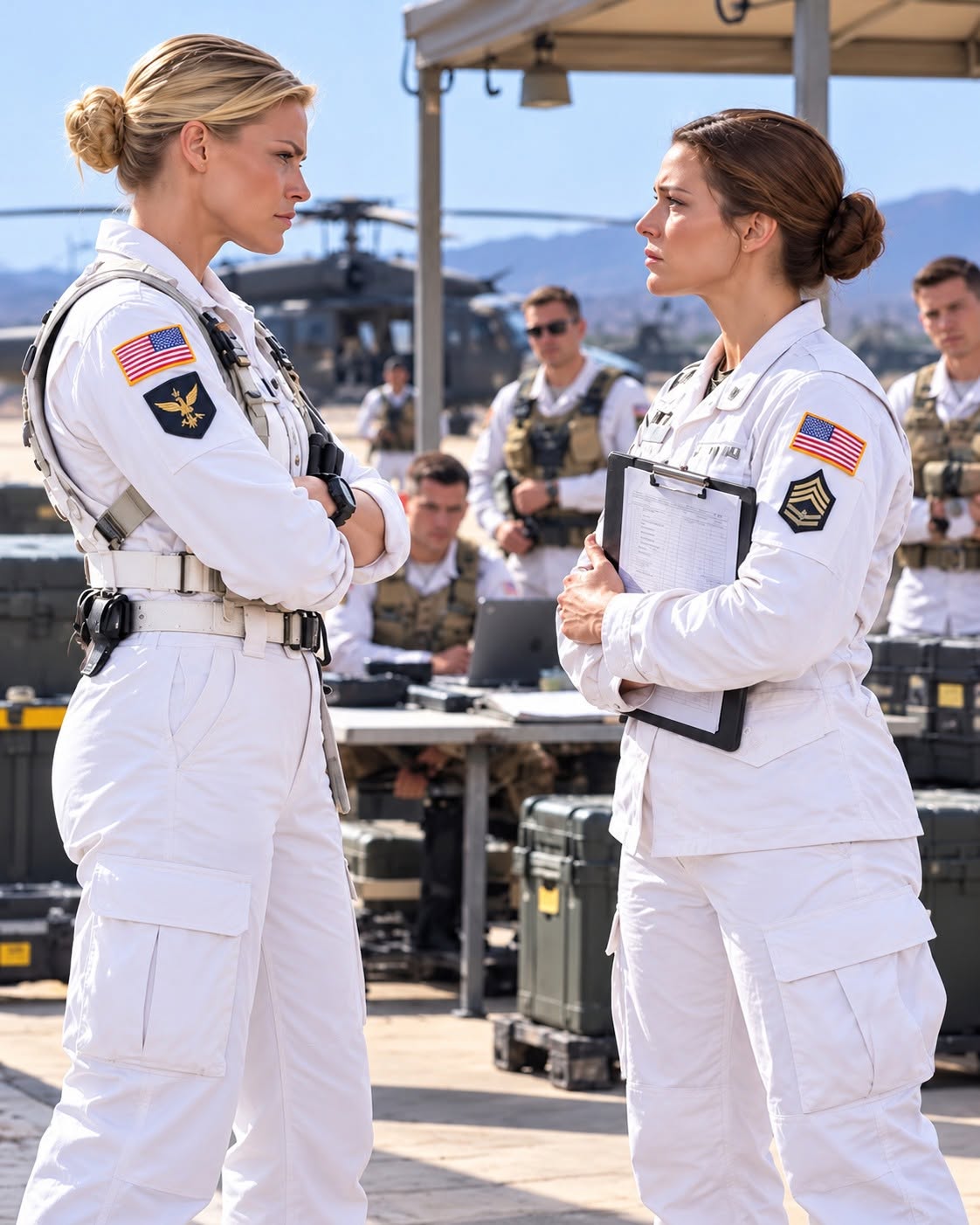
Lauren did not look like an officer facing an administrative review. She looked like a woman who had spent thirty-four years believing that the world was an auditorium built specifically to applaud her entrance. Her hair was pulled back into an immaculate, regulatory bun beneath her patrol cap, her uniform bore razor-sharp creases, and her combat boots were polished to a dull, high-grade sheen that had never seen a field trench.
“So,” Lauren said, taking a step toward me as the glass doors swung shut behind my boots. “Did Colonel Albright tell you that your little technical friends managed to cover for you?”
I stopped three paces from her, keeping my hands resting loosely at my sides, my posture completely neutral. “The review is finished, Major. The Directorate of Marksmanship verified that my nomination went through standard institutional channels based on my competition records.”
Lauren let out a sharp, dismissive breath that was half a laugh. “Competition records. That’s your shield, isn't it? You win a few shooting matches, you spend thirteen years cleaning carbon out of receivers in an air-conditioned armory, and you think that makes you qualified to advise a brigade on operational doctrine. You’re an enlisted armorer, Natalie. You’re supposed to maintain the tools, not tell the officers how to employ them.”
“I teach the fundamentals because I understand the mechanics of the weapon better than anyone on this range, Lauren,” I replied, my voice steady despite the old, familiar ache tightening in my chest. “And unlike you, I don't use my rank to steal assignments from other soldiers.”
The color drained from Lauren’s face in a sudden, violent wash, replaced by a dark, mottled crimson around her jaw. “What did you say?”
“Colonel Albright showed me the routing slip,” I said, stepping closer until our eyes were level. “You didn't just ask about my selection. You submitted an addendum trying to pull my orders and install yourself as the symposium lead. You tried to turn a routine training event into a resume bullet for your promotion board, and you didn't care if you burned my career to the ground to do it.”
Lauren’s eyes flickered, a momentary tremor of panic breaking through her polished facade before her chin snapped upward in defiance. “I was doing what any competent field-grade officer does: ensuring that a high-profile division event is led by someone who actually represents the officer corps! Do you have any idea what’s at stake here? My year group is facing a sixty percent cut on the primary lieutenant colonel board next spring. If I don't have a major tactical development bullet on my evaluation report, I get passed over!”
“Then earn it on your own merits, Lauren,” I said. “Don't steal mine.”
“Your merits?” She scoffed, reaching into her cargo pocket and pulling out a folded piece of paper with an aggressive, snapping motion. “You think you’re untouchable because Mercer likes you? Look at this, Natalie.”
She unfolded the paper and held it in front of my face.
It was a printed email originating from the office of State Senator Thomas Vance’s regional constituent affairs director—a man who had been a regular guest at our mother’s dinner table in Richmond for fifteen years. The subject line read: *Informal Inquiry Regarding Selection Irregularities at Maneuver Center of Excellence.*
“Mom called the senator’s office yesterday morning,” Lauren whispered, her voice dripping with triumphant venom. “She explained that a junior enlisted member of our family was being improperly favored over seasoned commissioned officers due to off-duty social associations with battalion leadership. If you think Colonel Albright’s little internal review is going to protect you, you’re out of your mind. By Friday morning, the legislative liaison office will be requesting every piece of your personnel file from Human Resources Command.”
The air felt thin, hot, and suffocating.
I stared at the senator’s letterhead. Our mother had never attended a single one of my award ceremonies. When I graduated at the top of my advanced individual training class at Aberdeen Proving Ground, she sent a card with five dollars inside and a note asking if I could mail my spare dress uniform home so Lauren could borrow the garment bag. When I deployed to the Syrian border with a specialized maintenance team, she called once to ask if I could buy discounted perfume at the post exchange.
Now, she had weaponized a United States Senator’s office within twenty-four hours to protect Lauren’s promotion packet from the consequences of her own arrogance.
Before I could speak, my personal phone vibrated violently against my hip. I pulled it out.
The screen displayed an incoming call from our mother: *Eleanor Bennett.*
I tapped the screen, brought the phone to my ear, and said, “Sergeant Bennett.”
“Natalie, stop this nonsense immediately,” our mother’s voice came through the receiver, sharp, frantic, and entirely devoid of any greeting. “Lauren called me in tears from the range office this morning. She said your commanding officers are threatening to put a reprimand in her file because you refused to admit that you received an unfair advantage! Do you have any idea what a reprimand does to an officer’s future?”
“Mom,” I said, my voice dropping so low that Lauren had to lean in to hear it. “Lauren filed a false official statement against me. She tried to have my orders canceled because she wanted my assignment for herself.”
“She is your older sister, Natalie!” Mom snapped, her voice rising into that piercing, guilt-laden cadence that had dictated every holiday of my childhood. “She has an advanced degree from William & Mary! She is an executive officer in the United States Army! You repair rifles, Natalie! You have a good pension waiting for you no matter what happens, but Lauren’s entire identity is tied to her rank! If she gets passed over for promotion, her career is finished! I want you to walk back into that Colonel’s office right now, tell him it was a family misunderstanding, and sign whatever waiver is necessary to clear her record!”
I looked at Lauren, who was watching me with a smug, expectant smirk, her arms crossed over her chest, waiting for the younger sister to fall in line the way I had always fallen in line.
“No, Mom,” I said.
A dead, shocked silence fell over the line.
“What did you say to me?” Mom gasped.
“I said no,” I replied, my voice steady, clear, and unyielding. “I earned my seat at this table. If Lauren wants to wear silver oak leaves, she can find a way to earn them without stealing my work. I will not lie for her, and I will not sign a waiver.”
I ended the call, slipped the phone back into my pocket, and met Lauren’s widening eyes.
Before she could speak, the heavy glass doors of the headquarters pushed open, and Master Sergeant Reed stepped onto the breezeway, holding a laminated clipboard. He looked from me to Lauren, his weathered sergeant’s face carved from pure stone.
“Major Bennett, Sergeant Bennett,” Reed announced, his command voice ringing across the concrete. “Lieutenant Colonel Mercer has just adjusted the training schedule for Range Eleven tomorrow morning. By order of the brigade commander, all company commanders and field-grade officers attached to this symposium will execute the advanced combat marksmanship qualification course alongside the mobile training team at zero-six-thirty.”
Reed looked directly at Lauren, his eyebrows lifting slightly. “And Sergeant Bennett has been designated as the primary technical evaluator on the firing line. Pack your gear, Major. We’ll see how well your theories hold up in the dirt.”
Related Stories