Chapter 3: The Price of Independence
The smell of burnt turkey and cold gravy hung heavy in the narrow kitchen as Grant’s words settled over the table like fine ash.
Brooke pulled away from my chest, her weeping cutting off with a sharp, ragged gasp. She looked at the red-stamped paper on the table, then up at her older brother, her eyes wide with total disbelief.
“Grant?” she whispered. “What did you just say?”
“I said Dad owed four hundred and fifty thousand dollars,” Grant replied, not looking at his sister. His gaze remained locked on me, measuring my breathing, searching for the crack in my composure. “In twenty-fourteen, when Carter Freight almost went under during the diesel fuel spike, Dad couldn't get a commercial loan from the regional banks. His debt-to-equity ratio was underwater.”
Grant took a slow, deliberate breath, smoothing the lapels of his coat.
“I was three years out of business school. I had just made partner at Meridian Capital. I structured an unsecured mezzanine credit facility through one of our secondary investment vehicles to keep his trucks moving. Four hundred and fifty thousand dollars at four percent interest.”
“Your father never told me that,” I said. My voice was quiet, but every word felt like dragging broken glass through wet cement.
“Of course he didn't tell you, Mom,” Grant sneered, a bitter, twisted satisfaction curling the edge of his mouth. “Russell Carter was too proud to admit that his twenty-eight-year-old son had to bail out his life’s work. He made every interest payment on time for six years, but when he sold the company to the Richmond group two years ago, he used an offshore escrow structure to bypass the debt payoff.”
He tapped the Henrico County judgment with his knuckle.
“Arthur Vance filed the formal notice of claim with the probate court two weeks ago. Under Virginia estate law, an unliquidated commercial judgment against the decedent takes precedence over all discretionary trust distributions.”
Grant leaned down until his face was six inches from mine.
“You don't own that three point eight million dollars, Mom. It’s frozen under an administrative lis pendens. And unless you sign an agreement authorizing Meridian to manage the estate liquidation, my firm will execute against the Westlake house by Friday morning.”
“You would evict your own mother?” Tessa’s voice cut through the room like an iron blade.
She had stepped out from behind the counter, her small hands clenched into fists at her sides, her chin lifted high.
“You stood in that cemetery three months ago and held your mother’s elbow while they lowered your father into the dirt,” Tessa said, her voice shaking with pure, unvarnished rage. “You knew about this debt the entire time. You knew she thought she was broke. You watched her pack her clothes into cardboard boxes, and you let her believe she was homeless just so you could hold this paper over her head?”
“This is business, Tessa,” Grant snapped, waving his hand dismissively as if swatting away a fly. “You wouldn't understand how commercial equity works.”
“I understand what a son is supposed to be,” Tessa replied, her dark eyes blazing with disgust. “And you aren't one.”
“Enough,” I said.
I picked up the Henrico County notice.
The paper felt cold against my dry fingers. I looked at the date of the original promissory note: *October 14, 2014.*
I remembered that autumn.
I remembered Russell coming home every night with his shoulders hunched, sitting at our kitchen table in the dark after I had gone to sleep, drinking black coffee until his hands trembled. I remembered asking him if we needed to cut back on groceries, and he had reached out, touched my cheek, and said: *“Don't you worry about the diesel, Elaine. Grant is helping me sort out the accounts. The boy is a wizard with numbers.”*
Russell hadn't hidden the loan because he was proud.
Russell had hidden it because he was terrified that I would realize his own son had charged him four percent interest to keep his father's company from drowning.
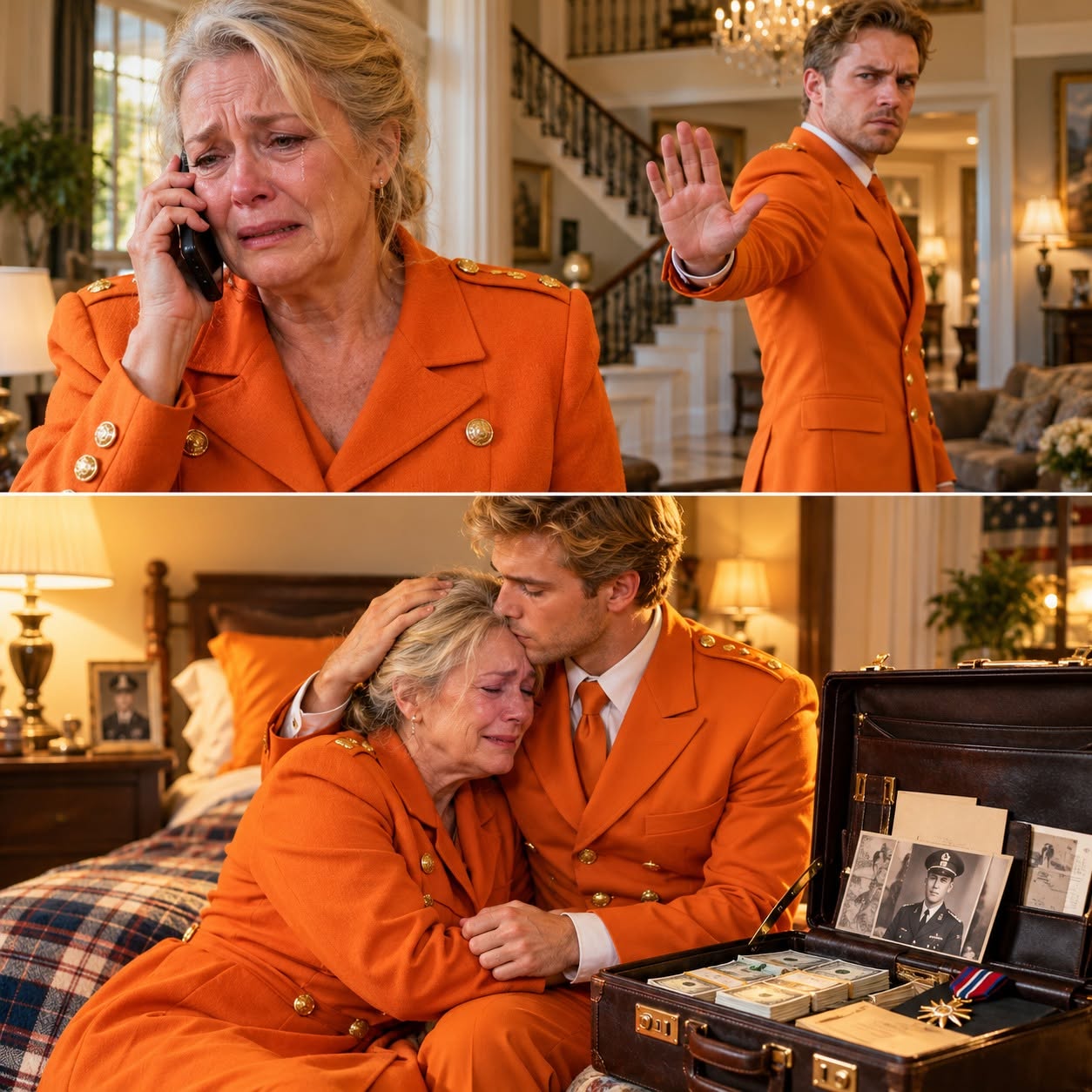
I folded the paper carefully, slid it into Russell’s leather briefcase, and clicked the brass latches shut.
*Snap. Snap.*
“Where are you going?” Grant demanded as I took my heavy wool coat from the back of the sofa.
“I’m going downstairs,” I said, pulling the collar tight around my throat. “To talk to my son.”
The wind in the alleyway was brutal, carrying the scent of wet asphalt, old exhaust, and the bitter winter chill off the river two miles away.
Owen’s battered blue pickup truck was parked behind the laundromat’s industrial waste bins, its engine idling with a low, irregular rattle.
Through the fogged passenger window, I could see the silhouette of his broad shoulders hunched over the steering wheel, his forehead resting against the hard plastic rim.
I walked through the slush, opened the passenger door, and climbed inside.
The cab was freezing. The heater was blowing lukewarm air against the floorboards, smelling of old coffee, damp floor mats, and the faint, sweet trace of the pine-scented air freshener the boys had bought him for Father’s Day.
Owen didn't lift his head.
“Owen,” I murmured softly.
“I don't want the garage, Mom,” he whispered into the dark. His voice was thick, hoarse from crying alone in the cold. “I don't want Dad’s money. I don't want a single nickel from that trust.”
“I know, sweetheart,” I said, reaching across the bench seat, laying my hand gently over his calloused knuckles where grease was permanently etched into the skin around his nails.
“You don't know,” Owen choked out, finally turning his head to look at me. His gray eyes were bloodshot, his face pale and swollen beneath the harsh yellow glare of the alley security light. “You think I took you in because I’m some kind of saint? You think I gave you our bed because I’m better than Grant?”
He gave a short, bitter laugh that tore at my heart.
“My whole life, Mom... Dad looked at Grant like he was a king. Grant went to UVA. Grant wore suits. Grant talked about private equity and leverage. Every time Dad talked about Grant at the dinner table, his chest puffed out like he was talking about the President.”
Owen wiped his nose with the back of his work glove.
“And then there was me. Owen, who couldn't pass algebra. Owen, who spent his weekends pulling transmissions out of junked Chevys behind the barn. Dad loved me, but he looked at me like I was a broken part he couldn't quite figure out how to fix.”
He turned his body toward me, his voice trembling with an ancient, unhealed wound.
“When you called me that morning... when you told me the bank took the house and you had nowhere to sleep... for the first time in thirty years, Mom, I felt like I was the one who could protect you. I didn't have money to give you, but I had a roof. I had a bed. I could keep you warm.”
A single, hot tear broke over his cheek, tracking down into the stubble along his jawline.
“And then you sat at that table today, and you told me it was an experiment. You told me you were holding four million dollars the whole time, watching me struggle to pay the electric bill, watching Tessa skip her medicine, just to see if I’d pass your little test before you handed me a prize.”
He buried his face in his hands, his broad shoulders shaking with silent, ragged sobs.
“It felt like Dad buying me a bicycle after I flunked the tenth grade, Mom. It felt like pity.”
I closed my eyes, the cold air burning my throat as the magnitude of what I had done crashed down upon my shoulders.
Russell and I had thought we were being so clever. We had sat at our kitchen table clipping grocery coupons, congratulating ourselves on our quiet wisdom, believing that secrecy was the same thing as protection.
We hadn't protected our family.
We had weaponized our silence.
“Owen, look at me,” I whispered, grabbing both of his wrists, pulling his hands away from his face until his eyes met mine.
“Your father didn't buy that garage to pity you, Owen,” I said, every word dropping like an iron weight into the freezing cab. “Your father went to see Mr. Henderson six months before he died because he was terrified.”
Owen blinked, frowning through his tears. “Terrified of what?”
“Terrified of Grant,” I said.
Owen’s brow furrowed. “Grant? What does Grant have to do with the shop?”
“Your father came to this garage in April, didn't he?” I asked, remembering the date on the commercial purchase contract. “Before he went into the hospital for the last time. What did he say to you, Owen?”
Owen stared at me for three long seconds. The anger on his face slowly dissolved, replaced by a strange, shadowy realization that made his breathing stop.
“He sat on the tool chest by bay two,” Owen whispered, his voice trembling. “He looked at my hands... and then he told me that no matter what happened after he was gone, I had to promise him one thing.”
“What did you promise him, Owen?”
“He made me swear that if Grant ever came to me with a contract,” Owen rasped, “I would never, ever sign my name.”
---
Related Stories