Chapter 2: The Cracks in the Concrete
The heavy exterior door of the apartment building banged against its metal frame downstairs, followed by the muffled rumble of Owen’s work truck starting in the alleyway.
Inside the kitchen, the silence was suffocating.
Grant was still standing in the entryway, his hand resting on the deadbolt. A slow, ugly smile began to spread across his face—a look of pure, vindictive satisfaction as he watched his younger brother reject the very prize that had just humiliated him.
“Well,” Grant sneered, adjusting his cashmere collar. “Looks like the saint didn't want his halo after all.”
“Get out, Grant,” Tessa said.
She hadn't raised her voice once all afternoon. She stood beside the kitchen sink, a five-foot-three woman with her sleeves rolled to her elbows, holding a damp yellow dish towel in her raw, chapped hands.
Grant blinked, caught off guard by the quiet authority in her tone. “Excuse me?”
“I said get out of my home,” Tessa repeated, looking straight into his eyes. “You haven't spent ten minutes in this apartment without looking at your watch or wiping your shoes. You came here for an inheritance, you found out you didn't get one, and now you’re standing in my kitchen mocking my husband while he drives around in the freezing cold because his heart is broken.”
Grant let out a sharp, condescending bark of laughter. “This dump isn't yours to defend, Tessa. You’re renting above an industrial laundromat on a mechanic’s wage. If my mother had an ounce of sense, she wouldn't have spent a single night in this fire trap.”
“I’d rather sleep on a broken couch with people who love me, Grant,” I said, rising slowly from the folding chair, “than spend an hour breathing the air in your five-bedroom museum.”
Grant’s face darkened. He opened his mouth to deliver another blow, but Brooke reached out and caught his sleeve, her fingers digging through his wool coat.
“Grant, stop,” Brooke whispered.
Her voice sounded strange—thin, hollowed out, stripped of the brittle suburban polish she usually wore like a shield. She wasn't looking at Grant. She wasn't looking at me.
She was staring down at her envelope on the table, her breath coming in shallow, ragged hitches.
“Brooke, let’s go,” Grant said, shaking his arm free. “We’re wasting our time. Let them sort out their little moral play.”
He pulled the apartment door open and marched down the hallway, his leather-soled shoes clattering heavily against the wooden stairs.
Brooke didn't follow him.
She sank slowly into the metal folding chair opposite mine, her designer overcoat pooling around her knees like an oil spill. She pulled her knees together, her hands gripping the edges of the table until her knuckles turned translucent white.
“Brooke?” I asked softly, stepping toward her.
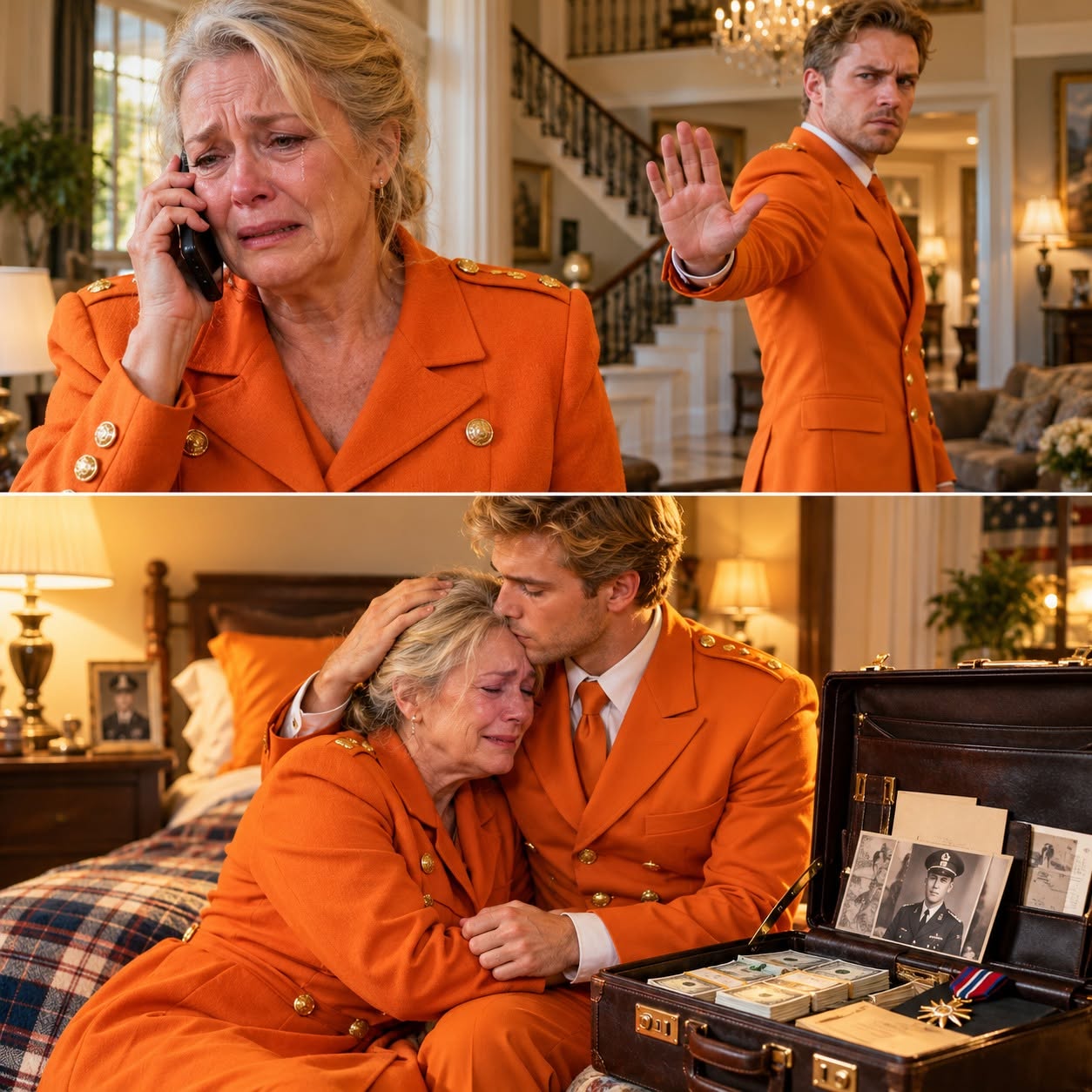
My daughter didn't look up. A single tear rolled over her lower lash line, cutting a dark track through her foundation, dripping silently onto Russell’s letter.
“You thought I asked about the wristwatch because I was greedy,” Brooke whispered.
I stopped two feet from her chair. “You called me once in three months, Brooke. You didn't ask how my hip was doing. You didn't ask if I had enough groceries. You asked if I had Dad’s gold Omega in my jewelry box.”
“Because the sheriff came to my house on Tuesday, Mom!”
The words tore out of her throat in a violent, jagged sob that echoed off the yellowed linoleum.
She covered her face with both hands, her shoulders heaving with sudden, terrifying convulsions.
Tessa set her dish towel down on the counter, her eyes widening with genuine alarm as she stepped toward the dining nook.
“What are you talking about, Brooke?” I asked, my chest tightening with an ancient, maternal dread that twenty years of distance couldn't erase.
“David left me in August,” Brooke wept into her palms, her body trembling so violently the folding table shook. “Two weeks before Dad’s funeral. He packed three suitcases while the children were at soccer camp, emptied our joint accounts, and flew to Scottsdale with his twenty-six-year-old paralegal.”
The room seemed to tilt beneath my slippers.
“David left?” I repeated, stunned. “You told us he was in Chicago on a commercial audit during the reception.”
“I lied!” she cried, lifting her blotched, ruined face to look at me. “I lied because I couldn't bear to let Grant know! I couldn't let Paige look at me with that pitying, superior little smirk she gives people who fail! David didn't just take the savings, Mom. He took a second mortgage out on our house four months ago using a forged corporate guarantee from his firm. The bank served the foreclosure summons on Monday.”
She pointed a shaking, manicured finger at the two sheets of paper containing Russell’s final words to her.
“I didn't tell you to look into a shelter because I was cruel,” Brooke sobbed, her voice cracking into a dry, breathless rattle. “I told you that because I was looking into one for myself and my two girls! I asked about the watch because I needed six hundred dollars to pay the electric bill before they cut the heat off on Wednesday morning!”
I stood frozen in the center of Owen’s small living room, the weight of her words crashing over me like icy water.
All those weeks.
All those long, silent afternoons I had spent sitting at Owen’s kitchen window, clutching Russell’s reading glasses, telling myself that my daughter was a selfish, unfeeling social climber who had discarded her mother the moment the money ran out.
I had built a fortress of moral superiority out of my husband’s three point eight million dollars. I had sat in judgment over my children, grading their loyalty on an arbitrary scale of self-sacrifice, entirely blind to the fact that my daughter was drowning in silence two miles down the highway.
“Brooke,” I whispered, stepping toward her, reaching out to wrap my arms around her shaking shoulders.
She didn't pull away.
She collapsed against my chest, burying her face into the front of my cardigan, weeping with the raw, abandoned agony of the seven-year-old girl who used to scrape her knees on our driveway.
I held her tight, feeling the thinness of her ribs beneath the heavy wool coat, rocking her gently while the laundry machines thudded beneath the floorboards.
The apartment door swung open with a sharp, pneumatic creak.
Grant walked back into the living room.
He hadn't left the building. He was holding his phone in his left hand, his face pale, his jaw set in a hard, aggressive line that had nothing to do with wounded pride and everything to do with corporate survival.
He didn't look at Brooke crying against my shoulder.
He walked straight to the table, pulled a printed document from his inner coat pocket, and slapped it down beside Russell’s briefcase with a concussive thud.
“Save the tears, Brooke,” Grant said, his voice flat, metallic, and completely devoid of warmth. “Mom didn't tell you the whole story about Dad’s three point eight million.”
I lifted my head from Brooke’s hair, my eyes narrowing. “What are you talking about, Grant?”
Grant tapped the printed sheet with his forefinger.
“I just called Arthur Vance, my commercial litigation counsel,” Grant said, looking directly into my eyes. “He ran a lien search on the Richmond transportation sale while I was sitting in my car downstairs.”
He turned the paper toward me.
Across the top of the header, stamped in red ink by the Henrico County Clerk of Courts, was an official legal abstract:
*NOTICE OF PENDING JUDGMENT LIEN // COMMERCIAL DEFAULT.*
*AMOUNT: $450,000.00.*
*DEBTOR: RUSSELL CARTER (DECEASED) / CARTER FREIGHT LOGISTICS.*
“Dad didn't sell that company clean, Mom,” Grant whispered, a cold, predatory light flickering behind his eyes. “He had an outstanding commercial liability on his primary warehouse lease in Henrico. And the judgment creditor who holds the lien against your three point eight million trust...”
Grant leaned forward, his hands resting on the edge of the table.
“...is my firm.”
---
Related Stories