Chapter 5: The Midpoint Reckoning
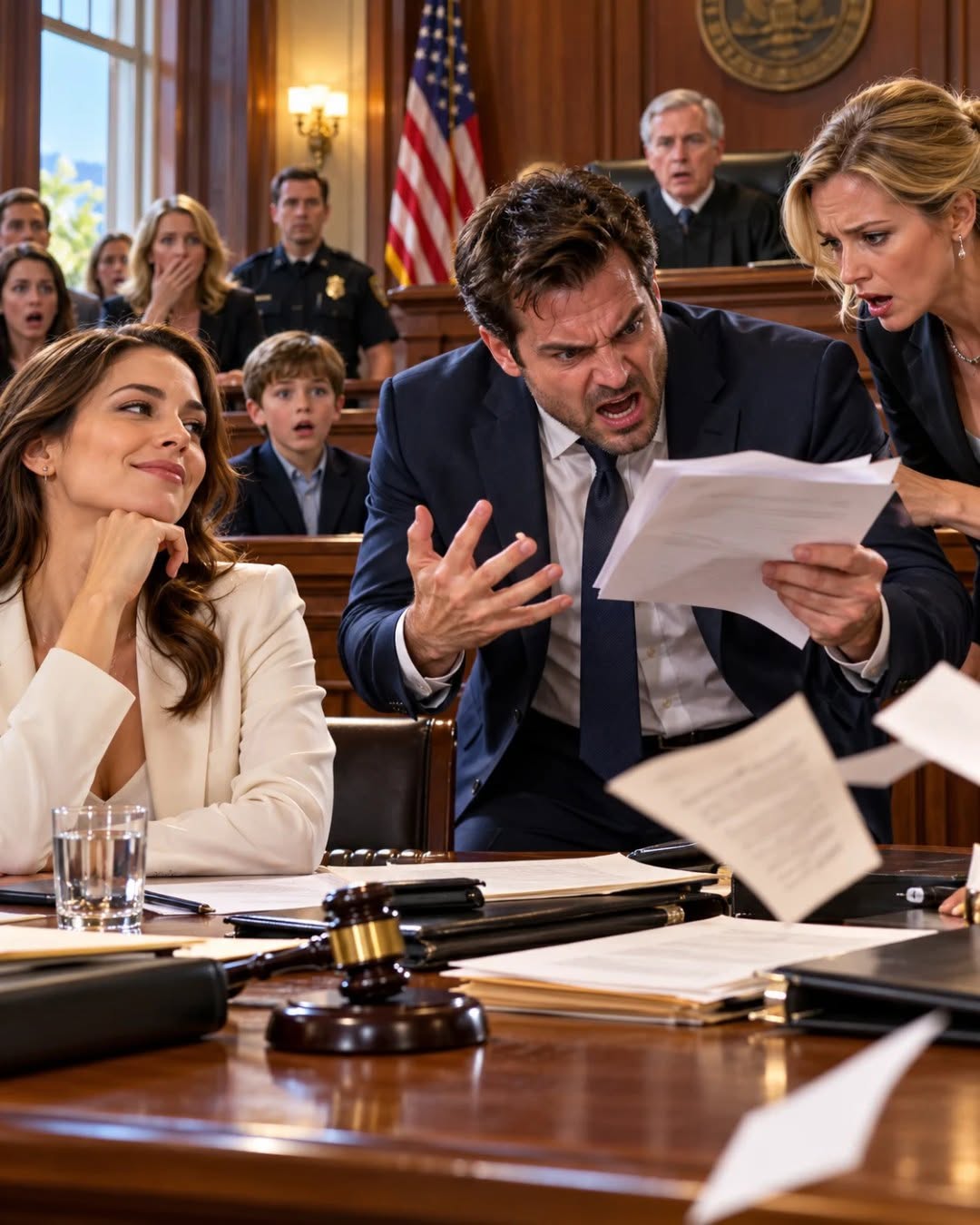
The metallic *click-clack* of the steel handcuffs ratcheting around Mark’s wrists was the only sound in the cavernous library.
Detective Miller, a seasoned investigator with twenty years on the commercial fraud squad, read Mark his statutory rights in a flat, rhythmic drone that made the whole scene feel surreal, like a documentary playing on a screen with the volume turned low.
Mark didn't look at the detective. He kept his eyes pinned to mine, his lips pulled back in that grotesque, venomous sneer.
“You think you’re untouchable, Laura!” he shouted, struggling against the detective’s grip as they hauled him toward the double doors. “You think you’re the grandmaster! Check the master deed on Maple Street! Ask Arthur whose project is breaking ground on that cul-de-sac in thirty days!”
The heavy oak doors clicked shut behind him, cutting off his voice.
The room fell into an unbearable stillness.
Rachel was still curled in the leather armchair by the hearth, weeping into her coat, her shoulders shaking with the silent, suffocating hysteria of a woman who had realized her entire life had been dismantled in twenty minutes.
I didn't look at her. I couldn't. Looking at my sister felt like looking at a stranger wearing the face of a child I had protected for thirty years.
I turned slowly to Arthur Vance.
Arthur had not sat back down. He stood behind his walnut desk, his hands resting heavily on the green leather blotter, his head slightly bowed. The authoritative composure he had wielded like a shield five minutes ago was gone, replaced by a deep, weary sorrow that seemed to add ten years to his face.
“Arthur,” I said, my voice steady, though my heart was pounding against my ribs like a hammer. “What was Mark talking about?”
Arthur closed his eyes for three long seconds. When he opened them, the blue was dull, clouded with a regret that made my stomach tighten into a knot of ice.
“Sit down, Laura,” Arthur said quietly. “Please.”
Sarah Miller placed a supportive hand on my shoulder, guiding me back into the leather chair opposite the desk. She remained standing beside me, her legal pad ready, her pen poised, her sharp eyes missing nothing.
Arthur reached into his desk drawer and pulled out an oversized, bound legal folio stamped with the official seal of the State Department of Transportation and the Capital Region Planning Commission.
He laid it on the desk and pushed it toward me.
The title printed across the front in heavy black type read:
**INTERSTATE 84 CORRIDOR EXPANSION AND WESTSIDE LOGISTICS RIGHT-OF-WAY CONDEMNATION ACT.**
My hands, usually so steady when holding a drafting pencil, began to tremble as I pulled the folio open.
I turned past the statutory authorizations. Past the environmental impact disclosures. Past the engineering schematics.
On page forty-two was a high-resolution municipal zoning map of our county.
A thick, bold red line cut diagonally through the north end of the city, slicing directly across the quiet residential pocket of Maple Street.
Right through the center of the two-acre parcel where my brick Craftsman bungalow sat.
“A municipal condemnation order,” Sarah breathed, leaning over my shoulder, her finger tracing the property boundaries. “A state eminent domain taking.”
“It was approved by the governor’s transportation committee six months ago, Laura,” Arthur said, his voice dropping to a harsh, gravelly whisper. “The state is expanding the highway spur to service the new regional medical distribution hub. Every single property on the west side of Maple Street is scheduled for mandatory demolition.”
“When?” I choked out, the air leaving my lungs.
“The demolition permits were issued on Monday,” Arthur replied. “The final notice of eviction and physical taking is scheduled to be served on the homeowners this Friday at five o'clock.”
The room seemed to spin.
The brick bungalow.
The painted wooden swing on the porch.
Tommy’s room with the blue quilt, his books unpacked on the shelves, the wide oak tree in the backyard where I had promised him a rope ladder and a trapdoor.
“Who represents the state’s commercial land acquisition syndicate, Arthur?” Sarah asked, her voice turning sharp as a razor, her eyes locking onto Arthur’s face.
Arthur looked down at his blotter. He didn't answer for three agonizing seconds.
Then he lifted his head.
“Vance & Partners, Sarah,” Arthur whispered, the words sounding like ashes in his mouth. “My firm.”
I stared at him, the man who had known my father since they were boys at Trinity College, the man who had sent flowers to my mother’s funeral, the man who had smiled at me across holiday dinner tables for thirty years.
“You knew,” I whispered, the realization hitting me like a physical blow to the sternum. “You knew before I bought the house.”
“No, Laura, God as my witness, I did not know you were the buyer!” Arthur said, his voice cracking with genuine, desperate agony as he reached his hands across the desk toward me. “The purchase was made through an anonymous blind trust! The deed was registered under an LLC in Delaware! I had no idea you were the tenant-in-common until Mark walked into my office three hours ago with the tax filings!”
“Mark knew,” Sarah said, the pieces clicking together with terrifying, surgical precision. “Mark knew about the eminent domain taking from the firm’s internal pipeline six months ago.”
“Yes,” Arthur murmured, sinking back into his chair, his face gray. “Mark was the lead junior partner assigned to the right-of-way acquisition team. He was the one who drafted the initial condemnation notices for the state.”
The whole horrifying architecture of Mark’s scheme laid itself bare before me.
Mark hadn't just tried to frame me for embezzlement.
He hadn't just tried to strip me of our marital savings.
He had known that I was searching for a quiet home for Tommy. He had tracked my real estate inquiries through Rachel, discovered which property my trust was acquiring on Maple Street, and deliberately accelerated the state’s condemnation timeline to ensure that the very house I moved into with our eight-year-old son would be flattened by state bulldozers within weeks of our divorce.
He wanted me homeless.
He wanted Tommy terrified, standing on a sidewalk with our furniture on the curb, while Mark sat on the ridge in his glass mansion, pretending to be the responsible, grieving father who could step in and demand emergency custody because the mother had no stable dwelling for the child.
“What is the state offering for the condemnation compensation, Mr. Vance?” Sarah asked, her tone entirely professional, cold, and predatory.
“The statutory appraisal on the Maple Street parcel was conducted by the state’s contracted evaluators three weeks ago,” Arthur said, his hand shaking as he turned to the final page of the folio. “Because the property was categorized as a residential dwelling within an active industrial expansion zone, the state’s mandatory purchase tender is seventy-eight thousand dollars.”
“Seventy-eight thousand?” I gasped. “I paid five hundred and twenty thousand dollars in cash from my trust!”
“The deed carries an unseverable municipal cloud, Laura,” Arthur said. “Under the emergency statute passed by the legislature, once the condemnation decree is stamped by the probate court on Friday, the title transfers immediately to the state highway authority. The property owner has thirty days to vacate before the sheriff executes a physical lockout. There is no appeal. There is no stay of execution.”
I sat frozen in the leather chair, staring at the red line slicing through my son’s bedroom on the municipal map.
Mark was sitting in a police holding cell facing a decade in state prison for corporate embezzlement, but from behind the steel bars, his trap was still springing shut.
In forty-eight hours, the state would take my home.
In forty-eight hours, the sheriff would post the eviction notice on my front door.
And if I had no permanent residence, Mark’s high-priced family law attorney would walk into emergency family court on Monday morning, file an ex-parte motion for temporary foster custody, and take my son away while the state bulldozers tore down our roof.
I looked up from the map, my hands slowly flattening against the walnut table.
The panic in my chest didn't break me.
It burned away, leaving behind a cold, lethal clarity that felt ancient, unbreakable, and entirely focused on one single objective.
I looked Arthur Vance dead in the eye.
“Arthur,” I said, my voice dropping into a register so quiet, so level, that Rachel stopped weeping in the corner.
“Yes, Laura?”
“Your firm represents the corporate developer building the medical distribution hub on the other side of that highway, correct?”
“Yes,” Arthur replied, his brow furrowing in confusion.
“And that medical distribution hub requires an EPA wastewater easement permit from the city water authority before the state highway can begin construction, doesn't it?”
Arthur blinked. “Yes. The environmental permit is the primary condition precedent in the master development charter.”
I picked up my leather handbag, pulled out my firm’s corporate credential card, and slid it across the desk until it tapped against the condemnation folio.
“My architectural firm didn't just design the clinic floor plans for the city, Arthur,” I said, the ghost of a smile touching the corner of my lips. “My firm holds the exclusive, patented municipal design rights for the city’s closed-loop bio-filtration drainage system. The very system your medical hub is legally required to install under state environmental law.”
Arthur’s jaw slowly dropped. The color drained from his face for a second time.
“Laura...” Arthur whispered, his pupils dilating in sheer, disbelieving awe. “You hold the patent?”
“I hold the patent,” I said, standing up from the table, smoothing my coat, and looking down at the man who had underestimated me just like my husband had. “And as of twelve o'clock today, my fee for the municipal easement license is exactly one property deed.”
I turned toward the double mahogany doors.
“You have forty-eight hours to reroute that highway, Arthur,” I told him over my shoulder. “Or your forty-million-dollar medical hub will be nothing more than an empty field of mud.”
Related Stories