Chapter 1: The Weight of the Win
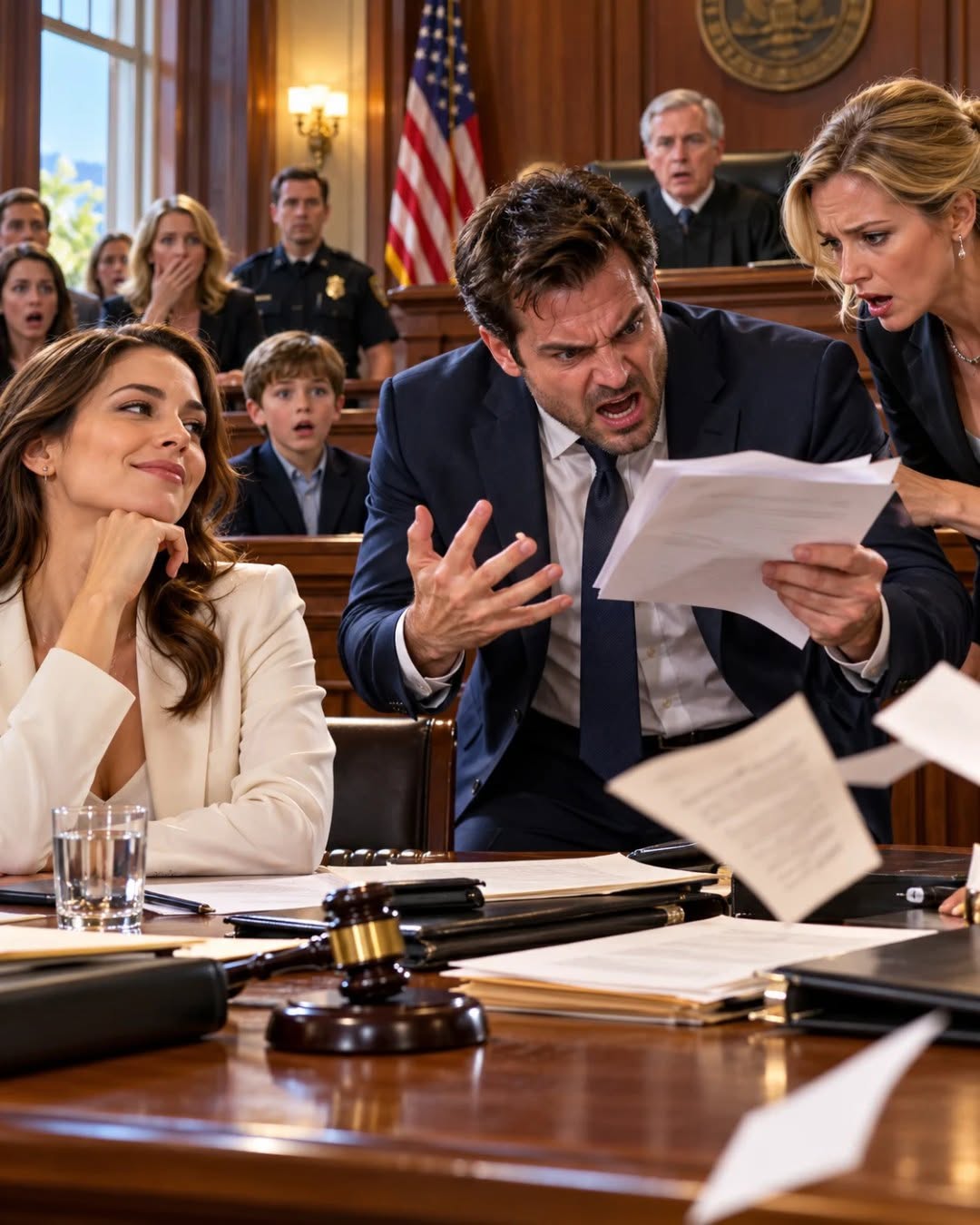
The silence in Courtroom 4B lasted so long I could hear the faint, erratic hum of the air-conditioning unit above the judge’s bench.
Mark sat frozen in his high-backed leather chair, his hands flat on the polished oak table. The color had completely drained from his face, leaving his skin the shade of wet paper. He stared down at the final page of Exhibit D, his lips parted, his breathing turning shallow and fast.
His attorney, Brenda Walsh, leaned over and pressed two manicured fingers against his sleeve. Her voice was barely a whisper, but in the dead quiet of the room, it cut like glass.
“Mark. Keep your mouth shut.”
She turned toward the bench, her professional smile brittle at the edges. “Your Honor, my client requests a brief fifteen-minute recess. There appears to be a clerical ambiguity in the addendum regarding the debt assumption clause.”
Sarah Miller, sitting beside me, rose to her feet before Brenda could finish her sentence.
“Objection, Your Honor,” Sarah said, her voice smooth, level, and entirely devoid of hesitation. “There is no ambiguity. Mr. Davis drafted these terms through his initial settlement demand three months ago. He insisted on receiving one hundred percent title and equity in the marital residence, the vehicles, and the primary liquid accounts. He affirmed under oath less than five minutes ago that he reviewed the attached liabilities schedule with counsel. The agreement is signed. The decree has been executed.”
Judge Harrison adjusted his reading glasses, pulled the heavy stack of documents toward him, and turned to the final four pages.
I watched Mark’s throat bob as he swallowed.
What Brenda had just realized—and what Mark was finally reading with his own eyes—was the trap he had constructed out of his own arrogance.
Mark had spent twelve years treating me like a decorative accessory to his ambitions. Because I had spent the last eight years running a boutique architectural design firm from home while raising Tommy, he assumed I was financially illiterate, timid, and easily intimidated. When he decided he wanted out, he believed he could bully me into absolute surrender with a single speech over the kitchen island.
He had demanded the four-bedroom custom home on the ridge—the house I had spent two years designing down to the mitered joints of the cabinetry.
He had demanded the two luxury foreign SUVs parked in the three-car garage.
He had demanded the primary investment account holding four hundred and twenty thousand dollars in liquid cash.
And to ensure I walked away with nothing, his original demand had included a ruthless clause: *Husband shall receive exclusive ownership of the real property, vehicles, and named bank accounts, free and clear of any claim, offset, or equalization payment to Wife.*
To accept his terms, I had instructed Sarah to add only one sentence—the standard, mandatory legal counterpart required under state property law: *Husband assumes sole, exclusive, and unshared responsibility for all mortgages, secondary liens, promissory notes, balloon obligations, and tax liabilities attached to said properties, indemnifying and holding Wife harmless in perpetuity.*
Mark hadn't read the attachments. He had been so drunk on the thrill of having stripped me bare that he signed the debt assumption schedule without asking for the underlying disclosures.
He didn't know that six months ago, I discovered he had secretly taken out an eight-hundred-thousand-dollar secondary equity line against the house to bankroll a disastrous commercial development project in the warehouse district. He had hidden the paperwork in a locked storage trunk in his office, fully intending to spring the debt on me during a contested trial so the court would force me to absorb half of his failure.
By demanding the house as his exclusive property, Mark had legally chained himself to every penny of that eight-hundred-thousand-dollar debt on his own.
The luxury SUVs? Both were leased under commercial balloon contracts with seventy-five-thousand-dollar mandatory buyout penalties due in forty-five days.
And the savings account?
Three weeks before he asked for a divorce, an official audit notification from the Internal Revenue Service had arrived in our mailbox, addressed to Mark Davis Consulting. He had failed to remit payroll taxes for two consecutive fiscal years. The IRS had already placed an administrative freeze on that specific account. By taking sole ownership of the funds, Mark had legally absorbed the entire federal tax liability—which exceeded five hundred and twenty thousand dollars including penalties and compounding interest.
The four hundred and twenty thousand dollars in cash wasn't his. It was already property of the federal government. And he still owed a hundred thousand more on top of it.
Judge Harrison slowly raised his eyes from the document. He looked over the top of his glasses at Mark, his expression turning cold.
“Mr. Davis,” Judge Harrison said, his voice echoing in the rafters. “You were asked twice on the record whether you understood the financial obligations attached to the real estate and personal property you demanded. You testified under penalty of perjury that you possessed the independent capacity to maintain these assets.”
“Your Honor, please,” Brenda said, her voice rising in panic. “My client was operating under a fundamental misunderstanding of the net asset valuation—”
“Your client is a senior managing director at an investment consultancy,” Judge Harrison cut her off sharply. “He does not get to claim commercial illiteracy simply because the assets he insisted upon carry substantial debt. The court finds no evidence of concealment or bad faith on the part of Mrs. Davis. The agreement is binding, final, and non-modifiable.”
The judge picked up his fountain pen, signed the decree with a decisive scratch of ink, and struck the block with his gavel.
The sharp *crack* sounded like a gunshot in the quiet room.
“The marriage of Mark Davis and Laura Davis is dissolved. Sole legal and physical custody of the minor child is awarded to the petitioner, Laura Davis. Court is adjourned.”
Judge Harrison rose and stepped through the rear door into his chambers.
Brenda turned on Mark, her face tight with furious disbelief. “Did you not check the lien registry on your own house? Did you not tell me about the payroll tax freeze?”
Mark didn't answer her. He pushed his chair back, the metal legs screeching violently against the linoleum. He lunged across the aisle toward me, his hands trembling, his eyes bulging with wild, cornered fury.
“You knew,” he hissed, spittle flying from his lips. “You knew about the secondary lien! You let me sign this!”
“Quiet, Mr. Davis!” the bailiff barked, stepping between us with a hand resting heavily on his utility belt. “Step back from the table.”
I stood up slowly, smoothing the fabric of my dark gray wool coat.
“You told me you wanted the house, the cars, and the savings, Mark,” I said, my voice quiet, even, and entirely devoid of anger. “You told me I could keep our son. You said it like Tommy was a box of old winter coats you didn't feel like hauling down to the basement.”
I picked up my leather handbag and looked him directly in his bloodshot eyes.
“You spent twelve years convinced I was stupid just because I didn't yell at you,” I added. “You got exactly what you asked for. Enjoy the house, Mark.”
Before he could answer, his phone buzzed loudly against the wood of the defense table.
Brenda looked down at the lock screen, and her jaw went slack.
“Mark,” Brenda whispered, her voice cracking. “It’s your managing partner. Arthur Vance. He’s calling from the firm’s executive line.”
Mark stared at the buzzing phone, his hands shaking so violently he couldn't swipe the screen.
He had forty-eight hours to clear the secondary lien on the house, or the bridge lender would file an emergency notice of default. And his primary bank accounts were already frozen by the federal government.
I walked past him toward the double oak doors of the courtroom, leaving my ex-husband standing in the wreckage of the victory he had celebrated ten minutes before.
Related Stories