Chapter 5: The Midpoint Shift
The twin turboshaft engines of the Black Hawk shrieked to life, their high-pitched turbine whine drowning out the distant wail of police sirens down the access road.
The rotor blades began to turn, slowly at first, casting long, sweeping shadows across the ruined lawn of the country club before blurring into an invisible disc of spinning steel. The downdraft flattened the shrubs, whipping the dry leaves against the landing gear, clearing the air of the scent of expensive perfume and congealed banquet food.
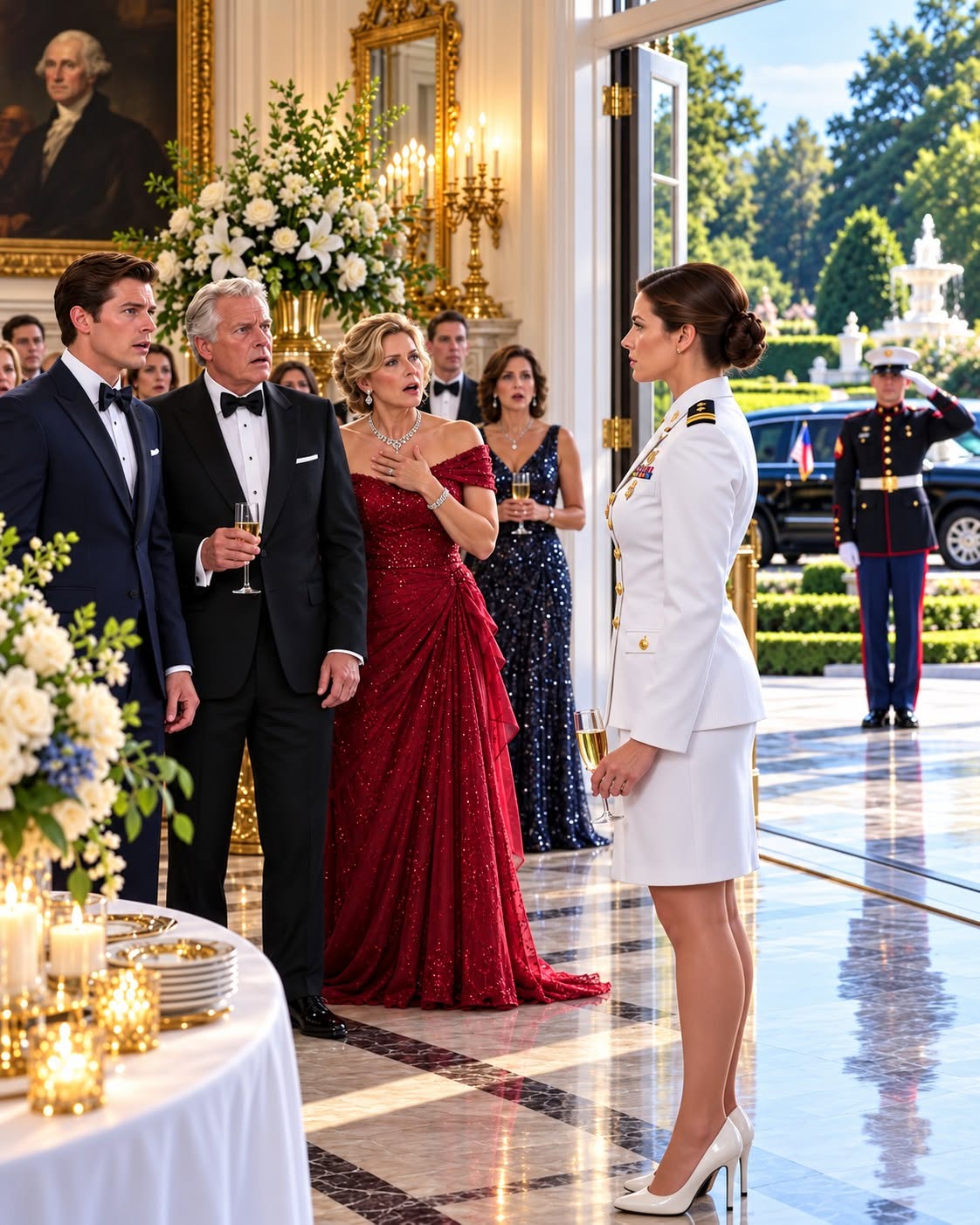
I stood at the base of the cabin steps, my hand resting on the fuselage.
My mother stood three feet away, holding her father’s leather case against her chest. Her hair was windswept, her dress fluttering against her knees, but her chin was up, her eyes clear, steady, and unbroken.
“You’re going to Norfolk?” Claire asked, her voice carrying over the turbine whine.
“I have to go to the ship, Mom,” I said. “The *Enterprise* is dead in the water. We have three hundred engineers at the naval station working to fabricate emergency bypass sleeves to hold those valves together until we can tow her into the basin.”
Claire reached out with her free hand, taking my white-gloved fingers in hers. Her grip was surprisingly strong—the grip of an ironworker’s daughter who had spent forty years surviving in silence.
“Fix the ship, Amelia,” Claire said, a small, fierce smile touching the corners of her mouth. “Your grandfather built those berths to hold carriers. Don't let your father’s greed sink one of them.”
“I won't, Mom.”
I leaned down, kissed her cheek, and climbed the three aluminum steps into the darkened cabin of the Black Hawk.
Lieutenant Colonel Vance reached out, pulled the heavy sliding door shut with a solid, pressurized thud, and locked the handle. The cabin dropped into that familiar, functional tactical realm of green night-vision lighting, communications headsets, and the sharp, clean smell of aviation kerosene and hydraulic fluid.
I strapped myself into the forward nylon jump seat, pulled the pilot’s headset over my ears, and clicked the boom microphone down to my lips.
“Pilot, this is Admiral Hayes,” I said. “Lift on your clearance.”
“Roger that, Admiral,” the pilot’s voice crackled through the intercom. “Departure corridor Alpha cleared through Norfolk regional airspace. Route direct to Naval Station Norfolk, flight time twenty-two minutes.”
The helicopter surged upward with a smooth, concussive heave, the country club lawn falling away beneath our skids.
Through the small observation window, I looked down one last time at the Oakridge terrace.
The tables looked like scattered white postage stamps on the green grass. The police cruisers were small blue matchboxes blinking along the driveway. And standing alone on the flagstones, an isolated, motionless black dot beneath the shredded canvas banner, was my father—staring up into the sky at the daughter he had spent twenty-two years underestimating.
The aircraft banked hard to the east, the sun setting behind our tail in a blaze of crimson and gold, leaving the ruins of the Hayes dynasty behind us in the dark.
I pulled the Toughbook from its bracket on the bulkhead, opened the screen, and unlocked the secure command trunk.
“Colonel Vance,” I said, my eyes tracking the live telemetry feeds streaming from the Atlantic Fleet Command center. “What is the status of the emergency metallurgical audit at the Norfolk machine shop?”
Vance looked up from his digital tablet, his face illuminated by the green glow of the instrument panel. His expression was grim, tight, and shadowed with an urgency that immediately made the hair on the back of my neck stand up.
“Admiral,” Vance said, leaning forward across the narrow cabin aisle. “NCIS just finished cross-referencing the shipping manifests seized from your brother’s office with the automated warehouse logs at the naval supply depot.”
“And?”
“The substandard stainless-steel couplings weren't just delivered to the *Enterprise* strike group, ma’am,” Vance said, his voice dropping into a register of quiet, terrifying gravity.
He turned his tablet toward me.
On the screen was an active, high-priority naval dispatch stamped with the red flashing banner of *Submarine Force Atlantic*.
“Grant didn't just fulfill surface ship repair orders,” Vance explained, pointing to a highlighted line of routing numbers on the tactical manifest. “Three weeks ago, under the same forged emergency small-business priority waiver, Hayes & Sons delivered twenty-four precision-machined diving plane actuator pins to the nuclear submarine refit facility at Kings Bay.”
The air left my chest in a sharp, cold realization.
“Which boat, Colonel?” I demanded, my hand gripping the armrest until the metal bit through my gloves.
“The *USS Hampton*,” Vance answered, his voice dead and level. “A Los Angeles-class fast-attack submarine. She cleared the sea buoy off Cape Hatteras six hours ago for deep-submergence sea trials.”
He tapped the screen, bringing up an acoustic tracking map of the Atlantic continental shelf.
A red flashing beacon was pulsing ninety miles off the Virginia coast, hovering over the dark blue contours of the deep ocean trench.
“Submarine Force Atlantic lost acoustic and satellite contact with the *Hampton* fourteen minutes ago, Admiral,” Vance whispered, looking straight into my eyes. “Her last emergency transmission was an automated hull integrity failure on the forward diving plane assembly at eight hundred feet.”
```
Related Stories