Chapter 2: The Forged Anchor
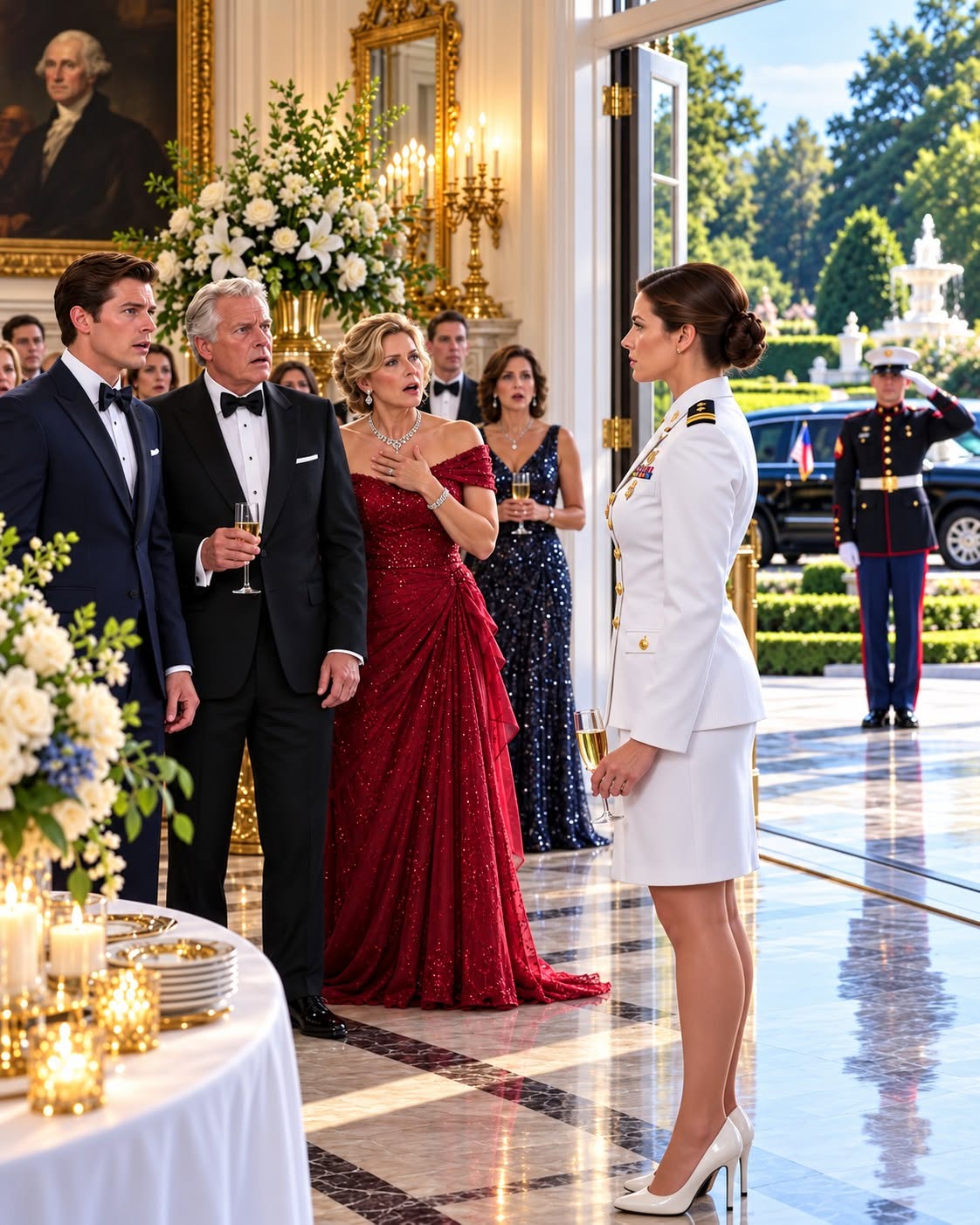
The private board suite of the Oakridge Country Club was lined with oil paintings of former club presidents, green leather armchairs, and the heavy, suffocating scent of cigar tobacco and panic.
Two armed naval police officers stood outside the closed double doors, their presence transforming the exclusive sanctuary into a temporary federal command node. Inside, the only light came from the blue glow of my encrypted Panasonic Toughbook, connected via a secure military satellite downlink to the Chief of Naval Operations bunker at the Pentagon.
On the screen, the three-star insignia of Vice Admiral Thomas Sterling flickered against a background of digital tactical displays.
“Amelia,” Sterling said, his voice crackling with high-frequency encryption grain. “The *Enterprise* has stabilized her auxiliary steam, but the reactor core cannot be brought to critical mass until those valves are replaced or reinforced. If those housings fracture under pressure, we’re looking at an uncontained radiation release forty miles off the Virginia coast. The President has given NAVSEA six hours to determine whether this was a catastrophic metallurgical anomaly or criminal procurement fraud.”
“I’m looking at the procurement ledger now, Admiral,” I said, scrolling through the high-density scans of the defense contract Vance’s team had pulled from the regional naval audit server.
“Your signature is on the sub-tier technical certification, Amelia,” Sterling noted, his gray eyes searching mine through the camera. “It cleared the naval sea systems command desk because your Department of Defense identification number was entered as the majority technical partner. Did you review those castings?”
“I have never seen these schematics in my life, Admiral,” I replied, my voice steady, though a cold, sharp rage was hammering against the inside of my ribs. “I was deployed with the Seventh Fleet in Yokosuka when these purchase orders were stamped. My power of attorney for domestic real estate was held by my father’s firm to manage my grandfather’s coastal property trust.”
Sterling’s jaw tightened into iron. “NCIS is already moving on the fabrication facility in Newport News. Get the civilian principals into that room and find out what metal they put in those pipes before I have the Provost Marshal kick down the front doors.”
“Understood, sir. Hayes out.”
I closed the connection with a keystroke, closed the laptop, and turned toward the corner of the room.
My father was pacing the length of the Persian rug, his hands trembling violently as he tugged at his silk tie. Grant sat slumped in a high-backed leather wing chair, his elbows on his knees, his face buried in his palms. He was shaking so hard his shoes rattled against the hardwood floor.
“Amelia,” Dad began, his voice pitching high, cracking into that familiar, defensive roar he had used whenever I questioned his ledger entries as a teenager. “This is a bureaucratic misunderstanding! You know how defense contracting works—there are hundreds of pages of technical specifications, duplicate forms, subcontractor certifications! Grant handled the logistics for the machine shop! A company like ours doesn't monitor every single titanium ingot coming off the commercial rail cars!”
I didn't raise my voice. I didn't step toward him. I remained seated behind the mahogany desk, my hands flat against the polished surface.
“The specifications for those valves called for forged Inconel-625, Dad,” I said, every word hitting the room like an artillery shell. “A high-nickel, corrosion-resistant superalloy capable of withstanding six hundred degrees of superheated radioactive water at two thousand pounds per square inch. The supplier manifest from Hayes & Sons shows you billed the United States Navy for forty-eight tons of certified military-grade Inconel at four hundred and twenty dollars a pound.”
I turned the Toughbook around, displaying the freight delivery manifests seized from their Norfolk rail siding twelve hours ago.
“What arrived at your machining facility in February was standard commercial-grade 316 stainless steel,” I continued, watching the blood completely drain from Grant’s neck. “Purchased from an uncertified scrap reclamation broker in Baltimore for fourteen dollars a pound. You pocketed seven point two million dollars in profit on an emergency defense modernization contract, and you installed kitchen-sink metal inside the primary cooling loop of a nuclear aircraft carrier.”
“It wasn't supposed to fail!” Grant suddenly wailed, his head snapping up, his eyes bloodshot and wide with absolute terror. “The engineering consultants told us the safety margins were over-engineered by four hundred percent! They said the carrier would run its trials at half-power and the valves would hold until the scheduled drydock availability in 2028! We were going to replace them during the planned maintenance cycle!”
“Grant, shut your mouth!” Dad bellowed, lunging toward his son with his hand raised, looking for a second like he was going to strike his thirty-five-year-old heir across the face.
“Don't touch him, Leonard,” I commanded.
The sound of his first name from my lips froze my father mid-stride. He stopped, his chest heaving, his fingers clawing at the empty air between us. In thirty-nine years, I had never called him anything other than *Dad*. The word hung between us like a severing cable, cutting away the last thread of filial deference.
“You let him do this?” I looked at my father, feeling an ache in my chest that had nothing to do with the military and everything to do with the little girl who used to wait on the dock for his truck to pull in. “You let him cut corners on a fleet contract?”
“We were going under, Amelia!” Dad hissed, dropping his hands, stepping toward the desk with an ugly, desperate sneer curling his mouth. “The commercial shipbuilding market collapsed after the bridge collapse in Baltimore! Our bank credit lines were frozen! We had eighty employees at the yard who were two weeks away from missing payroll! The five-hundredth-anniversary gala today? The roasted salmon, the champagne, the city councilmen? It was all borrowed money, Amelia! The company was forty-eight hours from bankruptcy!”
He leaned across the desk, slamming his palm down on the wood.
“You’re an Admiral!” he whispered, his eyes wild, frantic, begging. “You’re at the Pentagon! You sit in rooms with the Joint Chiefs! All you have to do is pick up that secure phone, call the naval sea systems desk, and classify this as an unanticipated material stress failure! Tell them it was a defective batch from the mill! The Navy will write it off under the defense contingency warranty! You can save your family, Amelia! You can save Hayes & Sons!”
I looked down at his hand on the desk—the hand that had rested on Grant’s shoulder twenty minutes ago while he laughed about the military chewing me up and spitting me out.
“You didn't just borrow money to save the company, Dad,” I said quietly.
I pulled a second document from Vance’s folder—a notarized corporate registry filing from the Commonwealth of Virginia, dated fourteen months ago.
“To qualify for that sole-source emergency defense contract, the bidding firm had to be at least fifty-one percent owned by a service-disabled combat veteran,” I told him, sliding the document until it touched his fingers. “You didn't have that certification. Grant certainly didn't. So you went into the family estate vault, took the military power of attorney I gave you when I was commanding a destroyer in the Red Sea, forged my name on a corporate restructuring agreement, and listed Rear Admiral Amelia Hayes as the majority owner and executive chairwoman of Hayes & Sons.”
Dad flinched as if I had thrown boiling water in his face.
“If the *Enterprise* suffers a reactor breach, Dad,” I whispered, “the criminal indictments for negligent homicide and defense procurement fraud won't name you. They will name me.”
Related Stories