Chapter 1: The Rotor Wash
The heavy plate-glass doors behind us did not merely tremble; they shuddered in their steel frames, vibrating with a deep, bone-rattling thrum that traveled up through the soles of my shoes.
Across the terrace, conversations died mid-syllable. Half-raised glasses of pinot grigio hovered in the afternoon glare. Aunt Ruth’s pearls slipped from her fingers, and my father’s arm—still draped heavy and patronizing across my shoulders—tightened instinctively, not to protect me, but to steady himself against the sudden, violent displacement of air.
Over the manicured treeline of the Oakridge Country Club, a twin-turbine Sikorsky UH-60 Black Hawk banked hard against the blue Virginia sky, its olive-drab fuselage cutting through the summer heat like a sharpened wedge.
The downdraft hit the lawn five seconds later.
A hurricane of manicured turf, dry oak leaves, and white linen napkins erupted across the fairway. The celebratory banner—*Half a Century of Hayes & Sons*—snapped violently on its grommets, torn in half between the name *Hayes* and the word *Sons*, the shredded canvas whipping wildly against the brick facade. Crystal centerpieces toppled onto the patio tables with sharp, musical crashes. Guests shrieked, clutching their hats, stumbling backward through the French doors into the banquet room as the aircraft touched down with absolute, mechanical precision sixty yards away on the eighteenth green.
The rotor wash died to a low, whining whistle, leaving an unnatural, ringing silence in its wake.
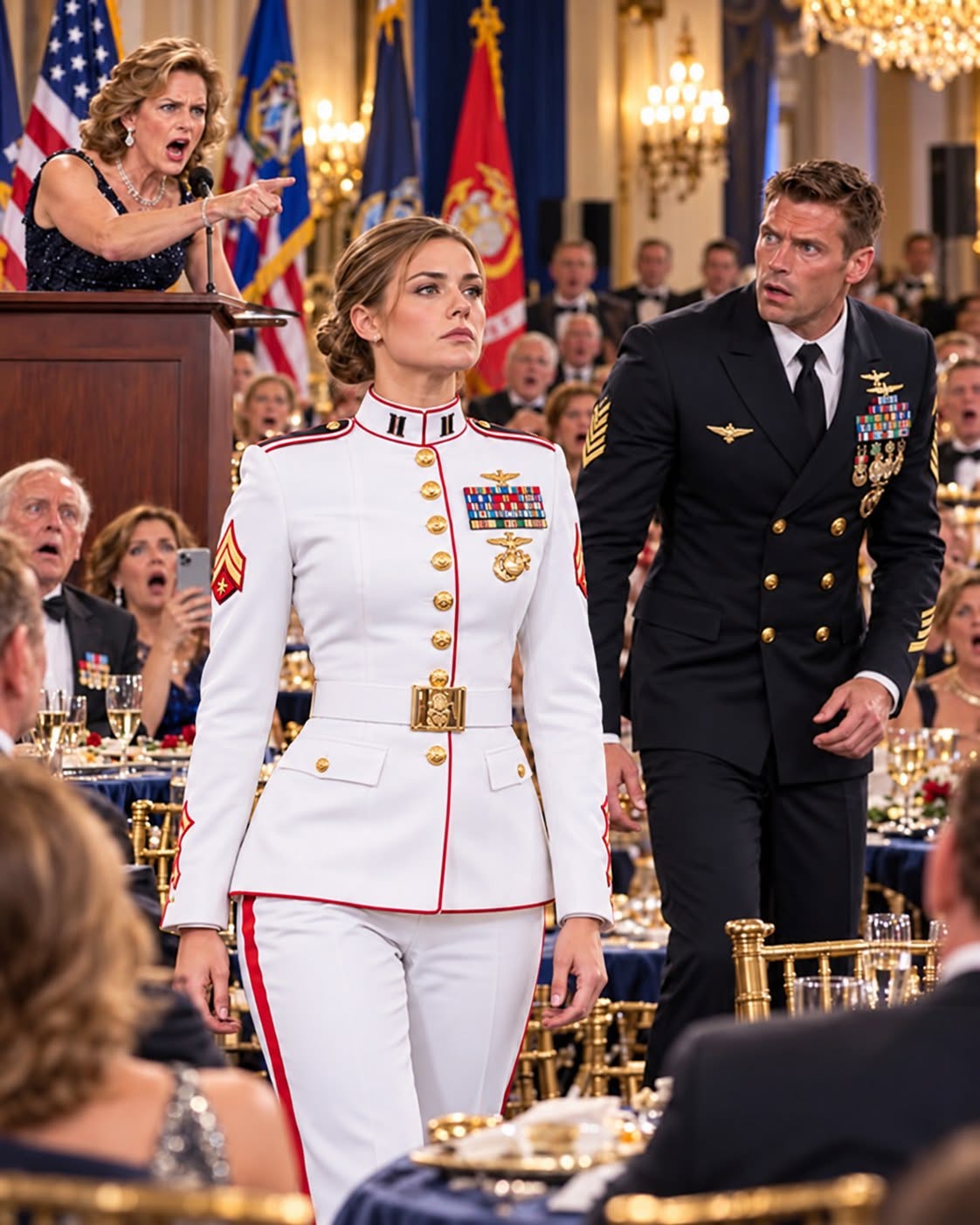
The port cabin door slid open with a metallic clatter. A Marine Corps officer in dress blues—carrying himself with the unyielding, iron-rod posture of a man who spent his life on parade decks and combat outposts—stepped out onto the turf. Behind him, two naval security personnel in crisp khaki service uniforms moved with practiced, synchronized economy, securing the perimeter of the lawn.
My father let go of my shoulder. His mouth fell open, his face slackening into an expression of indignant confusion. “What the hell is this?” he sputtered, his voice cracking as he looked around at the ruined tables, the scattered roasted salmon, the terrified partners from his accounting firm. “Who authorized an aircraft on private club property? Grant, go get the manager. This is an outrage. I’m hosting the mayor at four o’clock!”
Grant didn't move. He stood frozen beside the ice sculpture of a cargo freighter, his hands clenched into fists inside the pockets of his tailored navy suit, his gaze fixed on the gold eagle, globe, and anchor pinned to the Marine’s collar.
The Marine officer did not look at the clubhouse manager running frantically across the grass with a walkie-talkie. He did not look at my father, who was already puffing out his chest, preparing to deliver the same bellowing lecture he used on recalcitrant shipyard dockhands.
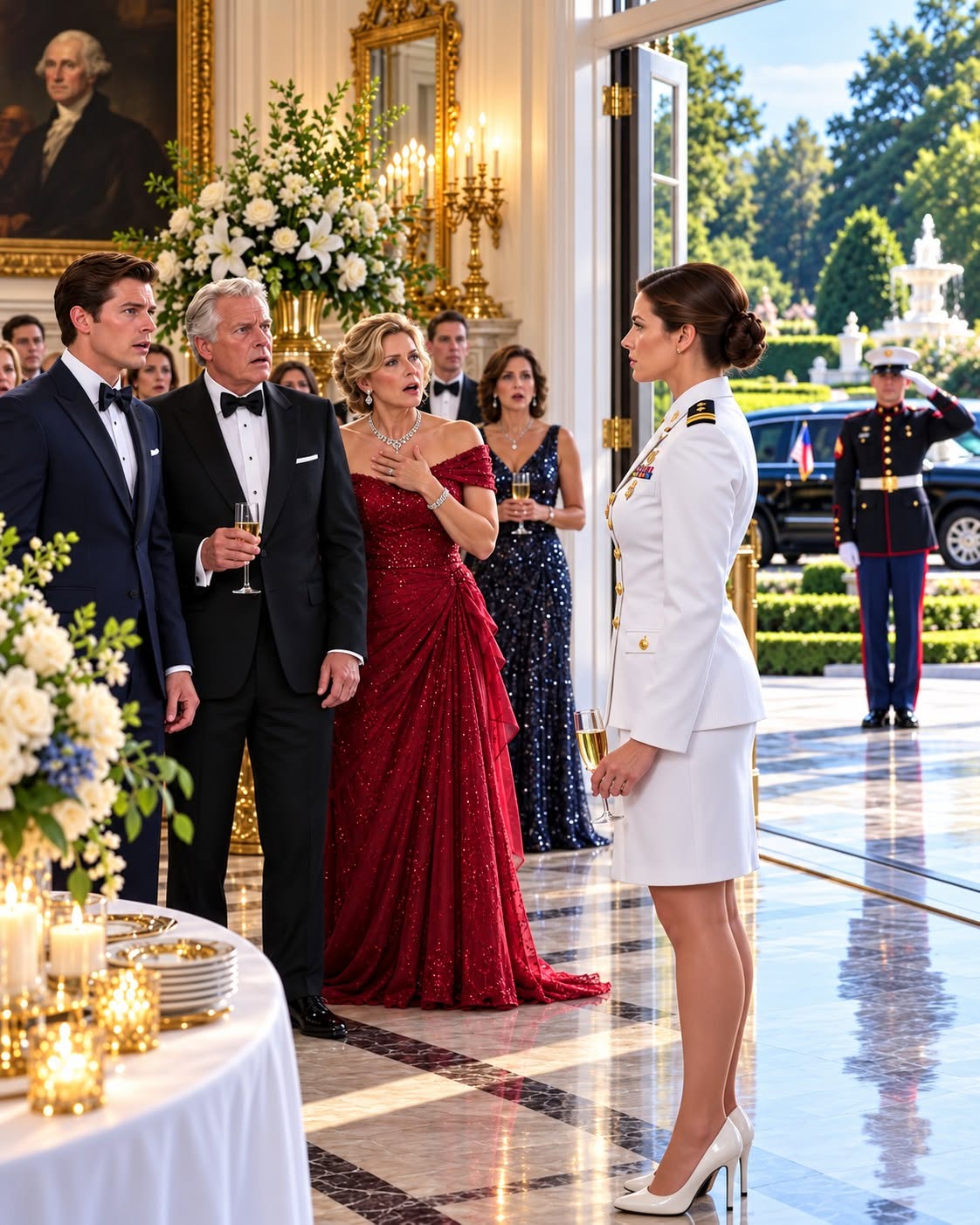
The officer marched straight up the stone stairs of the terrace, his polished leather shoes striking the flagstones with rhythmic, concussive thuds. He stopped three paces from where I stood, brought his heels together with a sharp, audible click, and snapped his right hand to the white brim of his barracks cover.
“Admiral Hayes,” Lieutenant Colonel Marcus Vance said, his voice cutting through the patio like a brass blade. “The Commander-in-Chief requests your presence on the secure trunk immediately. Transport is on standby. We are wheels-up in three minutes, ma’am.”
A collective, suffocating gasp swept across the terrace.
My mother dropped her champagne glass. It shattered on the flagstones between her designer pumps, the pale liquid pooling in the grout lines.
Leonard Hayes turned his head slowly, the vertebrae in his neck clicking with agonizing stiffness. He looked at the Marine officer’s white-gloved salute. He looked at the two armed naval sailors standing at parade rest on his private lawn. Then he looked at me—at the thirty-nine-year-old daughter he had just spent fifteen minutes dismissing as an unmarried girl playing with toy boats.
The color did not simply drain from his face; it was ripped away, leaving his skin the shade of wet flour.
“Admiral?” Leonard whispered, the word tasting like lead in his mouth. “Amelia... what is he talking about? You’re... you’re an engineer. You work at the shipyard in Norfolk.”
I didn't answer him immediately. I set my untouched glass of white wine on the edge of a wrought-iron patio table, pulled a small silver hair clip from my evening clutch, and secured my dark hair into a neat, regulatory roll at the nape of my neck.
“Lieutenant Colonel Vance,” I said, returning his salute with crisp, unhurried authority. “What is the operational classification?”
“Flash-priority, Admiral,” Vance replied, stepping aside to reveal an encrypted satellite communication terminal resting in a hardened steel briefcase carried by the trailing petty officer. “Carrier Strike Group Eight has suffered an uncontained structural failure during sea trials off Cape Hatteras. The primary reactor coolant circulation valves fabricated and installed during the recent overhaul cycle have cracked under thermal stress. The *USS Enterprise* is dead in the water, thirty miles off the shelf.”
My brother Grant let out a strangled, breathless sound from the doorway. His hands slipped completely out of his pockets, his knuckles brushing against the doorframe as his knees buckled slightly.
My eyes shifted from Vance to my brother.
The *Enterprise* overhaul. The emergency defense subcontracts awarded six months ago under an expedited naval infrastructure initiative.
“Colonel Vance,” I said, my voice dropping into that quiet, terrifying calm that had guided cruisers through typhoons and combat zones. “Who was the prime civilian vendor certified for the precision machining of those coolant valve assemblies?”
Lieutenant Colonel Vance opened the leather folder in his left arm, his expression as cold and unforgiving as deep water.
“Hayes & Sons Maritime Fabrication, Admiral,” Vance stated clearly, his voice carrying directly into the banquet hall where forty of my father’s business associates stood in paralyzed shock. “Signed off by the chief executive officer, Leonard Hayes. And guaranteed under a Department of Defense small-business priority waiver executed under your personal social security number.”
Related Stories