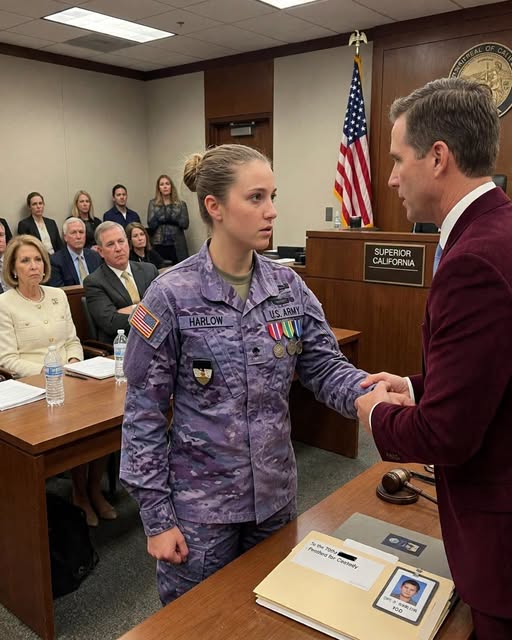
Chapter 5: The Colors on the Field
The morning mist was lifting off the sprawling parade grounds of Fort Stewart, revealing three thousand soldiers formed into ten company-sized blocks of dark green and black.
The brigade flag—a heavy silk banner bearing the red, white, and blue colors of the 48th Infantry—fluttered gently in the cool coastal breeze coming off the Atlantic.
In the VIP review stand overlooking the field, two hundred spectators sat in folding chairs: civilian dignitaries, family members, local mayors, and a row of senior officers in dress greens.
I stood on the edge of the crushed-stone track, adjusting the brim of my service cap.
The gold oak leaves were gone from my shoulders.
In their place, pinned to my epaulets by General Vance twenty minutes earlier in the brigade headquarters, were two polished silver eagles.
Colonel Maya Bennett.
Behind me, the low rumble of a staff car door closing broke the quiet.
""Colonel Bennett.""
I turned.
Standing at the base of the review stand steps was Lance Corporal Evan Carter.
He was dressed in his Marine Corps service bravos—the olive-drab trousers, the khaki long-sleeve shirt, the razor creases that looked like they had been ironed with a ruler. He had no friends beside him. He carried no swagger. He stood at rigid, textbook attention on the gravel, his thumbs pressed into his seams, his chin level, his eyes wide and clear.
Beside him, standing half a step back in a dark civilian overcoat, was his father.
Donald Carter looked smaller in the open morning light, stripped of the mahogany tables and executive gavels of the state capitol. He didn't speak. He kept his hands buried deep in his coat pockets, looking down at the crushed stone between his shoes with an expression of profound, quiet exhaustion.
I stepped down from the grass onto the gravel path, stopping two paces in front of the young Marine.
""Lance Corporal Carter,"" I said, my voice carrying the crisp, natural authority of the field.
Carter brought his right hand up to the brim of his cover in a salute that was so sharp, so violently precise, his fingertips seemed to vibrate against his brow.
""Ma'am,"" Carter barked, his voice cracking slightly before steadying into pure military discipline. ""Lance Corporal Carter reports as ordered, ma'am.""
""At ease, Marine,"" I replied, returning the salute with a single, clean motion.
He dropped his hand, but his shoulders remained locked. He looked directly into my eyes, hot shame still burning in the corners of his cheekbones, but underneath the embarrassment was something new. Something raw and real.
""My company commander told me to report to your staff aide before the ceremony, ma'am,"" Carter said quietly. ""To... to deliver an apology in person.""
""You don't need to apologize to me, Evan,"" I said.
He blinked, thrown off by the lack of formality in my tone. ""Ma'am?""
""You made a fool of yourself in front of fifty people who didn't matter,"" I told him, looking him up and down. ""The only person you owe an apology to is the Marine Corps for wearing that uniform while acting like a high school bully.""
Carter swallowed hard, his throat moving against his stiff khaki collar. ""Yes, ma'am.""
""Your father taught you one way to look at service, Evan,"" I said, gesturing toward the field where three thousand soldiers were standing at parade rest beneath their guidons. ""Take a look at that formation.""
Carter turned his head slightly, looking out across the sea of men and women.
""In that brigade, I have twenty-year-old mechanics from rural Alabama who can rebuild a diesel turbine in the dark,"" I told him. ""I have first lieutenants from Queens who speak four languages, and I have platoon sergeants from Chicago who have survived three sniper bullets and still run five miles before sunrise.""
I stepped closer, lowering my voice so it carried only to him and the older man standing behind his shoulder.
""None of them look alike, Evan. None of them grew up in the same house, prayed in the same church, or had a father who could pick up a phone and call a general.""
I looked directly into his eyes.
""The enemy doesn't care what an officer looks like when the mortars start coming over the wire. The only thing that matters is whether that officer has the courage to stand between their soldiers and the fire.""
Carter’s eyes welled with tears, but he didn't look away. He stood tall, his jaw setting into a line that finally looked like an adult's.
""I understand, ma'am,"" he whispered. ""Thank you, Colonel.""
""Go back to your unit, Lance Corporal,"" I said, offering a single, firm nod. ""Keep your mouth shut, do your job, and earn your stripes.""
""Yes, ma'am!"" he snapped, bringing his hand up in one last, immaculate salute.
He turned on his heel, marching down the gravel path toward the parking area with the long, swinging stride of a Marine who had just been given his life back.
Donald Carter remained standing on the gravel.
The older man looked up, his face lined with thirty years of retired pride and twenty-four hours of utter ruin. He opened his mouth to say something—an excuse, an apology, a defense of the twenty years he had spent nursing an administrative grudge—but the words died on his tongue.
""Colonel Carter,"" I said quietly, acknowledging him with a polite dip of my chin.
""Colonel Bennett,"" he answered, his voice barely a rasp against the wind.
He didn't offer a hand. He didn't try to smile. He slowly raised his right hand to his temple, rendering a long, solemn salute that held the weight of a complete, unconditional surrender.
I returned it without hesitation, turned my back on the gravel path, and walked toward the center of the field.
The drums began to roll from the division band, a low, concussive thunder that shook the morning grass.
General Vance stood waiting at the center of the reviewing line, holding the wooden staff of the brigade colors in his gloved hands. Beside him stood the division commander, flanked by two armed color guards holding the national ensign high against the coastal sky.
""Sound attention!"" the command sergeant major roared across the field.
Three thousand rifles snapped to the vertical in a single, synchronized crack that echoed off the pine trees like a thunderclap.
I walked to the brass marker in the center of the grass, stopping three paces from the four-star general.
Vance looked down at me, his gray eyes shining with an ancient, fierce pride that had nothing to do with politics, committees, or the small men who fought for seats behind mahogany desks.
""Colonel Bennett,"" Vance said, his voice carrying clearly over the rolling drums. ""Take the colors.""
I reached out, wrapping my gloved hands around the polished ash staff, feeling the heavy silk of the 48th Infantry settle into my grip like an anchor.
The wind caught the banner, unfurling the eagle and the stars against the open sky.
I turned to face the three thousand soldiers standing before me, drawing the cold Atlantic air deep into my lungs, and raised the colors high into the morning sun.
Behind the VIP review stand, parked near the perimeter fence, an unmarked black sedan with tinted windows sat idling.
Inside the rear passenger seat, a woman in an expensive gray business suit lowered her window two inches, holding a long-lens digital camera against the glass.
She watched the four-star general pass the brigade colors to my hands, snapped four rapid, high-resolution photographs of my face, and lowered the camera to her lap.
She picked up a secure satellite phone, dialing an unlisted ten-digit number.
""It’s done,"" the woman said into the receiver, her voice flat and devoid of emotion. ""The committee confirmed her, and Vance handed her the brigade.""
A brief pause stretched across the encrypted line.
""She doesn't know about the cargo manifest from Al-Qaim,"" the woman continued, looking through the tinted glass as the soldiers presented arms. ""She thinks Donald Carter was the only one looking for that vehicle.""
Related Stories