Chapter 3: The Boardroom in Atlanta
The Georgia State Capitol building sat washed in the cold, gray drizzle of a Thursday morning.
Inside the third-floor legislative annex, the mahogany-paneled committee room smelled of old paper, floor wax, and damp wool coats. Through the tall arched windows, the distant traffic on Martin Luther King Jr. Drive hissed against the wet asphalt.
Around the horseshoe-shaped conference table sat seven men and two women—retired flag officers, former state legislators, and civilian defense contractors who formed the governor’s oversight panel on military appointments.
At the center of the horseshoe sat Donald Carter.
At sixty-six, the retired colonel still carried himself with the heavy, unbending posture of a man who had spent thirty years being saluted. His silver hair was cut to the skin on the sides, his dark tailored suit bore a miniature Legion of Merit lapel pin, and his rimless glasses caught the overhead chandelier light like polished mirrors.
When the heavy oak doors at the back of the chamber opened, every head at the table turned.
I walked down the center aisle alone.
My Army service uniform was immaculate. The ribbons on my chest—combat action badge, bronze star with valor, purple heart, defense meritorious service medal—lay flat and straight against the dark wool fabric. The gold oak leaves on my shoulders caught the room’s pale light.
I stopped at the small wooden podium placed in the center of the carpet, snapped to attention, and rendered a crisp, sharp salute to the committee.
""Lieutenant Colonel Maya Bennett reporting as directed,"" I stated, my voice smooth, resonant, and completely devoid of tension.
Several committee members nodded politely.
Donald Carter did not move. He kept his hands clasped over a thick, blue-tabbed dossier on the blotter in front of him, his mouth set in a thin, dismissive line.
""At ease, Colonel Bennett,"" said Senator Evelyn Harris, the committee’s civilian chairwoman. ""Please have a seat.""
I took the wooden armchair behind the podium, resting my hands flat against my knees. I carried no briefcase. I had brought no legal counsel, no public affairs officer, and no administrative aide.
""Colonel Bennett,"" Harris began, her tone professional and pleasant. ""We are here to conclude the review process for your nomination to assume command of the 48th Infantry Brigade Combat Team. Your record across twenty-four years of service is, by any standard, extraordinary.""
""Thank you, Senator,"" I replied.
""However,"" Harris continued, glancing slightly to her left, ""a member of our executive panel has raised questions regarding operational documentation from your 2019 deployment with the Joint Special Operations Task Force. Colonel Carter, the floor is yours.""
Donald Carter leaned forward, resting his forearms against the mahogany table.
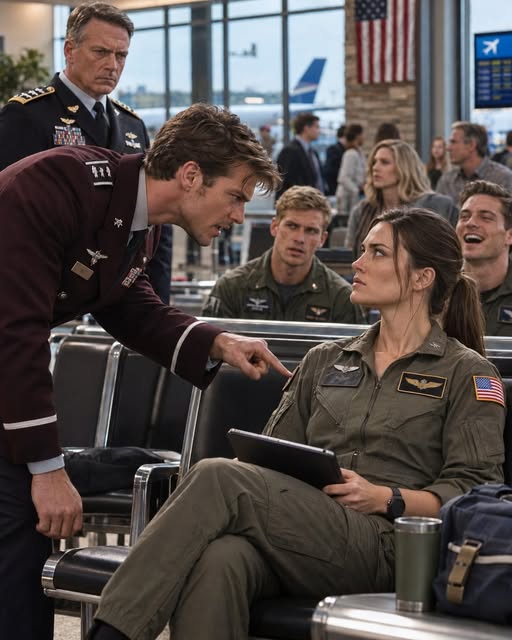
Up close, the resemblance between the retired colonel and the young Marine at Gate C27 was unmistakable—the same high, arrogant brow, the same square jawline, the same unshakeable belief that the room belonged to him by divine right.
""Colonel Bennett,"" Carter said, his voice deep, gravelly, and laced with that smooth, performative condescension I had listened to a decade ago at Fort Stewart. ""Let me be clear. No one in this room questions your courage. But commanding a brigade of four thousand soldiers requires more than bravery. It requires absolute operational predictability.""
He opened his dossier, tapping a sheet of paper with his gold pen.
""During the October twenty-nineteen rotation in the Euphrates Valley,"" Carter said, looking around the table to ensure he had his audience, ""you unilaterally altered the ingress route for a twelve-vehicle resupply convoy, ignoring the primary transit corridor approved by the battalion operations officer.""
He looked directly into my eyes.
""That deviation resulted in an improvised explosive device detonation beneath an RG-33 tactical vehicle. Two enlisted personnel suffered moderate blast trauma. The vehicle was a total loss.""
He paused, letting the silence settle over the room like cold water.
""In your formal response to the preliminary inquiry, you claimed you deviated because you suspected an ambush on the primary route,"" Carter continued, a faint, skeptical smile touching the corners of his lips. ""Yet the operational logs indicate there was zero satellite or signals intelligence confirming an enemy presence on the main corridor at the time of your decision.""
He closed the dossier with a soft, final thud.
""My question to you, Colonel Bennett, is simple: did you make that tactical change based on verifiable intelligence, or did you panic under operational stress and take a motorized column into an unvetted minefield?""
Two junior panel members shifted uncomfortably in their seats. Senator Harris frowned, looking at Carter with a flicker of sharp disapproval at the bluntness of the accusation.
I didn't blink. I didn't reach for a glass of water.
I drew on the muscle memory of twenty-four years in uniform, feeling the cold, steady calm that always took over my pulse when the mortars started landing.
""Colonel Carter,"" I said, keeping my tone respectful, even, and crystal clear. ""The intelligence that drove my decision was not satellite data. It was human observation.""
Carter raised an eyebrow. ""Human observation?""
""At zero-six-hundred on the morning of October twelfth,"" I explained, looking past him to the other members of the panel, ""the local produce market in the village of Al-Qaim failed to open. The street vendors who had operated on the corner of Route Bronze every day for six months were absent. Children were kept indoors.""
I locked eyes with Donald Carter.
""Any officer who has spent more than forty-eight hours outside an air-conditioned tactical operations center knows that an empty market in the Euphrates Valley means an imminent complex ambush,"" I stated, each syllable falling like a hammer strike. ""I diverted the column to the secondary river trail precisely because I refused to drive seventy young soldiers into an obvious kill box.""
Carter’s face tightened. A dull, dark red began creeping up from his starched white collar.
""And the IED, Colonel?"" Carter pushed back, his voice rising slightly. ""You still drove your column over an explosive device.""
""The device was an antipersonnel pressure plate that damaged the front axle of a single vehicle,"" I replied without missing a beat. ""The crew compartment was intact. The two injured soldiers returned to full duty forty-eight hours later. And thirty-five minutes after we diverted, a secondary reconnaissance team from the Third Cavalry Regiment confirmed that Route Bronze had been seeded with four command-wire directional charges and occupied by an eight-man machine-gun element.""
I leaned forward half an inch, my voice quiet, absolute, and unshakeable.
""I didn't panic, Colonel Carter. I saved seventy lives. And the after-action review signed by Major General Vance concluded that the decision demonstrated superior combat leadership under operational ambiguity.""
A dead silence descended upon the chamber.
Senator Harris picked up her pen, looking down at her notes with a quiet, decisive nod. The retired two-star sitting at the far end of the horseshoe glanced at Carter, clearing his throat with a dry, disapproving cough.
Carter’s jaw worked soundlessly for three seconds. His hands gripped the edges of his blotter, the gold pen rolling into the groove of the wood.
""That review was conducted internally,"" Carter muttered, his voice losing its polished composure, a crack of raw, personal resentment bleeding through. ""Internal reviews protect their own.""
Before Senator Harris could intervene, the heavy brass latch of the chamber’s side door clicked open.
A uniformed staff sergeant stepped inside, holding a crisp, red-stamped administrative courier envelope.
The sergeant walked directly to Donald Carter’s seat, leaned over, and placed the envelope flat on his blotter.
""From the base provost marshal’s office at Fort McPherson, sir,"" the sergeant whispered, audible to the entire front row. ""Urgent delivery regarding Lance Corporal Evan Carter.""
---
Related Stories