Chapter 4: The Grip on the Table
Donald Carter didn't open the envelope immediately.
His fingers hovered over the red wax seal as if it were coated in lye. His eyes flicked from the bold, black lettering—*UNITED STATES MARINE CORPS // PROVOST MARSHAL INCIDENT LOG*—up to my face, searching for a smug grin, a flicker of triumph, or some trace of the ambush he had clearly assumed I had prepared for him.
He found nothing.
I sat with my hands folded in my lap, my chin level, watching him with the detached, clinical neutrality of a surgeon examining an x-ray.
Senator Harris glanced at the interruption, her brows drawing together in mild irritation. ""Colonel Carter, do you require a brief recess to attend to private business?""
""No,"" Carter said quickly, his voice tight, his throat clicking as he swallowed. ""No recess necessary, Madam Chair. Just an administrative matter.""
With stiff, jerky motions, he slid his thumb beneath the envelope flap and pulled out the single sheet of yellow carbon-copy paper inside.
I knew what was on that paper.
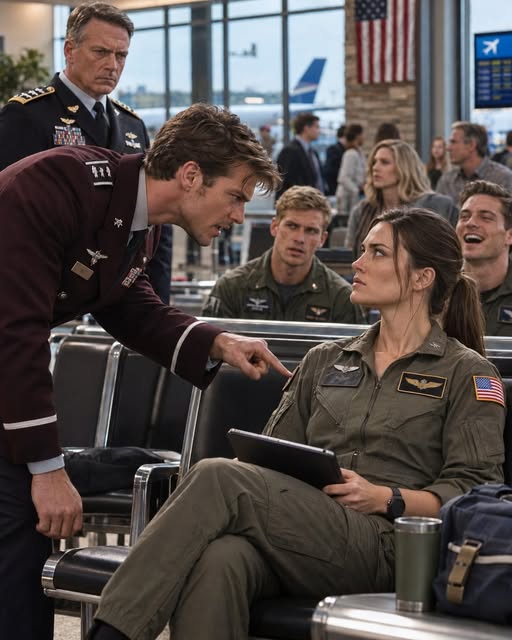
Incident report number 24-889. Location: Gate C27, Chicago O'Hare International Airport. Subject: Lance Corporal Evan Carter. Offense: Violation of Article 91 (Insubordinate conduct toward a warrant officer, noncommissioned officer, or petty officer) and Article 134 (General article — touching and mocking uniform insignia of a field grade officer in a public transit facility).
Witnesses: General Marcus Vance, Vice Chief of Staff of the Army; Lance Corporal Mason Reid, USMC; civilian bystanders.
As Carter’s eyes moved down the typed lines, every drop of color drained from his face.
The ruddy, authoritarian flush that had defined his posture for forty years disappeared, leaving his skin the sallow, grayish hue of dry mortar. The hand holding the paper began to tremble—a fine, violent vibration that rattled the carbon sheet against the polished mahogany table.
He reached the bottom of the page.
There, scrawled in the sharp, diagonal script of the station commander, was the disposition note:
*HOLD PENDING FORMAL CHARGES UPON DIRECTION OF REPORTING VICTIM.*
The paper was signed by General Marcus Vance.
And pinned to the top margin with a rusted brass paperclip was Evan’s military ID card.
Carter stared at the small plastic card, at his son’s smiling, cocky twenty-two-year-old face, as if looking at an unexploded ordnance on his own living room rug.
He understood the mathematics instantly.
If those charges were processed, his son’s enlistment was finished. A court-martial conviction for putting his hands on an Army lieutenant colonel while a four-star general stood two feet away meant a reduction to private, forfeiture of pay, and a bad-conduct discharge that would follow the boy for the rest of his life.
Worse for Donald Carter: the story would leak.
The local news outlets that covered his committee would have a field day. *Son of Military Oversight Chair Court-Martialed for Harassing Female Brigade Commander at Airport.*
His credibility would evaporate before the five o'clock news. His influence with the governor would be incinerated. The network he had spent twenty years building from country club patios and legislative dinners would collapse overnight.
And the only person who held the pen that could initiate or extinguish that fire was the woman sitting ten feet across the carpet, wearing the uniform he had just tried to strip from her.
Carter slowly lowered the paper to his blotter.
He took off his rimless glasses, his fingers clumsy, and rubbed the bridge of his nose with his thumb and forefinger. When he looked up, the arrogant, combative glare was entirely gone, replaced by a dull, hollow shock that aged him by fifteen years.
Senator Harris cleared her throat, tapping her gavel once against the leather strike pad.
""If there are no further questions regarding Colonel Bennett's operational record in the Middle East,"" Harris announced, looking around the horseshoe, ""we will proceed to the executive committee’s vote on the command nomination.""
""Wait,"" Carter croaked.
His voice was so raw, so cracked, that two committee members turned to look at him in genuine concern.
""Colonel Carter?"" Harris asked, her tone sharpening. ""Do you have another point to raise?""
Carter looked at the yellow carbon paper.
He looked at his son's ID card.
Then he looked at me.
For five long seconds, the room hung in absolute stillness. The rain drummed against the tall glass panes behind us, steady and relentless.
I could see the battle raging behind his eyes—the decades of pride, the deeply ingrained contempt for women who had climbed past his arbitrary boundaries, the bitter taste of an old slight at Fort Stewart that he had nursed like an open wound.
And against all of that: the future of his only son.
""Colonel Carter?"" Harris repeated, her patience wearing thin. ""We are waiting.""
Carter’s knuckles whitened as he pressed both palms flat against the mahogany table, leaning his weight forward as if his knees might not hold him if he tried to stand.
""I have... no further questions, Madam Chair,"" Carter said, the words dragging out of his throat like rusted chain over stone.
Harris blinked, surprised by the abrupt surrender. ""None?""
Carter swallowed hard, his eyes dropping to his blotter, unable to look across the room.
""Upon further review of the supplementary annexes,"" Carter muttered, his face gray and lifeless, ""it is clear that Lieutenant Colonel Bennett’s actions in the Euphrates Valley were within operational parameters. In fact... they demonstrated exemplary command judgment under direct fire.""
A collective, quiet sigh of relief moved through the chamber.
Senator Harris didn't waste a second. She raised her gavel.
""Hearing no further objections, the committee moves to confirm the nomination of Lieutenant Colonel Maya Bennett to command the 48th Infantry Brigade Combat Team.""
She looked around the table. ""All in favor?""
Eight hands went up immediately.
Harris looked at Carter.
Slowly, agonizingly, as if lifting a hundred-pound lead weight, Donald Carter raised his right hand into the air.
*Gavel.*
""The nomination is confirmed unanimously,"" Harris announced. ""Congratulations, Colonel Bennett. You assume command at zero-eight-hundred tomorrow.""
I stood up, snapped my heels together, and executed a sharp, perfect salute to the committee.
""Thank you, Madam Chair. Gentlemen.""
I turned on my heel and walked down the center aisle, my boots clicking with rhythmic, measured certainty against the carpet.
As my hand touched the brass handle of the heavy exit door, I heard hurried, uneven footsteps behind me.
""Colonel Bennett.""
I stopped in the marble corridor outside the chamber, turning around slowly.
Donald Carter stood on the threshold, clutching the red-tabbed envelope in his right hand, his tie slightly crooked, his breath coming in shallow, ragged bursts.
""Colonel,"" I said, my voice cool and neutral.
Carter looked around the empty hallway, ensuring that none of his colleagues were watching from the double doors. He took two steps closer, stopping three paces from me, his shoulders hunched as if the ceiling of the capitol were pressing down on his neck.
""You had Vance send this,"" Carter whispered, holding up the yellow carbon slip. His voice shook with a mixture of terror and bitter humiliation. ""You knew he was my son the whole time.""
I looked at the older man, feeling neither anger nor pity, only the cold, unshakeable clarity that had kept me alive in three combat tours.
""I knew who he was the moment General Vance took his CAC card in Chicago, Colonel Carter,"" I said quietly.
Carter’s eyes widened, a flicker of frantic, desperate calculation returning to his gaze. ""Then what are your terms? You want my formal resignation from the oversight committee? You want me to withdraw my endorsement of Hayes for the regional staff slot? Name it. Just... don't send the boy to a court-martial.""
I reached into my pocket, pulled out a small, plain silver pen, and took two steps forward until I was standing inches from him.
""I don't make backroom trades with civilian committees, Colonel,"" I told him, each word low, distinct, and lethal in its simplicity. ""And I don't destroy a twenty-two-year-old Marine’s life to win a political argument with his father.""
I took the red-tabbed envelope from his trembling hand, unscrewed the cap of my pen, and drew a thick, diagonal black line across the signature block of the incident report.
Across the bottom margin, in clear, bold block letters, I wrote:
*DISMISSED WITH COUNSELING AT UNIT LEVEL. NO FURTHER ACTION.*
I handed the paper back to him.
Carter stared at the ink, completely paralyzed, his mouth parting slightly in sheer, uncomprehending shock.
""Why?"" he croaked. ""After what he said to you? After what I tried to do to your career in that room?""
""Because your son was right about one thing, Colonel,"" I said, looking him dead in his bloodshot eyes.
""What?""
""Real officers don't look like him,"" I said softly. ""They don't hide behind their fathers' political connections. And they don't tear down other soldiers to feel tall.""
I turned my back on Donald Carter and walked down the grand marble staircase into the morning light.
---
Related Stories