Chapter 10: The Ground Beneath Our Feet
The wind blowing off the Blue Ridge mountains was fifty-two degrees, crisp and smelling of sweet damp earth, woodsmoke, and the clean, sharp scent of fallen oak leaves.
It was Wednesday afternoon—forty-eight hours after Courtroom Three had collapsed into federal indictments.
I stood on the stone retaining wall behind the Mercer farmhouse, looking out over the rolling green pastures of Route 9. Down near the creek, the cattle my father had loved were grazing peacefully in the autumn sunlight, their dark red hides gleaming against the golden grass. The old red tractor that David had spent three days repairing sat near the equipment shed, its diesel engine humming with that steady, rhythmic thrum that had been the heartbeat of our childhood.
Beside me on the low stone wall sat David, holding a thermos of hot black coffee between his work-hardened hands.
He looked different. The hollow, haunted shadows beneath his eyes had begun to soften, replaced by the healthy, weathered flush of a man who had spent forty-eight hours working with his hands in the dirt. His fingernails bore that familiar, honest crescent of tractor grease, and for the first time in five years, his smile didn't carry the weight of an apology.
“How’s the fuel pump holding up?” I asked, leaning back against the rough limestone.
“Needs a new gasket on the secondary intake,” David replied, taking a slow sip from the thermos. “Ray Lawson brought an old Caterpillar part down from his shop this morning. Said it was surplus from a Marine motor pool in ninety-four. Fits better than the factory piece.”
He paused, looking down at his boots, then turned his gaze toward me.
“Sarah... what happened at the naval station yesterday?”
I pulled a pair of dark leather gloves from my field jacket pocket and smoothed the leather over my fingers.
“The Coast Guard boarded the cargo vessel Cape Henry forty miles off the shelf,” I said, my voice quiet, carrying over the rustle of the dry grass. “They found seventy-two crates of counterfeit hydraulic valves destined for the naval shipyard in Portsmouth. Every single bill of lading was stamped with a mechanical reproduction of my Department of Defense inspection seal.”
David’s knuckles tightened around the thermos. “And?”
“And when NCIS forensic investigators analyzed the digital key used to transmit those inspection manifests from the regional supply server,” I continued, a faint, cold smile touching the corners of my mouth, “they discovered the transmission originated from an IP address inside Marcus Vance’s private residence in Great Falls. At twelve-fifteen on Sunday night. While I was sitting in Ward Four with you, witnessed by two federal agents and thirty hospital security cameras.”
David let out a long, shuddering breath that sounded like twenty years of fear leaving his lungs all at once. “So it’s over. Vance can’t touch you.”
“Marcus Vance was formally arraigned this morning in the federal courthouse in Alexandria,” I said. “Sixty-four counts of wire fraud, treasonous procurement tampering, and aggravated identity theft. His bail was set at twenty-five million dollars cash. The Department of Justice is seeking a thirty-year sentence in a federal maximum-security penitentiary.”
“And Vanessa?” David asked, his voice dropping into a quiet, painful register.
“Vanessa surrendered her passport to the county sheriff two hours ago,” I told him gently. “She was indicted as an unindicted co-conspirator for felony deed forgery and perjury. Her attorney is negotiating a plea agreement with the Commonwealth’s Attorney. She’ll serve eighteen months at the regional correctional facility in Fluvanna, and every dime of the seventy-five-thousand-dollar deposit she took from Pinnacle Rail has been recovered by the federal trustee.”
David stared out over the north pasture—the fifty acres of ground that Marcus Vance and Judge Bellamy had tried to turn into an illegal rail yard for stolen defense components.
“What do we do with the land, Sarah?” David whispered. “Half of it belongs to you. You earned every foot of it.”
I reached into the interior breast pocket of my field jacket.
I pulled out the dark bronze star and the blue-and-white ribbon of the Navy Cross.
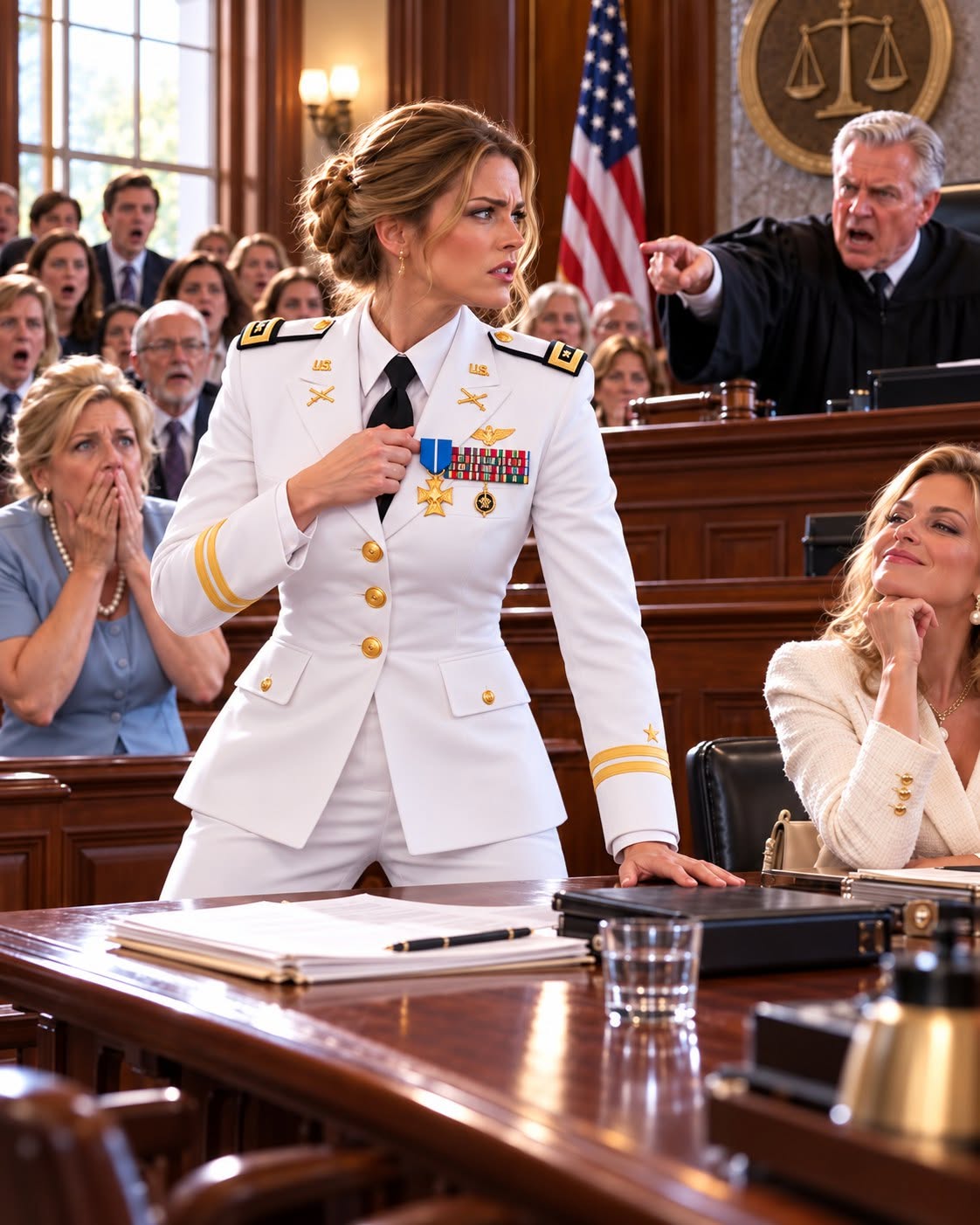
The metal felt heavy and cold in my palm, catching the amber glare of the afternoon sun. I thought about the courtroom on Friday morning—about Judge Bellamy ordering me to strip this medal from my chest, believing that without the ribbons, without the uniform, I was just a powerless woman he could sweep off the board with a gavel.
He had forgotten that a medal is not an ornament of status.
It is a covenant of sacrifice. It belongs not to the officer who wears it, but to the soldiers who didn't come home, and to the families who stand on the ground those soldiers died to protect.
I looked at my brother.
“When Grandpa left this farm to Dad,” I said softly, “he told him that the only land worth keeping is the land that feeds people who have nowhere else to go.”
I handed the Navy Cross to David.
My brother looked at the dark bronze medal in his palm, his breath hitching in his throat.
“Master Sergeant Miller and the VFW council came out to the house this morning while you were down at the creek, David,” I continued. “They have thirty-two combat veterans in this county who are transitioning out of service—men and women who need mechanical training, agricultural rehabilitation, and a place to sleep that doesn't smell like a hospital ward.”
David’s head snapped up, his eyes widening with a sudden, brilliant realization. “A veteran’s agricultural center?”
“The Mercer Foundation for Veteran Continuity,” I said, resting my hand firmly on his shoulder. “We deed the north forty acres to the foundation under a perpetual community trust. You manage the operations, David. You run the equipment shop. You teach young soldiers how to fix tractors and work the soil, with Master Sergeant Miller providing the administrative oversight.”
Tears welled in David’s eyes, but this time, he didn't wipe them away. He looked down at the Navy Cross, closed his fingers tightly around the bronze metal, and held it against his chest with a fierce, unbreakable pride.
“Dad would have loved that, Sarah,” David choked out, his voice thick with emotion. “He would have loved seeing soldiers on that north ridge.”
“He would have loved seeing you stand tall, little brother,” I replied.
A horn sounded from the driveway.
Adrian Cole’s sedan was parked near the front porch, accompanied by a dark blue staff car bearing the two-star flag of the United States Marine Corps Forces Command.
Lieutenant Colonel Marcus Hayes, my executive officer from Quantico, stepped out of the staff car, wearing his service alpha uniform, holding a thick leather courier folder under his arm. He walked across the lawn with crisp, measured strides, stopping five feet from the stone wall, bringing his hand to his brow in a sharp, flawless salute.
“Major Mercer,” Hayes announced, his voice carrying clearly across the quiet pasture.
I stood up from the wall, returning the salute with white-gloved precision. “Colonel Hayes.”
“I have official dispatches from the Commandant of the Marine Corps, ma’am,” Hayes said, stepping forward and handing me the sealed leather folder.
I broke the red ribbon seal, opened the parchment, and read the first paragraph beneath the gold seal of the Department of the Navy:
“Pursuant to the recommendations of the Armed Forces Integrity and Logistics Oversight Board, Major Sarah Mercer is hereby detached from standard operational rotation and appointed as Deputy Director of the Joint Tactical Procurement Task Force, with direct investigative authority over all commercial defense maritime contracting on the Eastern Seaboard.”
I looked up from the document, meeting Hayes’s steady, respectful gaze.
“The appointment is effective at zero-eight-hundred on Monday, Major,” Hayes said. “Your headquarters will be established at the federal annex in Norfolk. The Commandant specifically requested an officer who knows what happens to our troops when defense contractors cut corners on steel.”
I folded the orders and slipped them into my pocket.
I looked back at the white farmhouse, at the tin roof shining in the sun, at my brother standing strong beside the stone wall holding our family’s honor in his hand.
The battle for our parents' legacy was won. The farm was safe, the Mercer name was restored, and the ground beneath our feet was solid once more.
Then Colonel Hayes took half a step closer, his expression shifting from formal military stiffness into a quiet, shadowed gravity that made the wind suddenly feel colder.
“There is one more matter, Major Mercer,” Hayes whispered, lowering his voice so David couldn't hear.
I stopped. “What is it, Colonel?”
Hayes reached inside his coat and pulled out an unsealed, crimson-tabbed surveillance photograph, handing it to me with two fingers.
On the glossy paper was a grainy telephoto image taken forty-eight hours ago inside a private aircraft hangar at Dulles International Airport.
Standing beside a private Gulfstream jet, shaking hands with a high-ranking civilian member of the Senate Armed Services Committee, was a man wearing a dark trench coat.
His face was shadowed by the brim of his hat, but the ring on his left hand was unmistakable: the gold signet ring of the Mercer family crest, carved with the crossed anchors of a naval engineering officer.
A ring that had belonged to my grandfather.
A ring that had supposedly been buried with my uncle, Captain Thomas Mercer, when his submarine went down in the North Atlantic thirty-four years ago.
Hayes looked straight into my eyes, his voice barely audible above the rustle of the oak leaves.
“The corporate charters seized from Marcus Vance’s office didn't start with Pinnacle Rail, Sarah,” Hayes murmured. “They started in 1992. Under an offshore maritime trust registered in the name of an officer who was never supposed to come home.”
Related Stories