Chapter 5: The King at the Gate
Dawn broke over Manhattan in long, cold ribbons of amethyst and pale gold.
The snow had stopped falling around five in the morning, leaving Central Park blanketed in six inches of untouched, sparkling powder. From the sixtieth floor, the city looked immaculate, peaceful, and entirely indifferent to the blood that had been promised to its streets.
In the private dining room, Hazel and Nora sat at the massive cherrywood table, wearing matching emerald-green wool dresses that my personal tailor had brought up through the freight elevator two hours ago. Between them sat a towering plate of buttermilk pancakes, three bowls of fresh berries, and a stack of wrapped presents Frank had spent half the night retrieving from the private storage vault in the basement.
Nora was carefully unwrapping a miniature wooden dollhouse, her small fingers picking at the silver tape with surgical reverence, while Hazel proudly wore a new red velvet headband that didn't have a single frayed edge.
Maya sat beside them, dressed in a sharp charcoal suit Clara had never worn, sipping black coffee. The exhaustion hadn't vanished from her eyes, but the hollow, hunted terror had been replaced by something new, something hard and sharp: the fierce, unyielding resolve of a mother who finally had ground beneath her boots.
I stood by the window, adjusting the platinum cufflinks on my crisp white shirt, pulling on the dark charcoal vest that completed my three-piece suit.
The double doors of the dining room clicked open.
Frank stepped in, carrying a heavy manila folder and a secure radio unit. He nodded toward the hallway, his face unreadable.
""The convoy is assembled in the courtyard, Boss,"" Frank said quietly. ""Four Suburbans. Six motorcycles. Captain Rossi from the 19th Precinct has personal command of the escort.""
I looked down at the girls. Nora looked up, holding a tiny wooden chair between her fingers.
""Mister Reed?"" she piped up, her voice clear and sweet. ""Are you going to see Santa now?""
I walked to the table, crouched between their chairs, and gently tapped the tip of her nose with my index finger.
""I'm going to see some old friends, Nora,"" I told her. ""I have to deliver a few packages.""
Hazel leaned over, pressing her small, warm palm against my cheek. ""Don't forget your coat. The wind bites today.""
""I have my coat, sweetheart,"" I said, smiling—a real, genuine smile that felt strange and wondrous on my face, stretching muscles that had forgotten how to move for two long years.
I stood up, looked at Maya, and gave her a single, resolute nod.
""Lock the penthouse from the interior console,"" I told her. ""Frank’s second-in-command, Miller, has the outer perimeter. No one enters these doors except me. If you hear sirens on the avenue, don't look out the window. Just help them finish the pancakes.""
""Reed,"" Maya said, rising from her chair, her hand catching my sleeve as I turned to leave.
I stopped, looking at her fingers on the fine wool of my jacket.
""Make them pay for the fire,"" she whispered, her dark eyes blazing with an ancient, righteous fury. ""Every single dollar. Every single drop.""
""I intend to collect with interest, Miss Lin,"" I replied.
I walked out to the private elevator, Frank stepping in behind me, the brass doors sliding shut with a heavy, muted hum.
The descent to the street was fast and smooth.
When we stepped out into the private courtyard on 71st Street, twelve of my senior soldiers stood at attention beside four idling black Suburbans, their breaths forming white clouds in the freezing morning air. Every man wore a black wool overcoat with the silver serpent pin of the Sullivan family trust pinned to his lapel.
They didn't look like gangsters. They looked like an army returning to a province it had neglected for too long.
""To the Manhattan Club,"" I said, climbing into the rear of the lead vehicle.
The drive downtown was eerily quiet. Christmas morning traffic was nearly non-existent; the broad avenues of Manhattan lay open and clean beneath the winter sun, with church bells chiming in the distance from St. Patrick’s Cathedral.
We pulled up to the curb outside the Manhattan Club on 44th Street at exactly eight-fifteen.
The club was an imposing, century-old granite fortress that had served as the neutral meeting ground for the city's financial elite and syndicate bosses since the days of Tammany Hall. Two private security guards in black trench coats stood flanking the heavy brass entrance doors, their postures stiffening the second my four-vehicle convoy mounted the private driveway.
I stepped out onto the granite pavement.
The wind off the East River was biting, carrying the sharp scent of salt and burning chimney oak. I buttoned my coat, adjusted the heavy wool lapels, and walked up the steps with Frank half a pace behind my right shoulder, carrying the leather briefcase containing the zinc thumb drive and Judge Vance’s ledger.
The guards at the brass doors didn't reach for their weapons. They knew my face. They knew the way I walked. One of them immediately turned and pushed the heavy door open, his voice trembling as he spoke into his lapel microphone.
""Don Sullivan is on the premises.""
The grand foyer of the Manhattan Club was bathed in warm amber light from three crystal chandeliers. An enormous evergreen tree stood beside the grand marble staircase, draped in gold ribbons and antique glass ornaments.
In the private dining salon on the second floor, a massive round table had been set with silver platters of roast beef, vintage champagne, and stacks of commercial leather folios.
Seated around the table were seven men.
Don Salvatore Castiglione, eighty years old and frail, sat near the fireplace. Beside him sat Marco Moretti, the cold-eyed young boss who had taken over his family’s western trucking lines six months prior.
And at the head of the table, sitting in the high-backed velvet armchair that had belonged to my father for thirty years, was Raymond Vance.
Raymond was laughing, holding a crystal glass of port wine in one hand, gesturing with an unlit cigar toward a set of architectural renderings spread across the mahogany.
""—the terminal expansion at Pier 17 clears the planning commission by mid-January,"" Raymond was saying, his voice rich, buoyant, and entirely untouched by doubt. ""Once we have the unified charter signed today, the Sullivan accounts dissolve into the regional trust, and we—""
The heavy mahogany doors of the salon swung wide open.
The laughter died instantly.
The room went so cold, so dead, that the only sound was the crackle of dry pine logs in the limestone fireplace.
Raymond’s glass stopped halfway to his lips. The cigar slipped from his fingers, tumbling onto the green baize of the architectural table.
I walked into the room.
My footsteps were slow, measured, and completely silent against the Persian carpet. I didn't take off my overcoat. I didn't look at Castiglione. I didn't acknowledge Moretti.
I walked straight to the head of the table and stopped two feet from my uncle’s chair.
""Good morning, Raymond,"" I said, my voice quiet, conversational, and carrying the terrifying weight of a dropped guillotine. ""Merry Christmas.""
Raymond’s face turned the color of wet sidewalk cement. The skin beneath his eyes twitched violently, his knuckles going white as he gripped the armrests of my father's chair.
""Reed..."" Raymond stammered, forcing a grotesque, trembling smile to his lips as his eyes darted frantically toward the double doors, where Frank and four armed soldiers now stood with their backs to the wood, sealing the exit. ""We... we weren't expecting you until tomorrow. The board... we were just reviewing the harbor maintenance drafts.""
""I know what you were reviewing, Raymond,"" I said softly, reaching out and pulling the crystal glass of port from his trembling fingers.
I set the wine on the table, leaned forward, and placed both palms flat on the mahogany, bringing my face six inches from his.
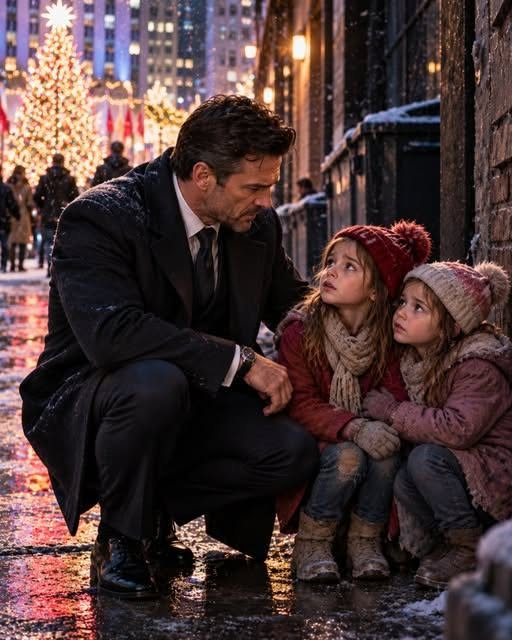
""I met two little girls in the plaza last night,"" I whispered, each word falling like an iron spike into the silence of the room. ""They asked me if Santa knew their address. They lived in a basement beneath an abandoned water bureau on 48th Street. With a woman named Maya Lin.""
The name hit the table like an artillery shell.
Don Salvatore Castiglione dropped his fork. Marco Moretti’s eyes went wide, his hand instantly freezing inches from his jacket pocket as Frank’s rifle leveled directly at the back of his neck.
Raymond didn't move. He sat pinned against the velvet cushions, his breath coming in shallow, wheezing gasps, his gaze trapped by the cold gray stone of my eyes.
""You told Paul Mercer the fire was mathematical, Raymond,"" I continued, my voice barely above a murmur, yet cutting cleanly through the frozen room. ""You told him the boy carries the name. And that the line had to end.""
I reached into my pocket, pulled out the gold signet ring I had worn since my father's funeral, and dropped it onto the architectural drawings between us.
It landed with a sharp, heavy *clank* that echoed off the mahogany walls.
""The line didn't end, Uncle,"" I said, stepping back and straightening my jacket. ""I just adopted two daughters.""
Raymond stared at the ring, his mouth opening and closing soundlessly, terror finally breaking through the smooth facade of thirty years of deception.
Before he could form a single word, the double doors behind Frank didn't just open; they were shoved inward with sudden, violent force.
A junior officer in the dress uniform of the New York State Police stepped into the threshold, flanked by two federal marshals carrying sealed white envelopes bearing the red seal of the United States District Court for the Southern District of New York.
The lead marshal didn't look at Raymond. He didn't look at Castiglione.
He walked straight past the frozen syndicate bosses, stopped beside my shoulder, and handed me a certified legal document.
""Mr. Sullivan,"" the marshal said, his voice ringing through the silent salon. ""The emergency probate injunction has been granted by Chief Judge Miller. But there’s a complication with the estate's foreign assets.""
I took the document, my eyes narrowing. ""What complication?""
The marshal looked across the table at Raymond Vance, whose face had twisted from terror into a bizarre, desperate smile of feral malice.
""The chemical transport containers from Pier 17,"" the marshal whispered, looking back at me. ""The ones that arrived the night of the fire two years ago. The federal manifest we just unsealed in Newark wasn't consigned to Raymond Vance.""
I looked down at the official shipping ledger stamped by federal customs.
The name listed as the sole corporate importer and primary owner of the transport that carried the accelerant to my family's home was printed in bold, undeniable black ink:
*Clara Sullivan.*"b
Related Stories