Chapter 2: Beyond the Yellow Line
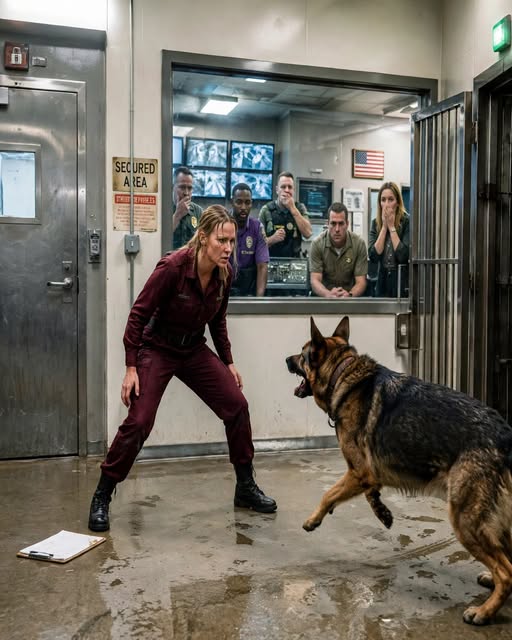
The explosion of motion was blindingly fast.
Eighty pounds of dense muscle, matted fur, and pure tactical instinct slammed against the reinforced steel bars with a metallic crash that rattled my teeth. Atlas didn't bark. Elite military working dogs didn't waste breath on noise when they were hunting or defending their space. He hit the bars shoulder-first, his teeth bared in a silent, terrifying snarl, saliva flying from his jowls as he tried to bridge the gap between us.
I didn't flinch. I didn't raise my arms or scramble backward.
Instead, I did the one thing Rusk’s manual said never to do: I sat down right there on the cold, wet concrete, crossing my legs and resting the metal clipboard flat against my knees.
""You're making a lot of noise for a condemned dog, Atlas,"" I said, my voice dropping into the low, steady cadence I had used on hundreds of stressed, traumatized animals over the years.
The Malinois froze mid-lunge.
His massive head tilted slightly to the side. The amber eyes locked onto my face, scanning my posture, reading the subtle micro-tremors in my muscles, smelling the adrenaline and cortisol leaking from my pores. Dogs like Atlas didn't see humans the way civilians did; they saw heart rates, chemical shifts, and intentions.
He lowered his shoulder, but he didn't step back. He paced back and forth behind the bars like a caged tiger, his tail tucked tight, his breathing coming in heavy, ragged gasps.
That was when I saw it.
Even in the dim, yellow light, the damage was sickening. A deep, jagged laceration ran across his left flank, crudely stitched with coarse black nylon thread that looked like it had been sewn by a drunk mechanic using a fishing hook. Fresh blood was seeping through the matted fur around the wound. His left front paw was swollen twice its normal size, the dewclaw torn straight down to the root.
This wasn't from a training accident. And it certainly wasn't from trying to ""tear a vet tech's face off"" a week ago.
This was abuse. Systematic, deliberate, sadistic abuse inflicted by someone who wanted to break a living weapon until he finally snapped—or until he looked dangerous enough to justify a lethal injection behind closed doors.
""Bastards,"" I whispered, the cold fury in my chest flaring hot enough to burn away the last remnants of my grief over my father's betrayal.
I reached slowly into the deep tactical pocket of my jacket, bypassing my phone, and pulled out a small, foil-sealed packet of high-grade freeze-dried beef liver training treats—the kind I always carried for rehabilitation sessions. I didn't toss it toward him. That would trigger a predatory retrieval or a defensive strike.
Instead, I tore the corner open with my teeth, pulled out a single square, and placed it gently on the concrete floor three feet outside the exclusion line.
Then I slid backward two feet, exposing my throat and lowering my chin—the universal canine signal of submission and non-aggression.
""It's okay, big guy,"" I murmured, staring at the floor between us. ""I'm not Rusk. I'm not Tyler. You don't have to fight anymore.""
For nearly two minutes, the only sound in Isolation Block C was the distant rumble of the thunderstorm outside and the heavy, rasping breath of the dog.
Then, a cautious, hesitant step.
Atlas pressed his nose against the bottom gap of the cell door, sniffing the air. The scent of real meat cut through the reek of chemical cleaner and old blood. His tail gave a single, tentative wag—so faint it was almost imperceptible.
He squeezed his massive snout beneath the heavy steel gap, licked the single square of beef liver off the concrete, and swallowed it whole.
Then he looked back up at me, his amber eyes no longer looking like a monster's.
They were looking like a protector waiting for permission to trust again.
Related Stories