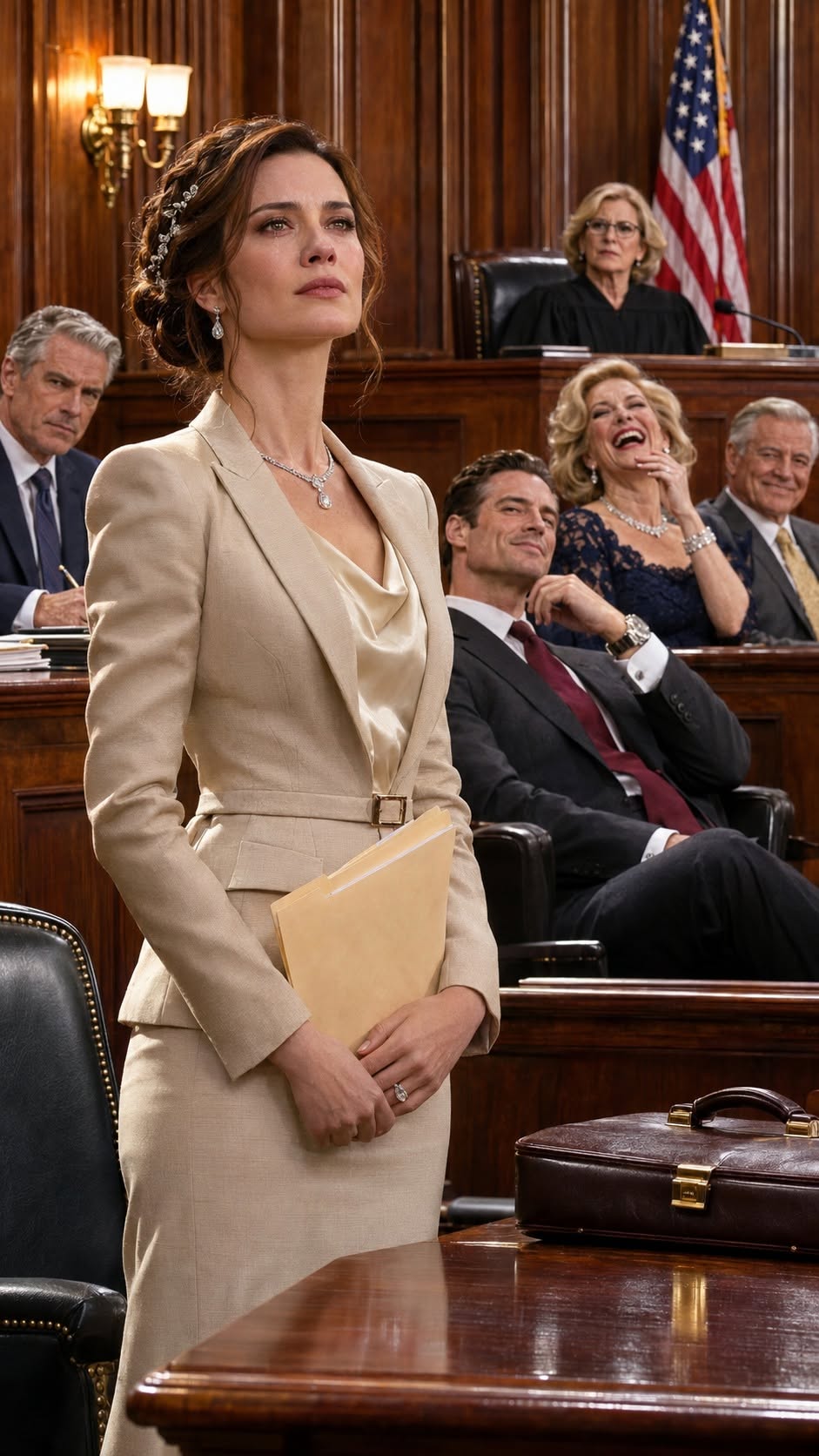
Chapter 3: The Toast at the Dais
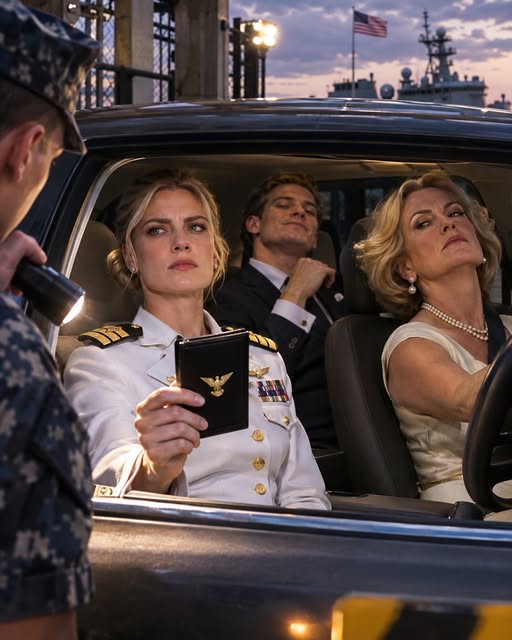
The grand ballroom of the Pennsylvania House was bathed in the warm, golden glow of brass chandeliers and the soft, murmurous hum of three hundred men and women in tailored tuxedos and formal dress uniforms.
At the head table, elevated six inches above the main floor beneath a massive silk ensign of the United States Navy, stood seven high-backed wooden chairs.
I sat in the center seat.
To my right was Vice Admiral Thomas Caldwell, Commander of the Atlantic Fleet. To my left sat the regional director of naval intelligence. In front of each setting was an embossed menu card, a crystal water goblet, and a heavy brass place marker engraved with our service titles.
Mine read simply:
*REAR ADMIRAL EVELYN HALE // KEYNOTE.*
Down on the main floor, at table forty-four near the service entrance to the kitchen, Marjorie and Wesley sat under the flickering light of a low votive candle.
Wesley had not removed his hands from his lap.
Three representatives from his defense contracting employer—men in bespoke black suits who had spent the last two months ignoring his emails—were seated two tables away.
Every few minutes, one of those executives would glance toward the head table, see me speaking quietly with the three-star fleet commander, and then look toward table forty-four with expressions of utter, bewildered shock.
Vice Admiral Caldwell leaned toward me, setting down his water glass with a slight, knowing smile that crinkled the weathered skin around his eyes.
“Your mother looks like she’s about to faint, Evelyn,” Caldwell murmured beneath the low chime of the string quartet playing near the terrace.
I took a slow sip of water. “She’s adjusting to a revised operational picture, Admiral.”
“I’ve known you since you were a lieutenant commander running the electronic warfare bay on the *Bataan*,” Caldwell said, his voice dropping into that quiet, fatherly cadence he only used off the record. “You never brought family to a fleet change of command. You never brought them to the promotion board in San Diego. Why tonight?”
I looked across the glittering room, watching Marjorie adjust her pearl necklace with hands that were still visibly trembling.
“My brother asked for a ride,” I said. “He told my mother he had secured an executive pass for the reception. He wanted her to see him in a room full of decision-makers.”
Caldwell let out a short, dry chuckle that sounded like sea spray hitting an anchor chain. “Well, he’s in the room.”
He checked his pocket watch, clicked the lid shut, and picked up his dessert spoon, tapping the side of his champagne flute twice.
The sharp, crystal chime cut through the ballroom like a whistle.
The string quartet lowered their bows. Conversations at sixty tables died instantly. Waitstaff carrying silver trays froze in the aisles.
Vice Admiral Caldwell stood up.
“Ladies and gentlemen, distinguished guests, and colleagues,” Caldwell began, his deep, resonant baritone filling the vaulted room without the aid of the microphone. “Tonight, we gather to mark the completion of the fleet’s next-generation autonomous battle management integration. For eighteen months, fifteen major defense consortia have competed to deliver the cryptographic backbone for our forward-deployed assets.”
He gestured with his left hand toward the three executives from Wesley’s firm, who immediately sat up straight, their expressions taut with professional anxiety.
“Many in this room believed this program was an administrative formality,” Caldwell continued. “A routine distribution of federal funding. But modern warfare does not tolerate unearned assumptions, and neither does the officer who was hand-selected by the Pentagon to oversee this transition.”
Caldwell turned his head, looking down the table directly at me.
“Twenty years ago, a young ensign stepped onto the deck of a guided-missile cruiser in the Persian Gulf with a degree in electrical engineering and a refusal to accept that systems couldn't be made stronger, faster, and more honest,” Caldwell said, his voice carrying the deep, unvarnished weight of military respect. “She didn't climb through political connections. She didn't seek the spotlight. She built the networks that bring our sailors home alive.”
The admiral raised his glass.
“To our keynote speaker, our project director, and the finest tactical mind in the Atlantic theater: Rear Admiral Evelyn Hale.”
The entire ballroom stood up.
Three hundred people rose as one, the applause thunderous, concussive, rolling off the mahogany-paneled walls like naval gunfire.
Down at table forty-four, Wesley stood up awkwardly, his knees bumping the edge of the tablecloth, clapping his hands with frantic, desperate energy.
Marjorie remained in her seat for two seconds, staring up at the dais as if she were looking at a statue of an ancient queen.
Then, slowly, her shoulders bowed, she stood up too.
Her hands came together in a faint, mechanical rhythm, her eyes glistening with tears that were not born of motherly joy, but of the terrifying, sudden realization of everything she had thrown away.
I stood up, stepped to the center podium, and adjusted the microphone.
I looked out across the sea of faces—the junior officers, the senior commanders, the industry leaders, the men who controlled billions in defense contracts.
And then I looked at table forty-four.
“Good evening,” I said into the microphone, my voice steady, calm, and clear. “Before we review the procurement allocations for the upcoming fiscal quarter, there is an item of business regarding the regional logistics bid submitted by Apex Tactical Solutions.”
At table forty-two, Wesley’s CEO turned pale as a sheet.
At table forty-four, Wesley stopped clapping entirely.
“The audit conducted by my office forty-eight hours ago,” I continued, each syllable falling like a lead hammer on iron, “revealed an irregular third-party consulting commission slipped into the vendor’s secondary annex. A commission registered to a private brokerage account under the name of Wesley Hale.”
---
Related Stories