Chapter 1: The Echo on the Porch
The envelope sat on my kitchen island like an unexploded firecracker, its thin blue airmail paper almost translucent against the dark granite.
Outside, a late October breeze rattled the dry leaves across our front lawn in Omaha, swirling them in tight circles before plastering them against the porch steps. Inside, the only sound was the low, rhythmic ticking of the wall clock and the muffled hum of the dishwasher running through its sanitize cycle. Sarah was upstairs helping Noah with his spelling list, her soft, encouraging voice drifting down the staircase every few moments.
I hadn't opened the letter. I didn't need to read beyond the return address penned in my mother’s sloping, shaky cursive to know that peace, once purchased, always comes with recurring invoices.
A heavy knock rattled the front door.
It wasn't the tentative tap of a delivery driver or the polite double-thump of our neighbors from across the cul-de-sac. It was sharp, demanding, and delivered with the flat of a palm against the deadbolt.
I stepped into the hallway, pulling the door open just enough to see through the glass storm panel.
Standing under our porch light was my father, Frank Miller.
Six months had aged him ten years. The thick gray hair he used to comb straight back was unkempt, sticking out in tufts above his ears. His beige windbreaker hung loose on his frame, the cuffs frayed, and his hands were jammed deep into his pockets as if he were trying to keep them from shaking. Behind him, parked crookedly against our curb, was his ten-year-old Buick LeSabre, its driver’s side hubcap missing and a plume of pale blue exhaust sputtering from its tailpipe.
I kept the glass door locked between us.
""Dad,"" I said through the screen.
Frank exhaled, his breath fogging the glass. ""You didn't answer your mother’s letter, Kenneth.""
""I read the return address. That was enough.""
He closed his eyes for a second, rubbing the bridge of his nose where deep red indentations marked the absence of his reading glasses. ""She’s sick, Kenneth. Real sick this time. Not one of her nervous spells. Her kidneys are failing. The doctors in Lincoln are talking about dialysis three times a week.""
A familiar ache tried to bloom in my chest—that automatic, Pavlovian guilt that had kept me writing checks for twenty years. But then I looked at his eyes. They were darting past my shoulder, scanning our entry hall, looking at the fresh coat of warm gray paint, the new hardwood runner, the framed photographs of Emily and Noah laughing at the Omaha Zoo. He wasn't looking for a sick woman's son. He was appraising real estate.
""If she needs dialysis, Medicaid covers state transport and certified clinics,"" I said, keeping my voice even, low, and devoid of the anger he was clearly expecting. ""You have the state supplemental policy I set up for you four years ago.""
Frank’s jaw tightened, the skin over his cheekbones turning an angry, mottled pink. ""Medicaid takes six months to process the rural waivers! And the supplemental policy lapsed in July because nobody paid the premium!""
""I didn't pay it,"" I corrected him calmly. ""Because I gave you six thousand dollars in cash in January specifically to cover the entire year’s medical premiums. Where did that money go, Dad?""
Frank looked down at the concrete porch floor. A dead oak leaf skittered across his scuffed leather shoes.
""Brenda had an emergency,"" he muttered.
The name hit the porch like ice water.
""An emergency,"" I repeated.
""Her car got impounded, Kenneth! The finance company was going to take it, and she needed transportation to take the boys to soccer! What was I supposed to do? Let my daughter walk three miles in the rain?"" His voice rose, regaining that old, booming entitlement that used to make me shrink into the carpet as a teenager. ""You have no idea what it's like out there! You sit in this fancy suburb with your construction manager salary, buying new furniture and acting like you're above your own blood! Your sister is drowning!""
""Then let her swim,"" I said.
The lock on the front door clicked. Sarah stepped into the foyer behind me, wearing an oversized knit sweater, her arms crossed over her chest. She didn't look angry; she looked completely impenetrable, like an iron gate closing at sunset.
""Hello, Frank,"" Sarah said quietly.
Frank’s face twisted into a scowl. To him, Sarah was the foreign agent who had poisoned his golden well. ""Sarah. Tell your husband to act like a man. His mother is lying in a hospital bed forty miles away while he plays king of the hill.""
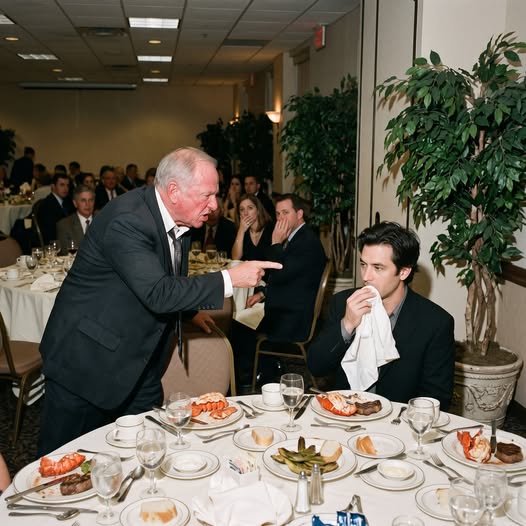
""Frank,"" Sarah replied, her voice steady enough to cut glass, ""the last time Kenneth acted like a man according to your rules, you sat his children next to the ficus trees and fed them scraps while your daughter drank three-hundred-dollar champagne on our credit card. You don't get to define manhood in this doorway.""
Frank took half a step forward, his hand rising toward the storm door handle. ""You disrespectful little—""
""Step off the porch, Dad,"" I commanded.
The volume wasn't high, but the tone made him freeze. For thirty-nine years, Frank Miller had known me as the boy who said *yes, sir*, the boy who worked sixty-hour weeks in the mud so his father wouldn't have to sell his boat, the man who swallowed public humiliation just to keep Sunday dinner peaceful. He had never heard me use the voice I used on commercial job sites when a subcontractor endangered a crew.
Frank pulled his hand back as if the aluminum handle were red hot.
""You're dead to us,"" Frank spat, his voice trembling with venom. ""Both of you. If Joyce dies this winter, her blood is on your hands. Don't bother coming to the funeral. Don't bother calling the church. You're cut out of the deed to the farm. Everything goes to Brenda.""
""The farm that has two mortgages and a tax lien on it?"" I asked, looking him dead in the eye. ""Keep it. Give it to Brenda with a bow on it.""
Frank turned on his heel, muttering curses under his breath, and marched down the walkway. He slammed the door of the rusted Buick, gunned the engine until it backfired, and peeled away from our curb, leaving two black tire marks across the asphalt.
I turned around, leaning my back against the locked door. Sarah took my hand, squeezing my fingers with a warmth that grounded me back into reality.
""You okay?"" she asked softly.
""I am,"" I said, surprised to find that my hands weren't shaking. ""For the first time in my life, I really am.""
Then my phone buzzed on the kitchen island.
It wasn't a call. It was an automated notification from my construction company’s security portal:
*ALERT: Unauthorized vehicle detected at Northwest Logistics Yard 4. Gate code override attempted using administrative employee badge: KENNETH MILLER (RETIRED/VOID).*
---
Related Stories