Chapter 4: The Visiting Room
The visitor’s booth in the Fairfax County Adult Detention Center smelled of industrial bleach, floor wax, and the dry, stale air of recycled ventilation.
I sat on the cold steel stool, my green fiberglass cast resting flat on the stainless steel counter, separated from the prisoner’s side by a three-inch pane of reinforced bulletproof glass.
A heavy iron door buzzed on the other side.
Nolan shuffled into the booth, his orange jumpsuit three sizes too large, his wrists chained to a heavy leather transport belt around his waist. The left side of his face was swollen, a dark yellow-green bruise spreading from his cheekbone down into his jaw where Master Sergeant Torres had driven him against the stage stairs. His styled hair was greasy and uncombed, and his eyes were wild, darting around the cubicle like a caged animal looking for an exit that didn't exist.
He dropped onto the stool across from me, his chains rattling sharply against the counter. He picked up the heavy plastic telephone receiver with trembling, handcuffed fingers.
I lifted my receiver with my right hand, holding it to my ear.
“You think you’re smart, don't you?” Nolan snarled into the mic, his voice crackling through the cheap speaker with vicious, hysterical malice. “You think because you had your general arrest me that you won? The judge denied bail this morning, Maya! They put me in a segregation unit with murderers! You did this to your own husband!”
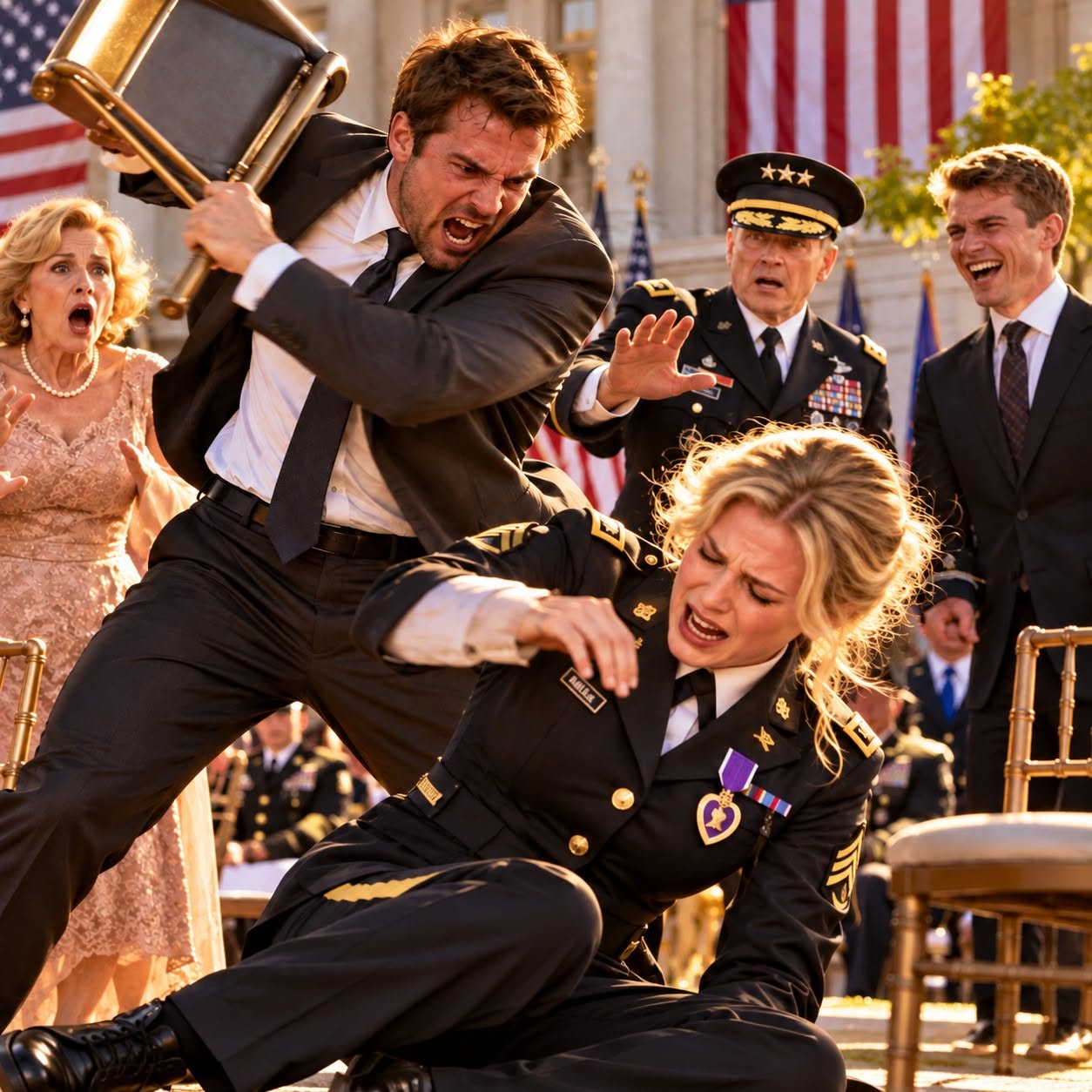
“You fractured my arm with a steel chair in front of four hundred people, Nolan,” I said, keeping my posture rigid, my eyes locked directly onto his. “You did this to yourself.”
“Because you disrespected me!” he shouted, slamming his cuffed hands against the glass hard enough to make the reinforced pane shudder. “You stood up there on that stage, letting that old man touch your shoulder, letting everybody clap for you like you’re some kind of hero! What about me, Maya? What about the three years I spent sitting in that damn house waiting for your emails? What about the dinners I had to attend alone while people asked where my wife was?”
“The dinners you paid for with eighty thousand dollars of stolen combat pay?” I asked quietly.
Nolan’s mouth snapped shut. A momentary flicker of terror darted across his features, before his lips curled into that familiar, petulant sneer.
“You owe me that money,” he whispered. “You were gone. You chose the Army over your family. If I had to put my life on hold for your precious career, I had every right to take what was mine.”
“And the life insurance, Nolan?”
The silence that followed was heavy enough to crush a man’s lungs.
Nolan’s eyes flickered down to the counter, avoiding my gaze for the first time since he sat down.
“One point five million dollars,” I continued, my voice smooth, cold, and entirely devoid of pity. “Five hundred thousand from the government SGLI policy, altered three days before I flew into Erbil. And another million from an offshore carrier in Bermuda, financed through monthly premiums drawn from my emergency deployment fund. You had Caleb listed as the primary beneficiary so my family wouldn't be able to challenge the payout under military survivorship laws.”
Nolan slowly lifted his head. The fear in his eyes had begun to calcify into something ugly, dark, and utterly unrepentant.
“You weren't supposed to come home from that valley, Maya,” Nolan said. He didn't whisper it. He said it with a flat, clinical certainty that made the hair on the back of my neck stand up. “When your convoy got hit outside Deir ez-Zor, when the casualty report came through the notification desk at Belvoir... I thought it was over. I thought we were finally free. We had the plans drawn up for Caleb’s commercial shop. We were looking at a house in Great Falls.”
He leaned in until his nose was an inch from the glass, his breath fogging the surface.
“And then you woke up in Germany,” he spat. “You woke up with a shattered leg and shrapnel in your shoulder, and you fought your way out of the hospital bed just to come back and make my life miserable. You came back broken, limping around the kitchen, expecting me to rub your back and tell you that you were brave. You weren't brave, Maya. You were just a nuisance that wouldn't die.”
I looked at the man I had loved for six years.
I looked at the face I used to carry in a laminated plastic sleeve inside the breast pocket of my body armor. In the freezing mountain nights in Kunar, in the dust storms outside Baghdad, I had looked at that photograph to remind myself that there was something gentle, something decent, waiting for me on the other side of the war.
It was a ghost. It had always been a ghost.
I was married to a parasite who had spent six years measuring my life in the price of my funeral honors.
“Thank you, Nolan,” I said softly.
He blinked, thrown off by the lack of tears, by the absolute, unbroken stillness in my face. “What?”
“For saying it out loud,” I replied.
I pointed with my thumb toward the small black dome mounted in the corner of the ceiling above his head.
“This visitation cubicle was designated under a federal investigative order signed by the United States District Court for the Eastern District of Virginia at noon today,” I told him. “Every syllable you just spoke into that microphone was recorded on high-definition audio and video by the Federal Bureau of Investigation’s insurance fraud task force.”
Nolan went completely white. His jaw dropped, his gaze snapping up toward the camera, then back to my face in absolute, unadulterated horror.
“You... you set me up?” he stammered.
“No, Nolan,” I said, slowly hanging the receiver back onto its metal cradle. “You set yourself up six years ago. I’m just the one closing the door.”
I stood up from the stool, adjusted my sling, and walked toward the exit without looking back. Behind me, the muffled sound of Nolan screaming and throwing his body against the reinforced glass echoed through the corridor, growing fainter and fainter until the heavy steel sally-port doors clicked shut, locking him in the dark.
Related Stories