Chapter 2: The Fracture Line
The fluorescent lighting in the surgical observation ward of Fort Belvoir Community Hospital hummed with a low, clinical buzz that vibrated against the back of my skull.
The clock on the wall read three in the afternoon. My dress uniform had been cut away from my left side by the trauma team, the wool fabric discarded in an biohazard bin, leaving me in a faded gray physical-training t-shirt and an arm encased in dark green fiberglass from the knuckles to the mid-bicep. Two surgical pins held the fractured fragments of my ulna in place, and the nerve block was finally beginning to recede, leaving behind a dull, throbbing ache that felt like an iron clamp tightening around my marrow.
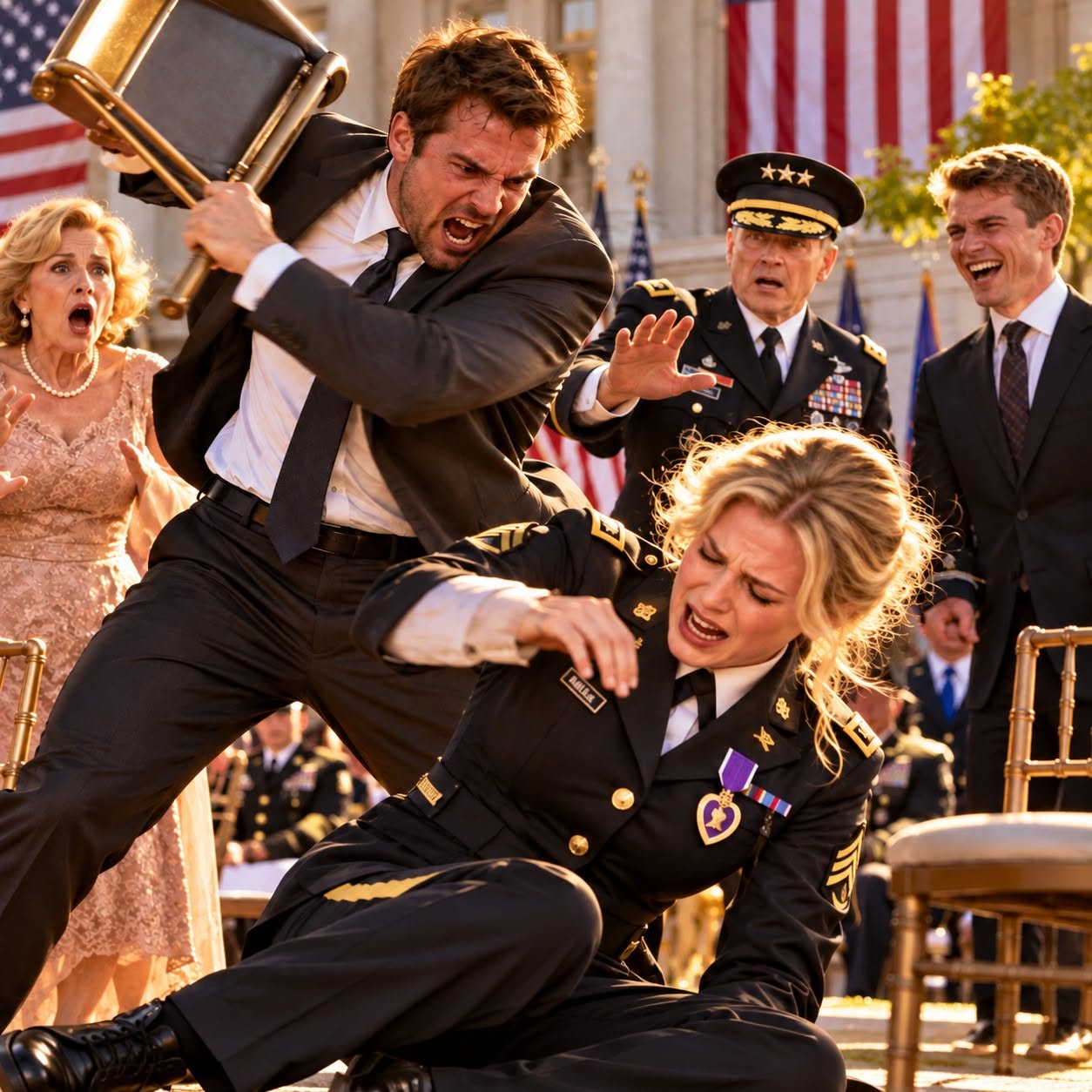
Pinned to the collar of my t-shirt, right over my heart, was the Purple Heart. General Whitaker had retrieved it from the floor of the auditorium himself, wiped the dust from the gold border with his own handkerchief, and handed it to me before the ambulance doors slammed shut.
The heavy door to the recovery room clicked open.
Captain Sarah Lin, a senior defense attorney from the installation Staff Judge Advocate’s office, stepped inside. Behind her was General Whitaker, carrying a slim leather folder under his arm, his service dress uniform still immaculate, though the lines around his eyes were deeper than they had been on the stage.
“How’s the arm, Captain Hayes?” Whitaker asked, pulling a plastic chair up to the side of the bed.
“The surgeon says I’ll keep ninety percent mobility if the bone knits cleanly, sir,” I answered, keeping my voice steady. “The pins come out in six weeks.”
“Good,” Whitaker said, his jaw tightening into iron. “Because in six weeks, you’re going to need both hands to sign the criminal indictments we’re handing to the United States Attorney.”
Sarah Lin laid her folder flat on the movable tray table, opening it to reveal a certified copy of a document bearing the raised seal of the Fairfax County Circuit Court.
“Nolan wasn't bluffing on that stage, Maya,” Sarah said, her voice sharp and clinical. “At eight-fifteen this morning, forty-five minutes before the base gates opened for the ceremony, his civilian attorney filed an emergency ex-parte petition for temporary adult guardianship and total financial conservatorship over your estate.”
I stared at the black-and-white scan of the court filing. There was my name, my military rank, my social security number, and a sixty-page annex detailing what Nolan described as a “catastrophic and unmanageable descent into violent, delusional combat trauma.”
“He claimed you were non-functional,” Sarah continued, pointing to a highlighted paragraph on page four. “He claimed you were experiencing active auditory hallucinations, that you had threatened his life with your service weapon, and that you were incapable of managing your daily affairs. He attached affidavits claiming that your promotion to Captain and the Purple Heart ceremony were the result of administrative pity from the Department of the Army to cover up a psychological breakdown.”
“Who signed the medical evaluation?” I asked, feeling a cold, dead weight settle into the pit of my stomach. “Army Medical Command cleared me for full active-duty service four months ago. I passed two comprehensive neuropsychological evaluations at Walter Reed before I was assigned to division staff.”
“It wasn't an Army doctor,” Sarah replied, flipping the page. “It was Dr. Kenneth Vance. The medical director of the Oakridge Wellness Center in Annandale.”
I went rigid.
“Kenneth Vance,” I whispered, the name catching in my throat like glass. “That’s Denise’s brother. Nolan’s uncle.”
“A board-certified psychiatrist who runs an off-base, private addiction and behavioral clinic,” General Whitaker stated, his voice dropping into that quiet, terrifying register that made staff officers tremble in briefings. “Dr. Vance submitted a sworn clinical evaluation stating that he had been treating you privately for eighteen months. He fabricated clinical session notes, prescription histories for heavy antipsychotics, and a diagnostic profile that categorized you as an immediate danger to yourself and your financial assets.”
The room seemed to tilt beneath me.
All through my recovery—the long months when I was learning how to hold a coffee cup without my left hand shaking, when the nightmares of the burning vehicle still woke me at three in the morning—Nolan had insisted that I attend Sunday dinners at his uncle’s house in Annandale. He had told me that Uncle Kenneth was just an affectionate family member who wanted to support my recovery. Uncle Kenneth had asked gentle, casual questions about my sleep patterns, my mood, and whether I ever felt overwhelmed by my duties.
I had answered him honestly. I had treated him like family.
He wasn't an uncle checking on a wounded niece. He was an operative conducting a clinical deposition, gathering raw material to construct a paper cage that would strip me of my legal rights the moment I became inconvenient.
“Why today?” I asked, looking up at General Whitaker. “Why did he file it on the morning of the ceremony?”
“Because of this,” Whitaker said, pulling a second document from his leather folder and sliding it across the tray.
It was an official disbursement notification from the Defense Finance and Accounting Service, dated three days ago.
*RETROACTIVE COMBAT TRAUMA COMPENSATION & SPECIAL INJURY SETTLEMENT // BENEFICIARY: CAPT. MAYA E. HAYES // AMOUNT: $342,000.00.*
“Under federal law,” Whitaker explained, “that lump-sum disbursement is exempt from standard marital asset distribution during a divorce. It belongs exclusively to the wounded service member. Nolan’s attorney knew that if you filed for divorce—which Nolan suspected you were preparing to do after you reported his threats this morning—he wouldn't see a single dollar of that settlement.”
“Unless,” Sarah Lin finished, her eyes dark with fierce, professional anger, “you were declared legally incompetent before the funds were transferred. Under Virginia conservatorship statutes, if an emergency guardian is appointed prior to disbursement, the funds are routed directly into a fiduciary account controlled entirely by the conservator.”
Sarah pointed to the final page of Nolan’s petition.
“Nolan didn't just ask to control your money, Maya. He designated Dr. Kenneth Vance’s clinic in Annandale as your permanent residential treatment facility. If Nolan had walked out of that auditorium today without an arrest, two civilian transport deputies were waiting at the main gate of the base with an emergency detention order to take you directly from the ceremony to a locked psychiatric ward.”
Related Stories