Chapter 5: The Midpoint Shift
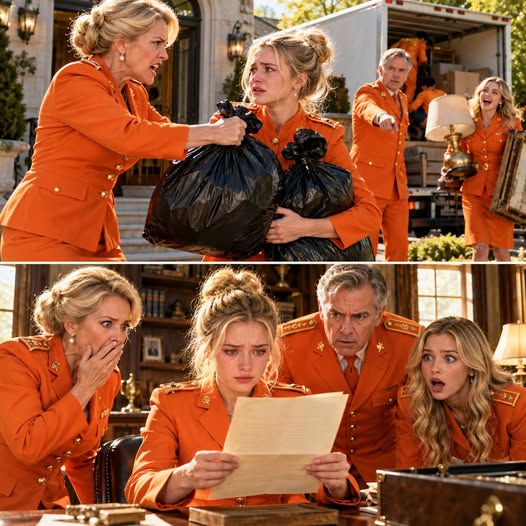
The moving truck pulled out of the gravel driveway at twenty past eleven.
Its heavy diesel engine groaned against the incline, the rear tires spitting wet gray stones against the mailbox before turning onto the county highway and disappearing into the low, bruised winter clouds.
Tessa had left five minutes earlier in her own car, without saying goodbye to our parents. She had walked down the porch steps carrying only her small leather overnight bag, looked at me through the rain with an expression of quiet, shattered grief, and whispered: *“I’m sorry, Paige. I swear to God... I didn't know.”*
I had nodded once.
Not forgiveness. Not yet. But an acknowledgment that the rot hadn't started with her.
Mom and Dad had left in Dad’s luxury sedan, following the moving van like two ghosts fleeing an open grave. Dad hadn't spoken another word after Evelyn finished her call with the federal field office in Cleveland. He had walked down the steps with his head bowed, his camel-hair coat damp with rain, looking less like a developer who owned companies and more like an old man who had finally run out of corners to hide in.
Now, the house was silent.
The only sound was the steady, rhythmic ticking of the brass clock on the living room mantel and the low hiss of the steam radiator beneath the front window.
Evelyn Brooks stood in the center of Grandpa’s study, holding a steaming mug of black coffee I had brewed on the antique stove.
The study smelled of aged paper, cedar shavings, and the faint, sweet trace of the cherry pipe tobacco Grandpa had given up a decade ago. Along the north wall, four floor-to-ceiling pine shelves were crammed with books on Ohio agriculture, civil engineering manuals, and three decades of weather almanacs.
“The FBI agent is dispatching a financial crimes investigator to the county recorder’s office this afternoon, Paige,” Evelyn said, setting her mug down on the edge of Grandpa’s massive oak desk. “Richard’s fraudulent heirship affidavit will be officially struck from the registry before three o'clock. The Apex contract is legally null and void.”
I sat in Grandpa’s high-backed leather swivel chair, my hands resting on the cool wood of the armrests.
The flannel shirt I wore was still warm, the cuffs smelling faintly of woodsmoke and peppermint tea.
“Is it over, Evelyn?” I asked, looking up at her through the gray light filtering through the study window.
Evelyn didn't answer immediately.
She turned around, looking at the tall pine bookshelves, her expression tightening into a solemn, guarded gravity that made the hair on the back of my neck prickle.
“The fight with your father is over, Paige,” Evelyn said softly. “Richard has committed multiple federal felonies. Between the identity theft, the forged quitclaim deed, and the loan fraud, he will be spending the next several years in federal court. He will never touch this house again.”
She paused, walking over to the third shelf near the window.
She reached up, her fingers sliding behind a row of bound 1980s county survey maps, and pulled out an antique, brass-fitted mahogany strongbox no larger than a cigar humidor.
The wood was dark, scarred by fifty years of handling, its small brass lock secured with a heavy iron padlock that bore the crest of the *Delaney Coal & Navigation Company*.
Evelyn brought the box to the desk, setting it between us with a dull, heavy clatter.
“What is that?” I whispered.
“Before your grandfather went into the hospital two weeks ago,” Evelyn said, sitting in the leather armchair opposite me, “he gave me the master key to this box. He told me that if Richard arrived with movers, I was to let your parents reveal their full nature before I intervened.”
She reached into her blazer, pulled a tiny, ornate brass key from her keyring, and held it out toward my fingers.
“And then,” Evelyn continued, “he told me that once your parents were gone, you needed to open this box alone.”
My fingers trembled slightly as I took the key from her palm.
The brass was cold, heavy with an ancient, forgotten weight. I slid the key into the small padlock, turned it ninety degrees, and felt the internal tumblers give a crisp, oiled *click*.
I lifted the lid.
Inside lay three items.
The first was a yellowed, handwritten birth certificate from March 14, 2002, issued by St. Luke’s Hospital in Cleveland.
Across the line marked *MOTHER*, Diane Miller’s name was neatly typed.
But across the line marked *FATHER*... the space was blank.
Beneath the birth certificate lay a certified copy of a DNA paternity exclusion report from a clinical genetics lab in Chicago, dated June 2002—three months after I was born.
The test results were unambiguous:
*PROBABILITY OF PATERNITY: 0.00%*
*ALLEGED FATHER: RICHARD SAMUEL MILLER*
*CONCLUSION: RICHARD SAMUEL MILLER IS DEFINITIVELY EXCLUDED AS THE BIOLOGICAL FATHER OF THE CHILD, PAIGE MILLER.*
The room seemed to lose all atmospheric pressure.
I stared at the paper, the letters blurring slightly beneath the dim study lamp.
Richard wasn't my biological father.
The sixteen years of coldness, the disgust in his eyes when he looked at my face, the casual cruelty with which they had locked a five-year-old girl in a dark apartment while they took their real child to Atlantic City—it wasn't just greed.
It was the venomous, festering hatred of a man who looked at a child and saw the living proof of his wife’s betrayal.
“Grandpa knew?” I whispered, my voice cracking into a dry, breathless rattle.
“Samuel knew the day you were born, Paige,” Evelyn said, her eyes gentle, shining with an ancient, profound respect. “When the DNA report arrived at their house, Richard threatened to throw Diane out onto the street. He told her he would strangle you in your crib before he’d raise another man’s bastard in his house.”
Evelyn leaned forward, resting her hand over mine on the desk.
“Samuel drove three hours through a blizzard to that apartment in Cleveland,” she whispered. “He walked into their living room, took you out of the bassinet, and told Richard: *‘This child is a Miller. If you ever raise your hand to her, I will bury you under the quarry.’*”
Tears finally broke over my lower lashes, hot and blinding, soaking into the faded flannel of Grandpa’s shirt.
He had known.
Every single day I lived in this house.
Every morning he fried eggs for me in the cast-iron skillet, every evening he helped me with my third-grade math homework at the pine table, every single night he tucked the patchwork quilt around my shoulders and told me stories about people who kept promises—he had known that we didn't share a single drop of blood.
He hadn't loved me because biology demanded it.
He had loved me because he chose to.
He had taken a child discarded by monsters, spent seventeen years eating canned beans and scrubbing his own overalls to shield her from their debts, and built an iron fortress around her life simply because he decided that a little girl deserved to know what honor looked like.
I wiped my face with the sleeve of the flannel, drawing in a long, shuddering breath that filled my chest with the scent of his tobacco and cedar.
“And the third paper?” I asked, looking down into the strongbox.
Sitting beneath the DNA report was a heavy, vellum legal deed from 1968, embossed with the gold seal of the *Delaney Family Land Trust*.
Evelyn’s face tightened.
The warmth in her eyes receded, replaced by that sharp, professional wariness that signaled a coming storm.
“Samuel Miller didn't buy this land with his railroad pension, Paige,” Evelyn said, her voice dropping into a low, cautious register. “This parcel was part of the original five-hundred-acre Delaney estate. It belonged to Samuel’s late wife, your grandmother Eleanor Delaney.”
She pointed to the restrictive covenant on the second page of the vellum document.
“Under the terms of the nineteen-sixty-eight Delaney Trust, this land was restricted by a bloodline reversionary clause. It can only be owned, held, or transferred by a direct, biological descendant of Eleanor Delaney.”
My heart stopped.
I looked from the deed to the DNA report sitting on the desk.
If I was not Richard’s biological daughter... I was not Eleanor Delaney’s biological granddaughter.
I shared no blood with the Delaney line.
“Evelyn,” I breathed, the realization hitting me like a physical blow to the sternum. “The trust... the Miller Family Trust that Grandpa made for me...”
“Your grandfather knew the covenant existed, Paige,” Evelyn said grimly. “He created the trust to give you legal possession, betting that nobody would ever look behind the curtain. But twenty minutes ago, while the FBI was processing your father’s fraud warrant in Cleveland, the Delaney family’s corporate attorneys in Pittsburgh received an automated alert from the county registry.”
Before Evelyn could finish the sentence, the sound of tires crunching on the gravel driveway outside echoed through the study window.
It wasn't a moving van.
It wasn't a surveyor’s pickup.
Through the rain-streaked glass, I saw a long, gleaming black Lincoln Continental pull to a stop behind Grandpa’s rusted mailbox.
The driver stepped out into the downpour, opening a heavy black umbrella before opening the rear passenger door.
A tall, austere woman in a dark charcoal cashmere overcoat stepped onto the gravel, carrying a slim leather litigation folio stamped with the gold crest of *DELANEY INDUSTRIAL HOLDINGS*.
She looked up at the porch, her cold, aristocratic gaze taking in the old wooden railings, the garden beds, and the house Samuel had spent fifty years protecting.
Evelyn Brooks slowly rose from her chair, her face pale as she looked through the glass.
“Paige,” Evelyn whispered. “The Delaney heirs have arrived.”
Related Stories