Chapter 1: The Three Stars
The security guard at the perimeter post was in his early twenties, his cover pulled low against the morning glare, eyes flicking back and forth between his terminal and the steady stream of sedans lining the outer approach.
When my shadow fell across the podium a second time, he didn't look up immediately.
""Ma'am, like I said before, if you're not on the roster, you'll need to step back to the visitor turnaround. I can't hold up the—""
He stopped.
The sentence died halfway up his throat.
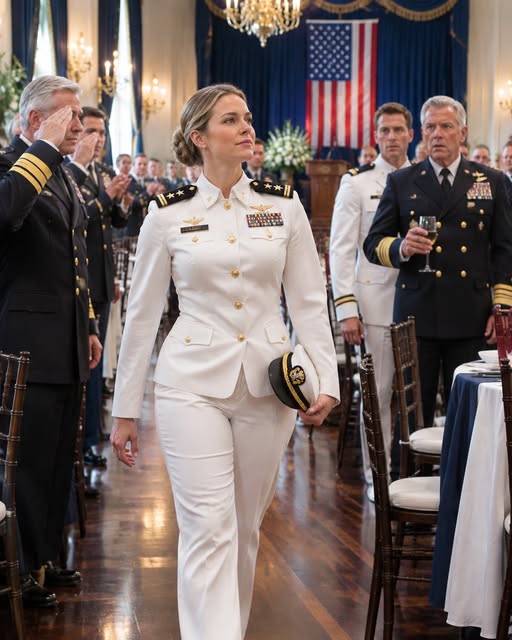
His gaze traveled from the polished black oxfords, up the razor-creased trousers of the service dress whites, past the rows of ribbons anchored across my left breast, and locked squarely onto the shoulder boards.
Three silver stars gleamed against the blue backing.
Vice Admiral.
The young sailor’s tablet hit the rubber mat of the guard box with a sharp plastic smack. His heels clicked together so violently his spine snapped into a steel rod.
""Atten-tion on deck!"" his voice cracked, ringing across the concrete barrier and echoing off the brick facade of the auditorium.
""At ease, Petty Officer,"" I said, my voice quiet, conversational, and carrying the unhurried authority of someone used to briefing theater commanders before sunrise. ""My name was omitted from the seating manifest. I'm here for Captain Hayes's retirement.""
""Ma'am—Admiral, ma'am—I didn't—the roster was submitted by the personal aide—""
""I know who submitted it,"" I replied, stepping past the turnstile. ""Open the gate.""
He lunged for the hydraulic release button as if his career hung on the fraction of a second it took the magnetic latches to disengage.
The heavy double doors of the auditorium were twenty yards away. Through the frosted side panes, the ceremony was already beginning. The muted drone of an invocation drifted through the acoustic seals, followed by the crisp, formal cadence of the master of ceremonies reading Daniel Hayes’s service summary: thirty-five years of surface warfare, destroyer commands, staff postings at the Pentagon, a career measured in polished brass and spotless administrative reviews.
I didn't enter through the side aisle where latecomers were usually funneled.
I reached for the central brass bar and pushed both doors open.
The auditorium held eight hundred people. The center aisle was fifty yards of deep blue carpet, lined on both sides by officers in choker whites, their gold braid catching the high overhead floods. On the raised dais at the far end stood my father, hands clasped behind his back, chin lifted, basking in the glow of his final official hour. Beside him stood Michael, immaculate, wearing the two stripes of a lieutenant, looking every bit the proud son of a proud captain.
The click of the heavy oak doors closing behind me cut through the acoustics of the room.
The master of ceremonies, a commander with ribbons from the Gulf War, paused mid-sentence. His eyes drifted from the lectern, down the long blue runner, and went wide.
In the military, protocol is muscle memory. It doesn't wait for permission, and it doesn't wait for family politics.
Row fifteen was entirely occupied by operators from Naval Special Warfare Group Two—men with broad shoulders, weathered faces, and civilian-cut beards that marked them as active-duty SEALs.
A master chief on the aisle saw my face first.
His jaw tightened. His eyes dropped to the ribbons, then snapped to the three stars on my shoulders.
He didn't hesitate. He didn't look toward the dais for guidance.
""Attention on deck!"" the master chief's voice roared through the vaulted hall, an acoustic thunderclap that rattled the light fixtures.
Three hundred men and women in the center block rose as one single, synchronized movement. The collective rustle of wool, the sharp stamp of boots, and the snap of salutes sounded like an artillery breach locking shut.
The entire auditorium followed. Admirals on the platform scrambled to their feet. Rear commanders pushed their chairs back so fast the wooden legs squeaked against the stage floor.
My father stood frozen.
His hands, still locked behind his back, twitched once. His smirk—the smug, dismissive curve of his lips from the parking lot—disintegrated into a slack, uncomprehending mask. Beside him, Michael’s jaw dropped, his hand rising in a ragged, late salute that wavered in the air.
I didn't look at my father.
I kept my chin level, eyes straight ahead, and walked down the center aisle at a measured, deliberate cadence.
Every step was silent. Three hundred pairs of eyes tracked my passage, the silence so dense you could hear the flutter of the American and Navy colors flanking the stage.
As I reached row fifteen, the master chief who had called the room lowered his salute by an inch, his voice dropping into a harsh, respectful murmur that carried only to me:
""Silent Echo remembers, Admiral.""
I offered him a single, crisp nod. ""Master Chief.""
I walked up the carpeted stairs to the dais.
Rear Admiral Vance, the regional commander presiding over the ceremony, stepped out from behind the ceremonial table, his hand coming to his eyebrow in a flawless salute.
""Admiral Hayes,"" Vance said, his voice carrying through the open microphone at the podium. ""We weren't informed you were able to clear your schedule from the Pentagon. An honor to have you on the platform, ma'am.""
""Thank you, Admiral Vance,"" I replied, returning the salute cleanly. ""I apologize for the late arrival. My name was missing from the security desk.""
Vance blinked, his gaze flicking toward my father with an icy, professional confusion that every junior officer in the room could read like an indictment.
My father had turned entirely gray. The silver hair that gave him such a distinguished presence at backyard barbecues looked thin under the stage lights. His collar seemed suddenly three sizes too tight.
""Rebecca,"" he whispered, the name slipping out of him before he could stop it.
I turned to him, my posture immaculate, hands resting easily at my sides.
""Captain Hayes,"" I said, my voice steady, amplified through the hall's sound system. ""Congratulations on thirty-five years of service.""
He stared at the stars on my shoulders as if they were burning white-hot metal.
He had expected me to slink away to my car. He had expected me to drive back to Washington in silence, nursing the familiar sting of being the invisible daughter.
Instead, the daughter he had erased was the senior officer in the room.
And behind the pride and the shock draining from his face, I saw something far worse than embarrassment.
I saw sheer, unadulterated dread.
Not because his daughter outranked him.
Because Captain Daniel Hayes had just realized who had been signing the operational directives for his son's deployment orders for the last three years.
---
Related Stories