Chapter 1: The Bread and the Eyebrow
The autumn wind off Lake Michigan had teeth that afternoon, carrying the sharp scent of damp asphalt and cooling diesel down 35th Street.
I had spent three hours walking through a gutted brick warehouse on the edge of Bronzeville—a forty-thousand-square-foot commercial shell that my firm was preparing to acquire for seven million dollars. My smartphone vibrated rhythmically in the pocket of my wool coat, flashing incoming approvals from Frankfurt and London, each notification representing more capital than an ordinary family would see in three lifetimes.
I stepped into the corner bakery simply to escape the cold while waiting for my driver to bring the car around. The shop smelled of cinnamon, scorched butter, and cheap industrial floor soap.
Then a small voice from the front counter cut clean through the chime of the door.
""Mom, one is enough. Eli and I can share.""
The sentence didn't sound like a child asking for a favor; it sounded like an adult making a battlefield concession.
I paused beside the wire display rack, turning my head toward the register.
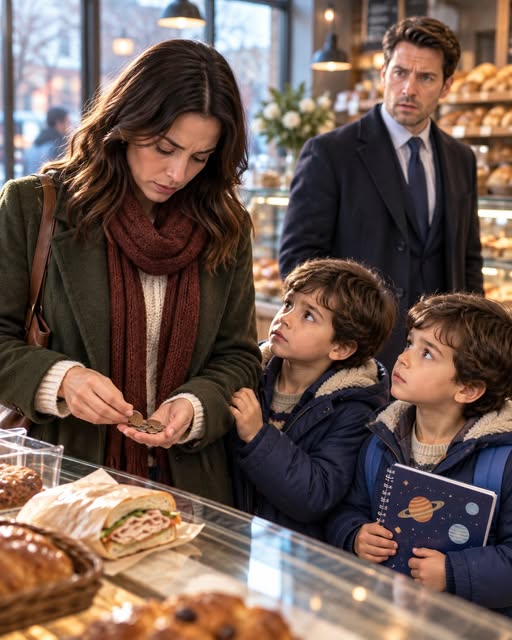
A slender woman stood at the counter, her worn navy trench coat buttoned to the throat, her fingers trembling slightly as she counted nickels and pennies into the palm of her hand. Beside her stood two small boys, both wrapped in oversized jackets with the collars turned up. One leaned against her hip for warmth; the other held a battered blue spiral notebook pressed tight against his chest, its cover decorated with hand-drawn planets.
""You don't have to worry about that, Theo,"" the woman whispered softly, her fingers probing the lining of her pocket. ""Let me check the other side. We have enough.""
My chest contracted so violently I nearly dropped my keys.
Naomi.
Five years.
Five years since the rain-soaked bedroom in Lake Forest where our marriage had fractured along the fault lines of my rising ambitions. I had stood in a tailored suit, surrounded by packing boxes, and told a passionate, gifted science teacher that her small-town classroom was an embarrassment to a man courting international private equity.
""If you can't support my life, you can leave it,"" I had snarled at her.
She hadn't yelled. She hadn't thrown anything. She had simply zipped her canvas duffel bag, walked down the marble staircase, and vanished into the winter dusk. I had let her go because I believed that pride was the only currency that mattered.
Now, she was three feet away, struggling to buy lunch.
The baker behind the glass display case—a burly man with flour on his forearms and a nametag that read Frank—glanced down at the coins, then gently pushed them back across the laminate counter. He reached under the shelf and pulled out a second wrapped paper package.
""I made an extra turkey sandwich before the noon rush, Naomi,"" Frank said, his voice warm and casual. ""Take it before I end up eating a second lunch myself.""
""Frank... no,"" Naomi murmured, her cheeks coloring. ""I have the coins.""
""You can help my niece with her science fair project on Saturday,"" Frank said with a broad, easy smile. ""We'll call it even.""
Naomi’s fingers closed around the coins, her shoulders dropping in a mixture of profound relief and suffocating humiliation.
Then the little boy holding the notebook looked up.
The room seemed to tilt on its axis.
His dark hair was tousled, his jaw was square and firm, but it was his brow that stopped my heart cold. Above his left eye, his eyebrow arched upward in a distinct, crooked line—a genetic signature that had belonged to my grandfather, my father, and me.
Resemblance wasn't proof. But looking down at that child, every spreadsheet, every contract, and every dollar in my corporate portfolio dissolved into static.
Naomi turned, guiding the boys toward the door, and her eyes locked onto mine.
Every trace of color fled her face. For three seconds, she stood frozen on the linoleum, her breath catching in her throat, her hands instantly pulling both boys behind the folds of her coat.
""Can we talk?"" I stepped forward, my voice cracked and unfamiliar to my own ears.
Naomi's gaze darted to the children, then back to my face, her eyes hardening into cold, unyielding iron.
""Not here,"" she said.
I pulled a heavy silver business card from my pocket, scribbled my private cell number on the back, and held it out. She took it between two fingers, carefully avoiding any contact with my skin, turned on her heel, and ushered the boys into the street.
That evening, sitting alone in my Lake Forest study, I ordered my senior attorney, Martin, to pull my original divorce file from storage.
At nine o'clock sharp, my personal phone lit up with a text message containing the address of a 24-hour diner on the South Side.
Then a second text arrived:
""Before you ask why I never told you, understand that I tried.""
Related Stories