Chapter 1: Two Envelopes
The marble corridor fell so silent that I could hear the scanner buzzing in the hostess's hand.
My husband stood next to my side in his Army dress uniform, his medals arranged as precisely as he always positioned them for photographs. Ten minutes before, in the car, he'd adjusted his collar in the mirror and cautioned me against making small talk.
""There are generals here, Sloane.""
""I know.""
""Cabinet secretaries.""
""I know.""
As we approached the East Wing checkpoint, he leaned toward my ear. ""Just smile when you're expected to.""
That was what settled heavily in my chest. Not the command. Not his hushed voice. The belief that I was only there as an ornament.
My husband is Colonel Mitchell Ashcroft. I'm Colonel Sloane Merrick. Equal rank. Same Army. Twenty-four years of service apiece. Yet throughout our three years of marriage, Mitchell had regarded my work in Army logistics as little more than an inflated office assignment.
At barbecues, he introduced me as ""the queen of spreadsheets."" At his mother's home, he joked that the Army had finally entrusted me with the oversized paper clips. His mother would chuckle, pat his arm, and say she was relieved that at least one of us had a career ordinary people could understand.
I allowed them to laugh. I couldn't explain what my office truly handled. I'd signed documents that prohibited it. I'd spent time in rooms where phones were forbidden, organizing evacuation routes, transporting medicine, fuel, aircraft, and personnel through regions most of tonight's guests couldn't locate on a map.
So I remained silent. And Mitchell took my silence as proof that I had nothing important to say.
Then the invitations arrived. His came first. Heavy cream-colored paper, with his name printed prominently. He raised it in our kitchen like a decoration of honor and phoned his mother before the envelope flap had fully fallen. ""Mom, we're going to the White House!"" Only it wasn't exactly ""we."" It was him.
My invitation arrived two days afterward, inside an ordinary government envelope. Different directions. A distinct arrival time. And a single line from the White House protocol office that made my hands freeze above the kitchen counter.
I slipped it into my desk drawer without saying anything.
On the evening of the ceremony, Mitchell hardly glanced at me until we approached security. He produced his invitation with a small flourish. The hostess scanned it and offered a smile.
""Welcome, Colonel Ashcroft.""
He gave a satisfied nod, as though the entire building had just validated everything he believed about himself.
Then she faced me. I opened my handbag and passed her my envelope.
Mitchell's smile faltered. ""What's that?""
I said nothing. I simply watched as the scanner moved across the small square code. Beep. The hostess studied her screen. Then she scanned it once more, more slowly. Her expression shifted first. Then her posture changed. She reached toward the radio fastened to her jacket.
""Protocol, checkpoint one,"" she said softly. ""She's arrived.""
Across the corridor, a four-star admiral interrupted himself halfway through a sentence. He excused himself from two generals and headed directly toward us.
Mitchell moved uneasily beside me. ""Sloane,"" he whispered. ""What's happening?""
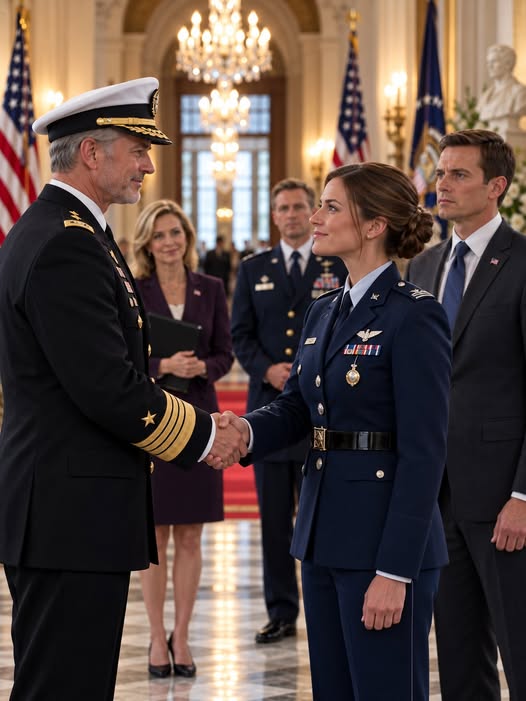
The admiral came to a stop before me and extended his hand.
""Colonel Sloane Merrick. It's a privilege to finally meet you face-to-face.""
My husband's shoulders stiffened.
I took the admiral's hand. ""The privilege is mine, sir.""
""The President instructed us to inform him the instant you arrived.""
Mitchell inhaled so sharply that the hostess turned to glance at him.
A protocol officer approached, clutching a black folder against her chest. She greeted me with a warm smile. Then she looked toward my husband with the measured courtesy people adopt when they're discreetly shutting a door.
""Sir, your designated seating is this way.""
Mitchell moved forward. ""My wife is with me.""
""Colonel Merrick has separate seating, sir.""
That single sentence accomplished what three years of arguments had failed to do. It brought the truth into the open without anyone lifting their voice.
I accompanied the admiral toward the East Room. At the entrance, I glanced back once. Mitchell remained standing at the checkpoint, one hand partially raised, as though refusing to comprehend what was happening might somehow prevent it.
Rows of golden chairs extended across the room. High-ranking officers rose as I passed them. An Air Force general greeted me with a smile, as if my name had been circulating around him for months.
""So you actually exist,"" he remarked quietly.
""Only on good days, sir.""
He laughed and directed me toward the front row.
The President entered. Everyone rose. Applause echoed beneath the chandeliers. I rested my folded hands in my lap.
The President started speaking. About work done quietly. About those who prepare for the worst day in someone else's life, ensuring that day ends with those people returning home. About heroes whose names never appear in headlines.
Mitchell was seated eight rows behind me. For the first time in three years, he was genuinely paying attention.
Then the President turned toward the front row. His eyes settled directly on me. And he hesitated, just before speaking my name.
---
Related Stories