Chapter 5: The Line in the Sand
My father’s bourbon glass tipped over on the workbench.
The amber liquid spread across the scarred pine boards, soaking into the cardboard flaps of the Defense Logistics Agency box, dripping off the edge with a rhythmic, hollow *tap-tap-tap* onto the cold concrete floor.
Robert Miller didn't reach out to catch the glass.
His hands hung limp at his sides, his shoulders curving inward as if his spine had suddenly surrendered its strength. He stared at the green canvas inserts inside the trunk, then up at my face, his breath coming in ragged, shallow gasps that sounded like tearing paper.
“Your aircraft?” my father croaked.
“My aircraft,” I repeated.
Behind me, Tyler sank to his knees on the concrete, his forehead pressing against the jamb of the side door, his hands clutching the back of his neck as he began to weep—not with the theatrical panic he had shown at the restaurant, but with the quiet, broken hysteria of someone who had finally realized the world was not a stage built for his entertainment.
Madison stood in the shadows behind him, her hands clamped over her mouth, staring at her father-in-law as though a demon had taken his seat in the garage.
“I didn't know, Emily,” my father whispered, tears finally breaking past his weathered eyelids and carving pale tracks down his stubbled cheeks. “I swear to you on your mother’s life... they told me the hardware was commercial surplus. They told me it was going to a private security firm in South America!”
“You didn't ask, Dad,” I said, feeling no triumph, no satisfaction, only that vast, freezing emptiness that comes when the people who were supposed to protect you turn out to be the ones who left the wire open. “You didn't ask because five thousand dollars a pallet was enough to keep Tyler in his crossover and keep your friends at the lodge thinking you were a successful man.”
Maddox stepped forward, pulling a pair of steel hinged handcuffs from his belt with a single, sharp metallic click.
“Robert Miller,” Maddox announced, his voice dropping into the formal, unvarnished cadence of federal law enforcement. “You are under arrest for conspiracy to violate the Arms Export Control Act, theft of government property, and aiding an unregistered foreign diversion network.”
My father didn't run. He didn't protest.
He slowly held out his thick, calloused wrists, the hands that had taught Tyler how to throw a baseball and had never once held a trophy I had won in high school track.
Maddox snapped the steel around his wrists with clinical efficiency.
The side door of the garage clicked open wider, and two federal marshals in dark tactical vests stepped through the frame, their weapons holstered, moving with the quiet precision of men who had done this a thousand times. They took my father by his elbows, turning him toward the driveway where the blue and red strobe lights of four unmarked vehicles were already painting the pine trees in silent, pulsing flashes.
As they led him past me, my father stopped.
He didn't look at Tyler. He didn't look at Madison.
He looked at the small silver lapel pin on my leather jacket—the miniature command wings of an Air Force master aviator that I had worn since my promotion last spring.
“Emily,” my father wept, his voice barely audible over the crunch of gravel outside. “What are you going to do?”
I looked straight into his bloodshot eyes.
“I’m going to do my duty, Robert,” I said softly. “The same thing I’ve done every day for fifteen years while you were pretending I didn't exist.”
The marshals guided him through the door into the cold night air.
The garage fell into a terrible, heavy silence, broken only by the low hum of the fluorescent tubes overhead and Tyler’s muffled sobs from the floor.
Maddox remained standing beside the workbench, holding an evidence bag, his eyes scanning the remaining shipping manifests scattered across the pine boards.
“Colonel,” Maddox said quietly.
I turned to him, zipping my leather jacket up to my throat against the damp draft blowing through the open door. “Yes, Gunny?”
“Major Higgins will receive my official report at zero-six-hundred,” Maddox said. “Corporal Miller will be placed on administrative suspension pending formal charges under Article One Hundred and Eight.”
He looked down at Tyler, who was still curled on the floorboards like a discarded uniform.
“Tyler won't be going to federal prison, ma'am,” Maddox added, his tone softening by a fraction. “The US Attorney agreed that his cooperation in identifying the Wilmington distributor warrants a referral to a special court-martial rather than a civilian indictment. He’ll lose his rank, he’ll receive a bad-conduct discharge, and he’ll forfeit two-thirds of his pay for six months. But he won't do hard time in Leavenworth.”
I looked down at my brother.
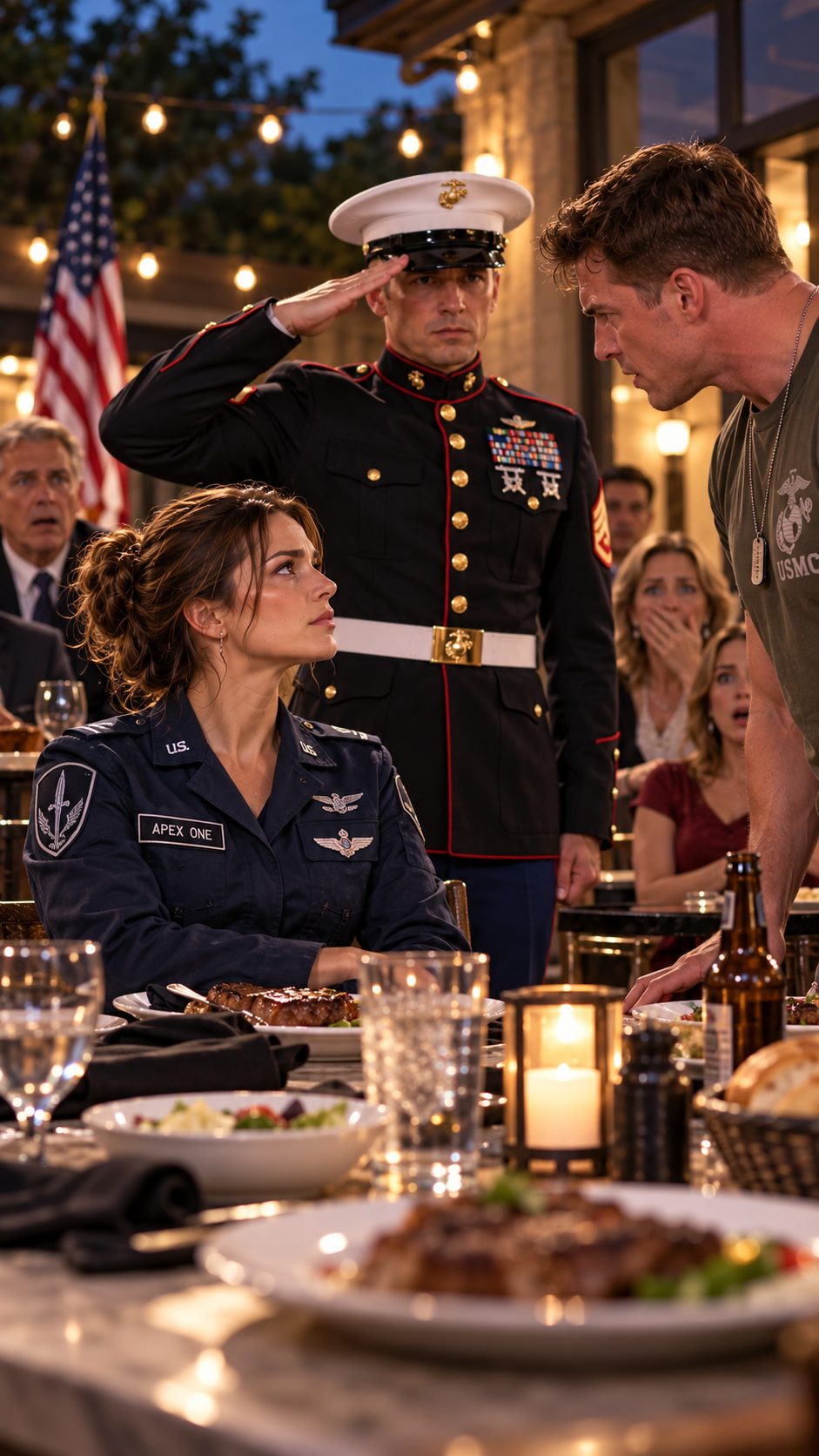
The golden child. The high school quarterback. The Marine who had demanded to hear my call sign so he could laugh at me in front of strangers.
He was twenty-four years old, sitting in the motor oil of his father’s garage, stripped of his uniform, his career, and his arrogance, left with nothing except the cold concrete beneath his knees.
“Thank you, Gunny,” I said to Maddox.
“Don't thank me, Colonel,” Maddox replied, offering a crisp, respectful nod. “I was just paying back a debt from Shigal.”
He turned and walked out the door, leaving me alone in the garage with my brother and his terrified wife.
Madison slowly knelt beside Tyler, putting a trembling hand on his shoulder, but Tyler didn't look up. He kept his forehead pressed to the floor, shivering in the cold, weeping until his breath gave out.
I walked to the door, stepped out onto the gravel driveway, and looked toward the house.
On the front porch, standing under the amber coach light in her bathrobe, was our mother.
Eleanor stood frozen, clutching the wooden railing with both hands, watching the red taillights of the federal cruisers disappear down Oak Ridge Road into the black pines. She didn't call out. She didn't scream. She simply stood there in the freezing mountain wind, looking down at the empty driveway, realizing that the family empire she had guarded with her silence had just been carried away in the back of two government sedans.
I didn't walk up to the porch.
There were no words left that could fix thirty years of willful blindness.
I walked to my rental car, unlocked the driver’s door, and slid behind the wheel. The leather was cold, but the engine started with a smooth, powerful hum, the headlights cutting two bright beams through the dark gravel lane.
I pulled my government phone from my pocket, tapped my thumb against the biometric sensor, and opened my encrypted communication app.
A single priority notification was waiting on the screen, sent forty minutes ago from the Joint Special Operations Command watch floor at Fort Liberty:
*COMMANDER, 24TH STRS: BE ADVISED. MISSION CORRIDOR 'APEX' RECLASSIFIED TO ACTIVE THEATER DEPLOYMENT AS OF 0400 HOURS. C-17 TRANSPORT ON STATION AT POPE FIELD FOR IMMEDIATE AIRBORNE INSERTION. SQUADRON COMMANDER REQUIRED ON SITE.*
I stared at the glowing green letters on the glass.
The world outside this quiet suburban driveway was waiting—a world where integrity wasn't an option, where loyalty was measured in actions rather than boastful words, and where the people under my command trusted me with their lives every single night.
I shifted the car into drive, turned down the lane toward the highway, and left the Miller house behind me in the dark.
Then my phone vibrated in my hand.
A new incoming secure dispatch, routed through an unlisted naval satellite relay, flashed across the screen with a red priority banner:
*ALERT: ANONYMOUS COMM BOUND TO APEX FREQUENCY RECEIVED AT CAMP LEJEUNE PROVOST MARSHAL. ORIGIN: PORT OF WILMINGTON DOCK 4. MESSAGE READS: 'THE TRUCKS DIDN'T CARRY NIGHT-VISION GEAR TONIGHT, EMILY. CHECK THE FLIGHT MANIFEST FOR YOUR MOTHER'S TRIP TO ATLANTA TOMORROW MORNING.'*
Related Stories