Chapter 4: The House on Oak Ridge
The drive to my parents’ house took twenty-two minutes through dark, winding county roads lined with tall loblolly pines.
Maddox rode in the passenger seat of my rental sedan, his government phone plugged into the auxiliary port, a low stream of encrypted telemetry data scrolling across the dashboard display.
Madison followed behind us in her crossover, her headlights bouncing in our rearview mirror like twin nervous eyes. Tyler was in the passenger seat of her car; Maddox had confiscated his military ID and cell phone before we left the steakhouse parking lot, leaving my brother stripped of every scrap of leverage he possessed.
My parents lived in a two-story brick colonial on Oak Ridge Road, set back on three acres of manicured lawn.
The house was dark except for the amber coach light above the front door and a single fluorescent glow coming from the detached three-car garage behind the kitchen.
I cut the engine fifty yards down the driveway, rolling to a stop on the gravel beneath the shadow of a weeping willow.
“Federal marshals have the rear property line covered through the tree line,” Maddox said, disconnecting his phone and sliding it into his holster. “The warrant is authorized for immediate execution, but the United States Attorney agreed to let me conduct an on-site interview first, provided you are present as an active military observer.”
“Why me, Maddox?” I asked, my hands resting on the steering wheel, my knuckles pale in the dim dashboard light. “Why drag me into the middle of this?”
Maddox turned his head, his scarred face illuminated by the green glow of the digital clock.
“Because two years ago in the Shigal Valley, when you stayed on station with a burning engine to pull my team out of the rocks, you could have punched out,” Maddox said, his voice quiet, stripped of all clinical protocol. “Your wingman told you to eject. The command post told you to eject. You stayed because you wouldn't leave Americans on the ground.”
He reached across the console, his rough thumb tapping the yellow carbon receipt resting on the dash.
“Your father took three hundred thousand dollars in kickbacks to clear these shipments, Emily,” Maddox said. “And two weeks ago, four of those monoculars were recovered from an intercepted smuggling boat off the coast of Yemen. If those serial numbers hit the open wire without context, the military brass will look at your last name, look at your squadron command, and assume you were the umbrella protecting the operation.”
My stomach went completely cold.
The pieces shifted again.
Tyler hadn't just used my name to intimidate an armory officer.
The syndicate running the diversion had chosen Robert Miller specifically *because* his daughter was a newly selected special operations commander. If the federal hammer ever fell, the paper trail was designed to look like a family conspiracy—an Air Force colonel funneling equipment through her Marine brother and retired civilian father.
My entire career.
Fifteen years of broken sleep, ruptured eardrums, lost friends, and silent sacrifice.
All of it had been positioned by my own father to serve as the blast shield for his illegal retirement fund.
“Let's go,” I said.
We stepped out onto the damp gravel. The night was cold, the wind rustling through the pine needles with a dry, hissing whisper.
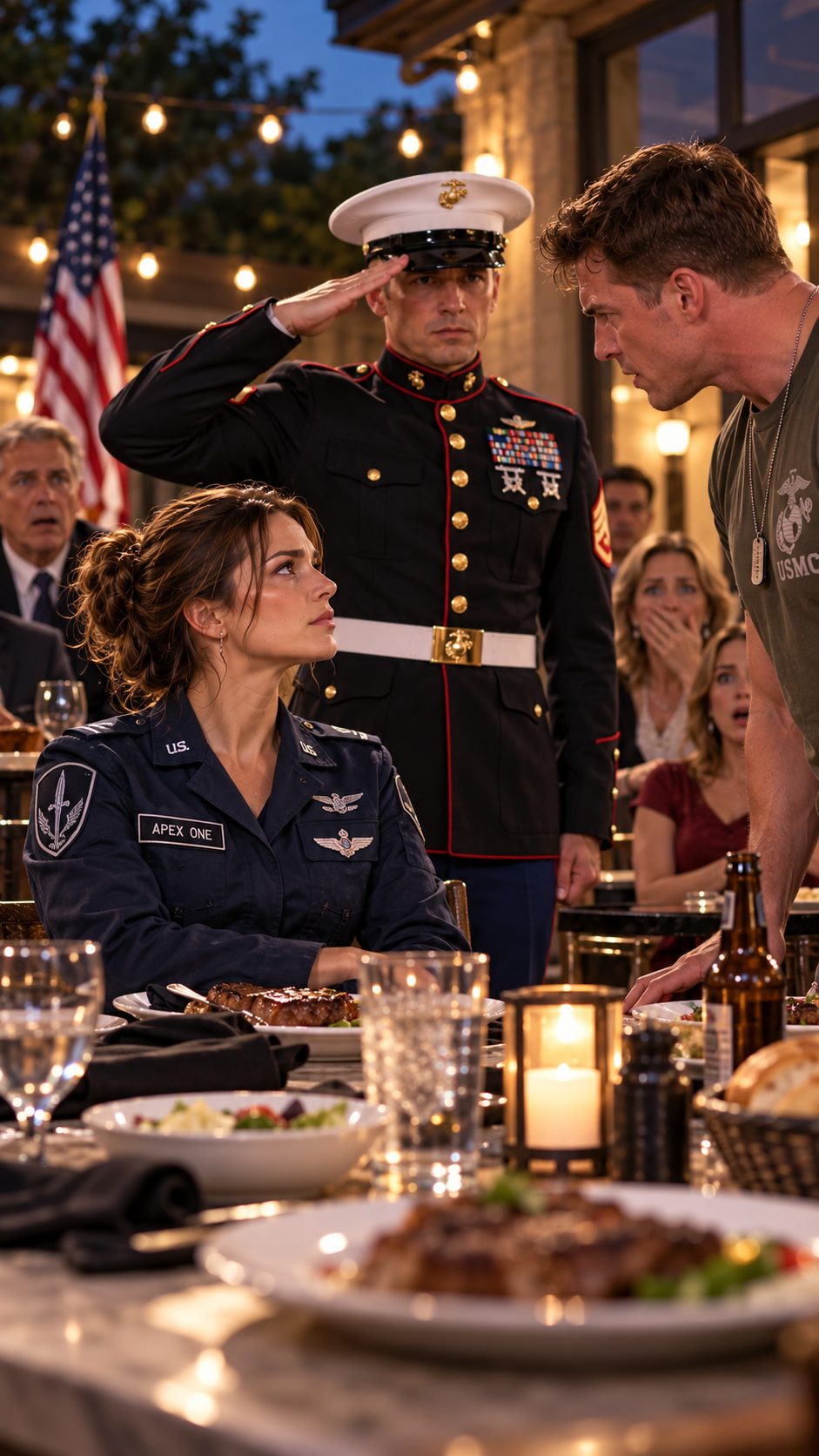
Madison pulled up beside us. She killed her engine, and Tyler stepped out into the night air. He looked smaller now, his shoulders hunched, his Marine Corps shirt damp with sweat and stale beer, his eyes darting frantically toward the dark windows of his childhood home.
“Emily,” Tyler stammered, his teeth chattering in the mountain chill. “What are we doing here? If the feds are coming, we should call a lawyer! Dad knows the county judge!”
“Shut up, Tyler,” I said, not even turning my head to look at him.
We walked up the brick walkway toward the detached garage.
Through the frosted glass panels of the side door, I could see the silhouette of my father. He wasn't sleeping. He was standing beside his heavy industrial workbench, wearing his gray work fleece, a glass of bourbon in his hand, looking down at an open metal shipping trunk.
I didn't knock.
I turned the brass knob, pushing the heavy wooden door open until it clicked against the wall bumper.
The smell of motor oil, sawdust, and cold damp concrete hit me instantly.
Robert Miller froze.
His back was to us, but his shoulders hitched toward his ears as the latch clicked. He didn't turn around immediately. He slowly raised his glass of bourbon, took a long, burning swallow, and set it down on the scarred pine workbench beside an open cardboard box labeled *DEFENSE LOGISTICS AGENCY // PROPERTY NUMBER 884-A*.
“You shouldn't have brought that Marine to dinner tonight, Tyler,” my father said, his voice flat, weary, and entirely devoid of surprise.
He turned around slowly.
He looked at Tyler, shivering on the concrete threshold. He looked at Maddox, whose hand was resting casually inside his jacket near his service weapon.
And then his eyes settled on me.
For thirty-four years, Robert Miller had looked at me with disappointment—the daughter who wasn't a boy, the child who wouldn't stay in her lane, the girl who refused to let his booming voice dictate her choices.
Now, under the harsh hum of the overhead shop lights, he looked at me with something that looked terrifyingly like relief.
“Hello, Emily,” my father said softly.
“Dad,” I replied, stepping past Maddox until I was standing three feet from the shipping trunk.
Inside the green canvas foam inserts lay six AN/PRC-152 tactical radio units, each bearing the red classification band of the National Security Agency.
Cryptographic communications hardware. The kind of radios that allowed ground forces to coordinate direct air support without being jammed by electronic warfare arrays.
The exact radios my squadron used every single day.
“How long, Dad?” I asked, my voice carrying the steady, chilling weight of an officer reading an execution warrant.
My father looked down at the radios, his fingers lightly brushing the rubber antennas.
“Your brother was drowning in Raleigh four years ago, Emily,” my father whispered, the words dragging out of his chest like gravel. “He lost his truck. He took out two payday loans to pay for Madison’s engagement ring. He came to this garage on a Sunday afternoon, sat on that tool chest, and cried like a baby.”
Tyler made a choked, strangled sound near the door, but Maddox stepped in front of him, keeping him silent.
“I went to the bank,” my father continued, his eyes wet, staring at the scarred wood. “I applied for an equity line on this house. The loan officer told me that after thirty years at the utility, my credit limit was tapped out. He told me that an engineer on a fixed pension wasn't worth thirty thousand dollars.”
He lifted his head, his gaze locking onto mine with an ugly, defiant spark of justification.
“Then an old contractor from the port called me,” my father said. “He told me that if I allowed a few freight pallets to sit on the substation loading dock for forty-eight hours between truck runs, he would deposit five thousand dollars into an offshore escrow account in the Bahamas. Just signatures on shipping vouchers, Emily! Nobody was supposed to get hurt!”
“Nobody was supposed to get hurt?”
My voice didn't rise, but every word cracked through the garage like dry timber snapping under an overload.
“Those radios are keyed to the NATO tactical data link, Dad,” I said, pointing at the green trunk. “If an adversary gets their hands on that frequency hop algorithm, they can triangulate every special operations bird within four hundred miles of the Persian Gulf.”
I took one more step, closing the distance until I could smell the bourbon on his breath.
“You didn't just steal from the government, Robert,” I said, dropping the title of father like an empty casing. “You sold the tactical frequency that my pilots use to come home alive.”
My father blinked.
The justification drained out of his eyes, replaced by a sudden, sickening realization that seemed to hollow out his entire chest.
“Your pilots?” he whispered.
“I’m the commanding officer of the 24th Special Tactics Reconnaissance Squadron, Dad,” I told him, each word cold as deep space. “The unit that uses that exact cryptographic key. If those radios cleared the port of Wilmington tomorrow, the first aircraft that would have been targeted by hostile radar in the Middle East was mine.”
---
Related Stories