Chapter 5: The Chicago Ledger
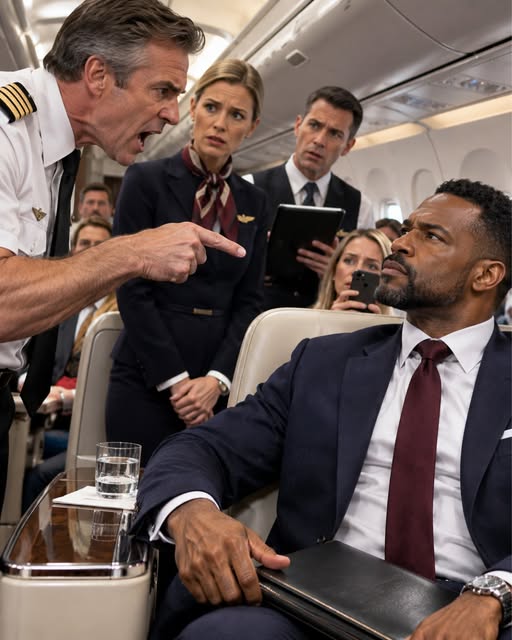
The descent through the cloud deck over Lake Michigan was smooth, the Boeing 737 banking gently over the glittering skyscrapers of downtown Chicago before aligning with Runway 27L at O'Hare.
The midday sun had broken through the morning fog, washing the tarmac in blinding, clean light.
When the wheels touched down with a crisp, barking chirp of rubber against grooved concrete, a quiet ripple of applause moved through the cabin—not the routine clapping of relieved tourists, but the collective release of eighty passengers who understood that they had ridden through a piece of history between gates.
The jet rolled to a halt at Gate B12.
The seatbelt chime extinguished, but before the passengers in coach could stand to pull their bags from the overhead bins, the forward curtain parted.
Captain Sarah Miller stepped out of the flight deck, followed by Brenda Torres, who had flown the jumpseat from the origin station to ensure the administrative handover was executed without friction.
Standing at the bottom of the jetway stairs, visible through the open boarding door, were four men in dark tailored suits and two uniform officers from the Chicago Police Department’s airport detail.
Among them stood a man with silver hair and an expensive camel-hair coat: David Higgins, the regional chairman of the Air Line Pilots Association.
Higgins held a heavy leather portfolio under his left arm. His face was gray, his jaw locked in that particular, defensive tension of an executive who knows he is about to surrender ground he has held for a decade.
I stood up from Seat 1A, buttoned my midnight-blue jacket, and picked up my black leather folder.
""Mr. Reed,"" Captain Miller said, extending her hand. Her grip was dry, firm, and carried the weight of an officer who had reclaimed her cockpit. ""Thank you for the flight.""
""Thank you for the professionalism, Captain,"" I replied, shaking her hand. ""Have a safe rotation to Denver.""
I stepped through the threshold onto the accordion floor of the jet bridge.
The cool, ozone-scented air of the Chicago concourse washed over my face, carrying the distant roar of turbofans and the rhythmic rumble of baggage carts on the lower service ramps.
David Higgins took two steps forward, his boots clicking heavily against the ribbed flooring.
""Malcolm,"" Higgins said, his voice strained, fighting for the easy, familiar camaraderie he had used during our contract negotiations six months ago. ""We need to talk about the wording of the press release. The union executive board is concerned that naming Parker directly in the systemic audit will create an adverse precedent for standard grievance arbitrations.""
I didn't stop walking.
I forced him to turn on his heel and match my pace as we moved down the long, carpeted incline toward the terminal doors.
""The statement was released fifteen minutes ago, Dave,"" I said, not looking at him. ""The *Tribune* already has the text. Associated Press picked up the wire two minutes later.""
Higgins’s mouth tightened. ""You moved without consulting the labor committee?""
""The labor committee had thirty years to address Steven Parker, Dave,"" I replied, stopping at the glass security partition that separated the gate concourse from the main terminal.
I turned to face him, the four men in suits forming an uneasy semi-circle behind him.
""You had forty-two formal complaints sitting in the personnel vault in Fort Worth,"" I continued, each word measured and cold as slate. ""Twelve from first officers. Nineteen from flight attendants. Eleven from ground personnel. Every single one of them was downgraded to an 'administrative communication error' because Steven Parker was the nephew of your former vice president.""
Higgins looked down at his leather portfolio, unable to hold my gaze.
""He had thirty-five years of service, Malcolm,"" Higgins muttered. ""He was five months from mandatory retirement. We could have handled this with a quiet medical leave.""
""My father didn't get quiet medical leave when his rotator cuff tore on Ramp Three in nineteen-ninety-eight, Dave,"" I said. ""Your committee denied his disability claim because you said his injury was pre-existing. He worked his final three years with his arm in a canvas brace, taking aspirin out of his lunchbox so he wouldn't miss a shift.""
I leaned in slightly, until my face was six inches from his silver hair.
""The era of quiet medical leave for men who abuse this company's workers is over. You will sign the joint administrative consent decree by three o'clock this afternoon, or I will instruct our legal team to file a federal civil rights injunction against the local union charter for systemic failure of representation.""
Higgins went completely pale. His fingers twitched against the leather of his folder, but he didn't argue. He knew the files. He knew the numbers.
And more importantly, he knew that the man standing in front of him wasn't an outside private equity liquidator who could be intimidated by the threat of a strike.
""The decree will be on your desk by two, Malcolm,"" Higgins whispered.
""Two o'clock is acceptable,"" I said.
I turned away from the union delegation and walked through the sliding glass doors into the main terminal rotunda.
Waiting near the information desk, holding a heavy wool overcoat over his arm, was an elderly man in a gray chauffeur's cap.
His name was Marcus Washington—Kevin Washington’s father.
He had retired from the airport postal facility seven years ago, and his hands, like my father’s, were permanently rough from thirty years of handling sorting trays and mail sacks in unheated hangars.
When he saw me walking across the terrazzo floor, he didn't snap a salute. He didn't bow his head.
He stood straight, his eyes bright with a deep, generational pride that had survived every indignity this city had ever thrown at his family.
""Good afternoon, Mr. Chairman,"" Marcus said softly, holding out the coat.
""Good afternoon, Marcus,"" I replied, slipping my arms into the dark wool. ""How is Kevin?""
A slow, brilliant smile broke across the old man’s face.
""He received a call from the chief pilot's office thirty minutes ago, Malcolm,"" Marcus said, his voice trembling slightly. ""He's assigned as the relief captain on the seven-eighty-seven rotation to Tokyo next Tuesday.""
I paused, looking at the grandfather clock hanging from the center of the terminal dome.
The hands showed twelve-forty-eight.
Thirty years late.
But right on time.
""Tell him to keep his approach speed clean, Marcus,"" I said, resting my hand firmly on the old man's shoulder as we turned toward the exit. ""We have high standards at this airline.""
Behind us, through the towering glass windows of the departure rotunda, Northstar Flight 417 was already pushing back from the gate, its polished aluminum wings catching the afternoon sun as it taxied toward the active runway, carrying a new captain, a new crew, and a sky that finally belonged to everyone.
Related Stories