Chapter 3: The Thirty-Year Roster
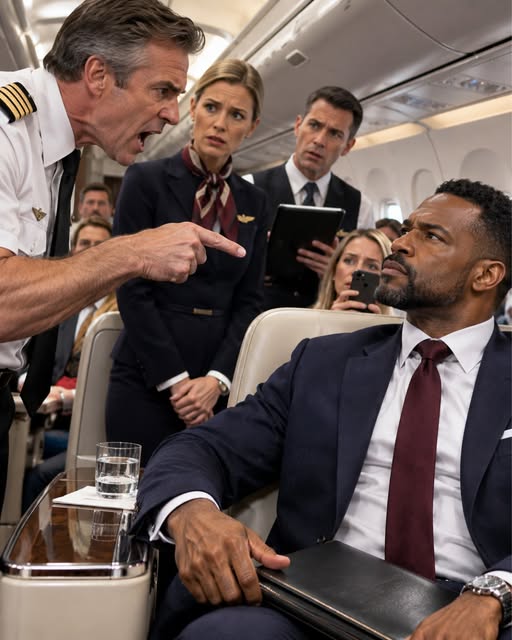
I laid the second document aside and picked up the third sheet from the black portfolio.
It wasn't printed on corporate bond paper.
It was an aged, yellowing photocopy of an internal personnel grievance from Trans-Midwest Airlines—the regional carrier that Northstar had absorbed thirty years ago during the deregulation wave of the early nineties.
The date stamped across the top was April 14, 1994.
I held it up toward Steven Parker.
The harsh fluorescent reading light over Seat 1A illuminated the signatures at the bottom: three ramp baggage handlers who had filed a formal complaint with the Equal Employment Opportunity Commission regarding a junior first officer who had spent six months directing racial slurs at the ground crew during baggage transfers.
The junior officer named in the 1994 complaint was First Officer Steven Parker.
And the lead complainant, whose neat, pencil-drawn cursive was still visible at the bottom of the page, was Charles Reed.
Parker’s breath left his lungs in a sharp, rattling hiss.
""Your father,"" Parker whispered, his eyes widening until the whites were visible around his dark pupils. ""He... he was the one who went to the regional director.""
""My father worked thirty-two hours of overtime that month to pay for the uniform I wore to my high school graduation, Steven,"" I said, my voice dropping into that quiet, absolute clarity that commanded boardrooms from New York to London. ""He sat in the breakroom on Ramp Three with his boots frozen to his socks, listening to you tell your captain that men like him belonged in the cargo hold with the luggage.""
Parker didn't answer. He couldn't.
The past—the buried, comfortable past where junior pilots could abuse baggage handlers without fear of consequences because nobody in corporate looked twice at the men in orange vests—had just walked out of the shadows and sat down in Seat 1A.
""My father didn't hate you, Steven,"" I continued, tracing the edge of the yellowed paper with my thumb. ""When the regional director dismissed that complaint thirty years ago because your uncle sat on the board of trustees, my father came home, washed the grease off his hands with kerosene, and sat down at our kitchen table.""
I looked up, meeting the captain’s hollow gaze.
""He told me that men who use their uniforms to diminish other people are always afraid of their own insignificance. He told me that one day, the arithmetic of this world would balance itself out. He just didn't live long enough to see the columns add up.""
""You bought the airline,"" Parker rasped, his back hitting the mahogany partition behind the galley. ""You spent five hundred million dollars... just to settle a thirty-year-old grudge?""
A low laugh rippled through the first few rows of the cabin.
The businessman in 2C shook his head, looking at Parker with pure disgust. ""You really think you're that important, don't you, Captain?""
I closed the portfolio with a soft, clean click of the silver zipper.
""I didn't buy Northstar for you, Steven,"" I said. ""I bought Northstar because it was a failing carrier with great routes, twenty thousand dedicated employees, and an executive culture that allowed men like you to treat this fleet like a private kingdom. You were simply an unpaid line item on a ledger I finally had the time to audit.""
Brenda Torres stepped forward, holding out a printed envelope bearing the official red seal of the Northstar Chief Operating Officer.
""Captain Steven Parker,"" Brenda announced, her voice echoing down the length of the silent cabin. ""As of eight-thirty-two this morning, your flight certifications have been suspended pending formal review by the Federal Aviation Administration. You are relieved of command of Flight 417. You will surrender your company identification, your airfield security badge, and your flight deck keys to First Officer Vance immediately.""
Parker didn't reach for his pockets.
He stood like an iron statue whose paint had begun to peel, staring down at the woman who had delivered the order.
""Brenda, call the union rep,"" Parker pleaded, his voice cracking into a high, jagged whine that sounded completely foreign coming from his broad chest. ""Call Dave Higgins. Dave knows me. We flew the Kuwait charters together during Desert Storm. He won't let this happen on an active jetway.""
""Dave Higgins was in the boardroom when the vote was taken, Steven,"" Brenda replied, her eyes steady, merciless. ""The union voted unanimously to accept the revised whistleblower protections. They aren't filing a grievance for you. They’re the ones who handed Mr. Reed the logs from Atlanta.""
The cabin began to move again, but not toward Parker.
Passengers were looking at their watches, checking their phones, and quietly leaning across the aisles to share what they had just witnessed with the people sitting across from them. The woman in 2B stopped her recording, tapped the screen twice to save the file, and looked up at me with a nod that carried thirty years of unwritten solidarity.
First Officer Marcus Vance stepped out from the cockpit, holding a leather key pouch and a black FAA-certified logbook.
He walked past Parker without breaking stride, stopping beside Brenda.
""First Officer Vance,"" Brenda said. ""Is the aircraft secured?""
""Cockpit is sterile, ma'am,"" Vance replied, his shoulders straight, his chin lifted. ""Checklists are complete through engine start. We have a reserve captain, Captain Sarah Miller, currently on standby in the crew lounge on Concourse B.""
""Call her,"" Brenda ordered. ""Tell her she has thirty minutes to take command of Flight 417.""
Vance nodded once, clicked his heels together in a crisp, military movement, and turned back toward the flight deck to begin the reconfiguration checklists.
Parker stood alone in the center of the aisle, his hands hanging limp at his sides, his four gold stripes looking suddenly like cheap yellow braid on an ill-fitting suit.
He looked at me one final time.
He wanted to say something—some final, cutting remark to salvage the wreckage of his thirty-five years in the sky. But when his eyes met mine, he saw only the calm, unblinking stillness of a man who had known the outcome of this game before the first pawn was moved.
Slowly, his fingers reached up to his shoulder boards.
He unclipped the gold-striped epaulets from his white shirt, dropped them onto the floor of the galley, and turned toward the open jet bridge door.
He didn't look at the passengers. He didn't look at his crew.
He walked out into the cold, drafty air of the jetway, his heavy footsteps echoing against the corrugated metal walls until the sound was swallowed by the roar of the regional jets spooling up on the tarmac below.
---
Related Stories