Chapter 5: The Unbroken Line
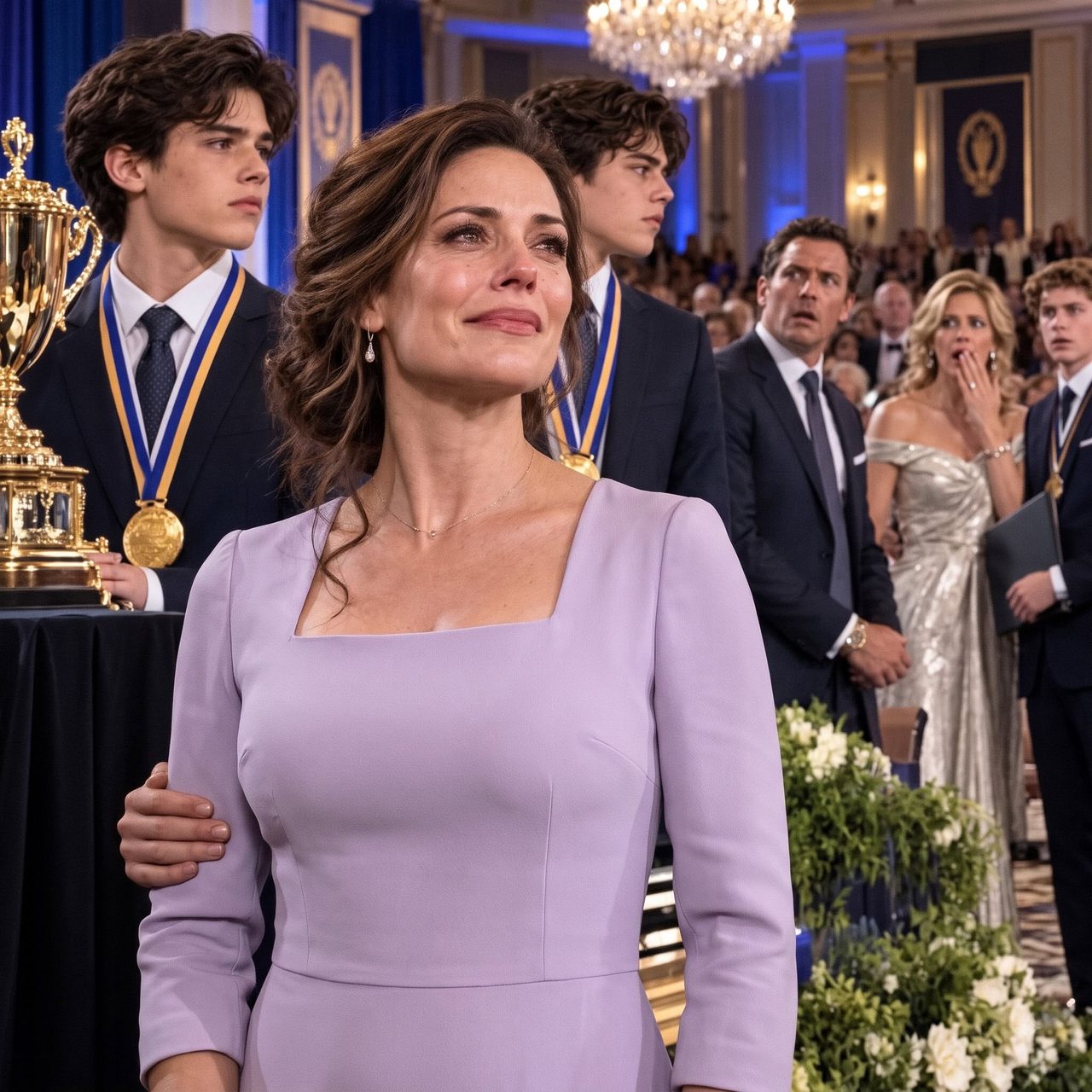
The awards ceremony was held in the grand ballroom under blazing crystal chandeliers.
The grand trophy—a massive, gleaming silver pillar mounted on an oak base—sat on a velvet table at the center of the stage.
“For unprecedented excellence across theoretical mathematics, computational modeling, and original research,” the board president announced into the microphone, his voice booming with pride, “the 2026 State Academic Championship grand prize is awarded unanimously to Noah Mercer and Eli Mercer!”
The applause was deafening. The entire room stood as one, cheering as my sons walked up the steps to accept the heavy crystal medals around their necks and the towering trophy between them.
They didn't look at the audience. They looked at each other, sharing a quiet, knowing smile that spanned thirteen years of quiet resilience, late-night study sessions, and the unbreakable bond of a home built on love rather than convenience.
When they stepped down from the stage, flashbulbs popped from local news cameras and academic journals.
I stayed near the back exit, slipping my hands into the pockets of my old winter coat. The patched lining didn't feel heavy anymore. It felt like armor.
As the crowd surged forward to congratulate the winners, a figure pushed roughly through the sea of people, heading straight toward me.
It was Richard.
His face was flushed, his tie crooked, his polished facade completely burned away by humiliation and burning, bitter realization.
He stopped two feet from me, breathing heavily.
“Rachel,” he whispered, his voice trembling with a desperate, pathetic urgency. “Rachel, look at them. Look at what they’ve achieved. We... we created that. My blood, my intellect... I gave them that foundation.”
I looked at him—really looked at him—for the first time all day. I didn't feel anger. I didn't feel the sting of the past. I only felt a profound, pitying emptiness.
“Your blood, Richard?” I asked softly, a faint smile touching my lips. “You walked away when they were three because you wanted a life without obligations. You left us with empty shelves and unpaid rent. They didn't build this brilliance on your foundation. They built it on the ruins you left behind, while you were busy trading your family for a shiny car and a country club membership.”
Richard staggered back a step, as if I had struck him across the face.
“I’m their father,” he choked out, his voice cracking. “I have a right to talk to them. I have a right to share this.”
“You lost that right the day you walked out that door without looking back,” a cool, steady voice interrupted.
Noah and Eli were standing behind me. The grand trophy sat gleaming between them on its oak base. They didn't tower over Richard with anger; they stood beside each other with the quiet, unshakeable strength of men who needed nothing from him.
Eli adjusted the heavy gold medal around his neck.
“We used our mother’s last name years ago, Richard,” Eli said, his voice entirely calm, entirely devoid of emotion. “And we filed the paperwork with a judge who actually cared about obligations. You weren't there when we learned to ride bikes. You weren't there when we solved our first equations. And you certainly aren't part of this.”
Richard stared at his sons—his real legacy, standing right in front of him—and finally understood the true cost of what he had thrown away.
Before he could speak, before he could reach out a trembling hand, Noah turned to me, offering a warm, brilliant smile that chased away every ghost of the past.
“Come on, Mom,” Noah said, taking my arm. “Let’s go home. We have a trophy to put on the kitchen table.”
Related Stories