Chapter 2: The Rules of the Game
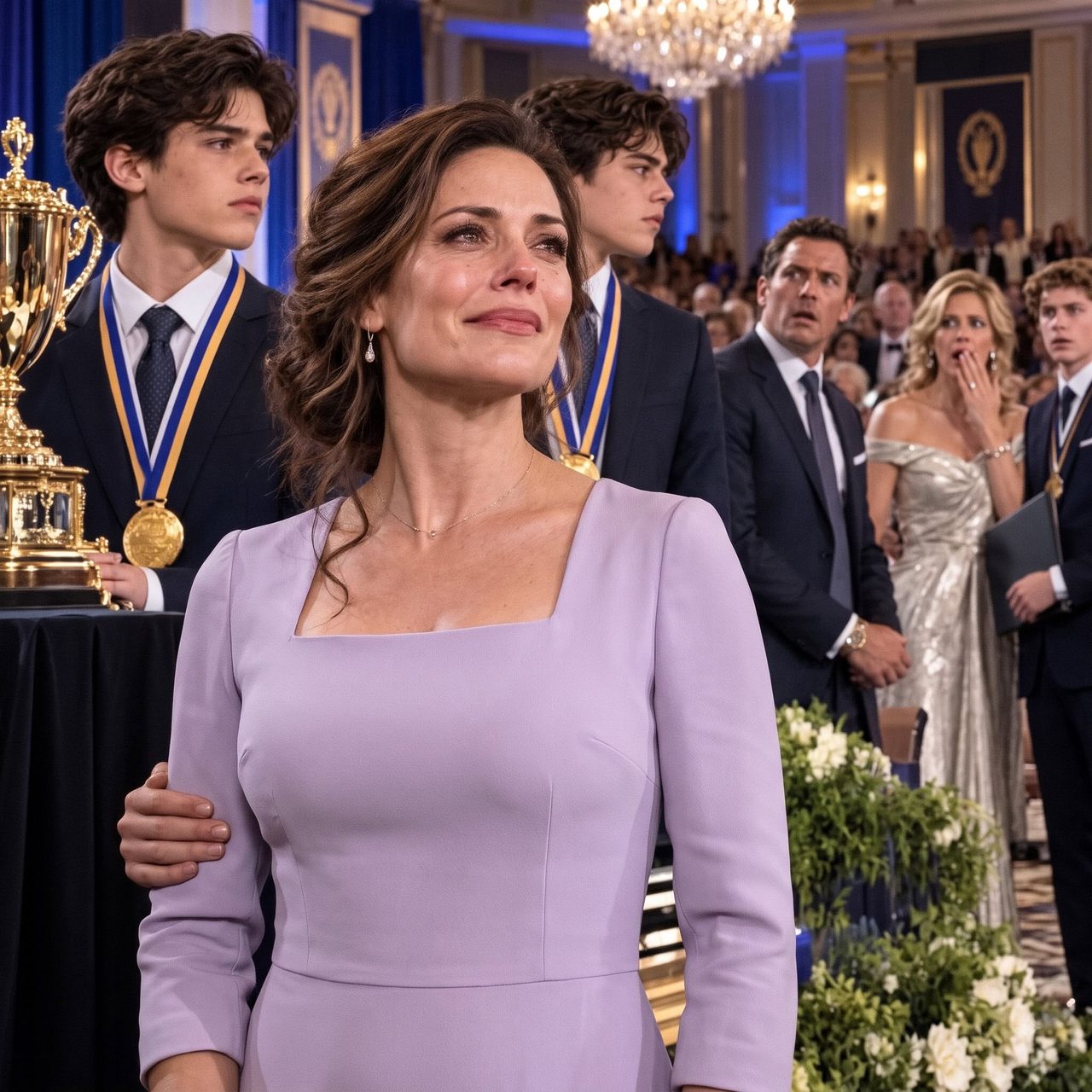
The main auditorium was packed with hundreds of students, nervous parents, and stern-faced judges holding clipboards. The air smelled of fresh paper, anxious sweat, and expensive cologne worn by parents trying to buy academic pedigree.
I found a seat in the back row, tucked beneath the balcony overhang where the shadows were deep and quiet. From here, I could watch the stage without drawing the attention of the private-school contingent occupying the front rows.
Vanessa and Richard had managed to secure seats in the third row, directly behind the judges’ reserved section. Cameron sat among the finalists in the front rows, wearing a custom blazer that cost more than my monthly grocery budget. He looked relaxed, occasionally turning around to whisper something to a group of boys from a prestigious academy across town, laughing softly behind his hand.
A few rows down from him sat Noah and Eli.
They didn't look around the room. They didn't care about the gold-leaf molding on the ceiling or the murmurs of the wealthy parents around them. Eli was quietly reviewing a notebook filled with dense, handwritten equations, while Noah adjusted the zipper of his canvas duffel bag, his expression entirely focused.
At precisely 9:00 AM, the state board president stepped up to the podium, tapping the microphone to quiet the room.
“Welcome, finalists, mentors, and families, to the twenty-third annual state academic excellence championship,” the president announced, his voice echoing off the mahogany walls. “This year, we have a record number of participants across mathematics, physics, and computational logic. Before we begin the morning heats, I want to highlight a historic milestone.”
In the front row, Richard straightened his tie, leaning forward with an expectant smile, clearly assuming the board was about to recognize a major endowment donation—perhaps the one he had bragged about making to the regional education fund last month.
“For the first time in the history of the competition,” the president continued, smiling broadly, “we have a tie for the highest preliminary score in the advanced mathematics division. Not only did these two students break the previous state record set in 2011, but they accomplished it independently, utilizing entirely novel proofs.”
Richard’s smile widened. He glanced back at Vanessa, giving her a subtle nod.
“Please give a round of applause,” the president said, raising his voice, “to Noah Mercer and Eli Mercer from the public district.”
The auditorium erupted into polite applause.
Richard’s smile vanished instantly. His head snapped around toward the stage, his eyes locking onto the two boys standing up from the middle rows to acknowledge the introduction.
Noah and Eli didn't smile or wave. They simply nodded once, their posture straight and unyielding, before sitting back down to open their binders.
Across the room, Vanessa twisted around in her seat, her eyes darting between the stage and me sitting alone in the shadows. I caught her gaze, lifted my chin, and didn't look away until she hurriedly turned back around, her face flushed with sudden, sharp embarrassment.
“That’s impossible,” Richard muttered loudly enough for the people around him to hear. “There must be a grading error. Public school kids don't break state records.”
A woman sitting next to him—the mother of one of Cameron’s classmates—frowned and looked at Richard sideways. “Excuse me? Those boys scored nearly ninety-eight percent on the logic modules. My son said their proof structure was revolutionary. Do you know them?”
Richard’s face tightened. He stared at the back of Noah’s head, his mind desperately trying to bridge the gap between the ragged toddlers he had abandoned in a cramped apartment thirteen years ago and the elite scholars now dominating the state championship.
“No,” Richard forced out through gritted teeth. “Never seen them before in my life.”
It was the first lie of many he would tell that day to protect his fragile, manufactured reality. But the competition was only beginning, and the scoreboard had a habit of telling the truth, no matter how loudly you tried to shout over it.
---
Related Stories