Chapter 3: The Base Hospital
The military ambulance siren wailed as it tore through the gates of Fort Knox, bypassing the civilian checkpoints and heading straight for the emergency bay of the Ireland Army Health Clinic.
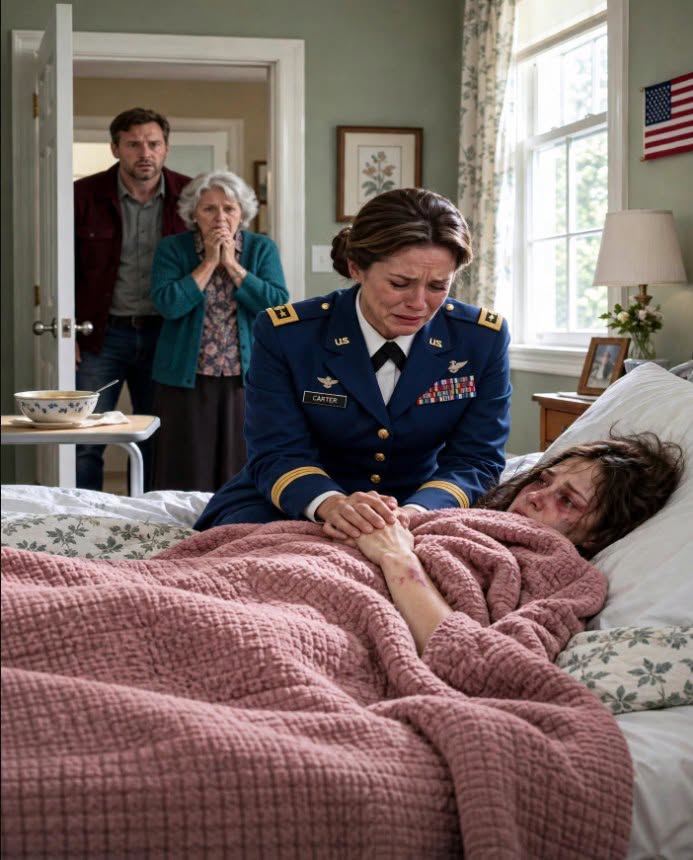
I rode in the back, holding Abby’s hand, my thumb rubbing circles against her knuckles. The combat medics were working with quiet, terrifying efficiency, strapping an oxygen mask over her face and hooking up an IV line.
“Blood pressure is dropping, Colonel,” the lead medic, a young corporal with sweat beading on his forehead, told me. “She’s severely dehydrated. And look at her abdomen—there’s significant contusion patterning around the lower left quadrant.”
I looked down. Through the tear in her oversized shirt, a dark, boot-shaped bruise bloomed across her ribs.
My stomach heaved. For sixty-three days, while I sat behind my polished desk reviewing troop movements and signing off on equipment requisitions, my daughter had been beaten in the dark. While I slept in my quarters on base, believing my family was safe because they lived in a quiet Indiana suburb, someone had systematically tried to destroy her.
When the ambulance doors swung open, a team of military doctors and obstetricians were already waiting on the tarmac.
They wheeled her into Trauma Bay 2.
I tried to follow, but a doctor in green scrubs blocked the doorway, his expression grim. “Colonel Braddock? You need to stay outside the trauma curtain while we stabilize her.”
“I am her mother, Doctor,” I said, my voice carrying the weight of twenty-eight years in uniform. “And I am a senior officer on this installation. You are not keeping me away from my daughter.”
The doctor hesitated, looked at the silver eagles pinned to my collar, and then nodded. “Fine. But stay out of the clinical team's way.”
Inside the bright, sterile room, the equipment beeped with a frantic, uneven rhythm. An ultrasound machine was rolled up to Abby’s bedside, and the technician squeezed cold gel across my daughter’s swollen, bruised stomach.
“Can you find a heartbeat?” I asked, my voice cracking for the first time.
The technician didn't answer immediately. She pressed the wand harder against Abby’s skin, sliding it back and forth, her eyes locked on the monochrome monitor. The room grew so quiet I could hear the hum of the overhead lights.
Abby opened her eyes, looking at me through the oxygen mask. “Mom... is she okay?”
“She’s going to be fine, bug,” I whispered, using the old nickname from when she was small, praying to a God I hadn't spoken to since Rob died. “Just watch me. Look at me.”
“There,” the technician breathed out.
A rapid, steady *whoosh-whoosh-whoosh* filled the room.
The baby’s heartbeat. Fast, frantic, but alive.
I let out a breath I felt like I’d been holding for two months.
“Heart rate is one hundred and forty,” the obstetrician announced, stepping away from the screen. “She’s in distress, and there’s evidence of placental abruption caused by blunt-force trauma. We need to prep her for an emergency C-section immediately. If we wait, we lose them both.”
---
Related Stories