Chapter 2: The Paper Fortress
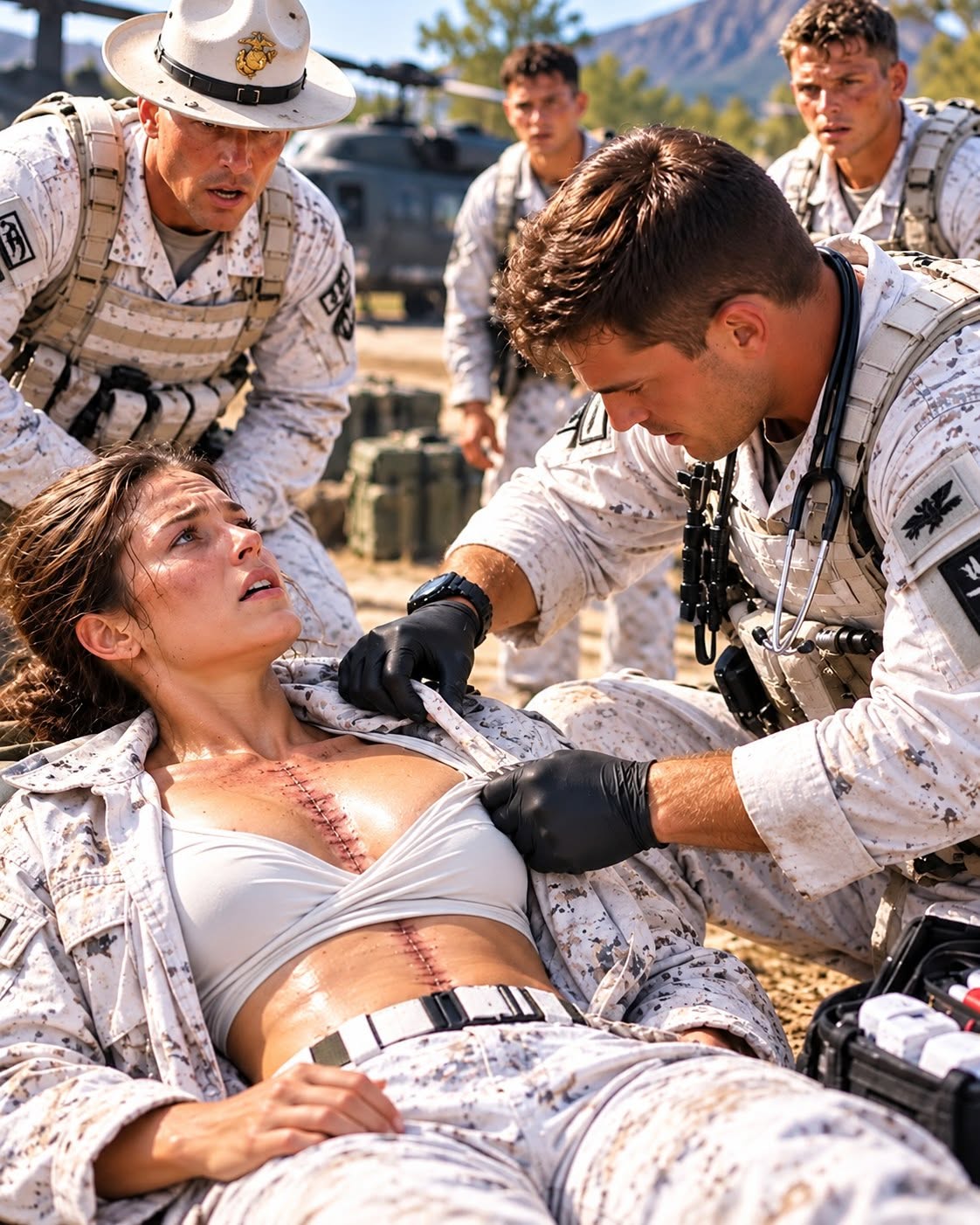
The ceiling of the trauma observation bay was a sterile, unforgiving white.
I woke to the rhythmic, low-frequency hum of a saline pump and the cold, medicinal smell of chlorhexidine. My left side was wrapped in fresh, thick layers of sterile burn dressing that smelled sharply of silver sulfadiazine ointment. A cool blanket was pulled up to my collarbone, and an IV line was taped securely to the back of my right hand, feeding cold fluid into my dehydrated veins.
The door to the private room pushed open with a soft, pneumatic click.
Captain Sarah Lin, the battalion medical officer, stepped inside with a thick, blue-tabbed medical folder tucked under her arm. Her combat uniform was clean, her captain’s bars gleaming under the fluorescent light, but her face was drawn into a tight, severe mask of clinical outrage.
Behind her, filling the doorframe with an uncomfortable, brooding presence, was Staff Sergeant Cole Vega. He had washed the red clay from his forearms, but his combat uniform was still damp with dried sweat, his patrol cap gripped tightly in his left hand.
“Specialist Mercer,” Captain Lin said, pulling a metal rolling stool up to the edge of the bed. “You’re awake.”
“Yes, ma'am,” I said, my voice rough and gravelly. I tried to sit up, but the pull across my sixth rib drove a sharp spike of nausea through my stomach.
“Lie flat,” Lin commanded, her tone brooking no argument. “You have second-degree friction abrasions across twelve square inches of split-thickness donor tissue. Two of your titanium rib-fixation screws show signs of mechanical stress on the portable radiograph, and your inflammatory markers are double the normal threshold. In plain English: another two miles on that road, and you would have sheared the graft clean off the muscle wall and triggered systemic sepsis.”
She opened the blue-tabbed folder, dropping it onto the rolling tray table with an echoing plastic snap.
“Now explain to me how in God’s name a soldier with sixty percent graft coverage across her thoracic cage and permanent orthopedic hardware bypassed the medical processing station at Fort Moore.”
I kept my eyes fixed on the ceiling tiles. “I passed the occupational physical assessment test, Captain. I scored a two-hundred-and-ninety on the physical fitness test. I met every height-and-weight standard.”
“You omitted three major reconstructive surgeries and an eight-month stay at the Brooke Army Medical Center burn unit from your induction questionnaire,” Lin fired back, her finger jabbing at the intake sheet. “That is a direct violation of Article 83 of the Uniform Code of Military Justice. Fraudulent enlistment. It carries an automatic administrative separation under other-than-honorable conditions and potential federal confinement.”
The room went dead silent. The threat sat between us like an unexploded mortar round.
I had known this moment would come. For six weeks, I had taped my collar shut, changed in unlit latrine stalls before dawn, and slept with my back pressed against the metal springs of my bunk so no one would see the silver ridges across my ribs. I had gambled everything on reaching the final selection board before my body tore apart.
“She didn't omit it, Captain,” a deep voice broke the silence from the doorway.
I turned my head.
Vega stepped forward into the sterile light, his combat boots thudding softly on the linoleum. He didn't look at Captain Lin; he looked directly at me, his jaw set into an iron, unyielding line.
“What did you say, Sergeant?” Lin asked, turning on her stool.
Vega reached into the cargo pocket of his trousers, pulled out a tri-folded sheet of carbon-copy paper bearing an official Department of the Army seal, and laid it flat on the rolling tray beside her folder.
“Her medical history wasn't omitted,” Vega said, his voice flat, steady, and devoid of fear. “It was granted an administrative provisional waiver six months ago by the directorate of human resources at Fort Moore. Under my signature as the acting battalion training liaison.”
Captain Lin snatched the paper from the tray, her eyes tracking rapidly across the lines of text. “You signed a medical clearance for an infantry selection candidate with unhealed burn grafts? Are you out of your mind, Vega? Do you have any idea what the brigade commander will do to your career when he sees this?”
“Look at the date, Captain,” Vega replied quietly.
Lin frowned, checking the bottom margin. “March fourteenth.”
“Six months ago, a batch of forty-five medical waiver packages crossed my desk for administrative review,” Vega explained, his voice tightening with a dark, bitter weight. “They were routed under standard operational codes. I saw the name *Mercer, R.* I saw a high physical score and an endorsement from the state national guard adjutant. I assumed it was another hotshot kid from the mountain units who had broken a collarbone in high school football and needed a rubber stamp to enter the pipeline.”
Vega took a step closer to the bed, his dark eyes burning into mine.
“I didn't read the surgical annex, Captain. I stamped it, signed it, and sent it to the brigade adjutant because we were twenty recruits short of our quarterly infantry intake quota.”
The truth landed in the room like a cold iron weight.
Vega hadn't known I was Jesse’s sister because he had never bothered to look past the first page of my file. To him, I had been an anonymous line on a personnel manifest—a body to fill an empty training slot. And when I arrived at Fort Benning looking small, narrow, and quiet, he had spent six weeks trying to break me simply because he thought I was a waste of his time.
“Staff Sergeant Vega,” Captain Lin said, rising slowly from her stool, her face pale with cold fury. “You have just admitted to criminal dereliction of duty in the presence of an officer. If this waiver is illegitimate, both of you are facing a general court-martial.”
“Then pull the file, ma'am,” I said, speaking up for the first time, my voice cutting through the clinical chill of the bay.
Lin turned to look at me.
“Look at the signature line on the original medical board review from Fort Sam Houston,” I told her, my fingers curling into the hospital blanket. “The physician who approved my initial transfer back to active duty wasn't an administrative clerk. It was Colonel Marcus Vance. The same officer who oversaw the accident investigation board at the National Training Center two years ago.”
Vega’s head snapped toward me, his eyes widening in pure shock. “Vance approved this?”
“He didn't just approve it, Sergeant,” I said, looking straight into the face of the man who had ridden me into the dirt for forty-two days. “He personally ordered my assignment to this specific selection cycle. Because he knew you were the primary instructor.”
---
Related Stories