Chapter 1: The Other Language
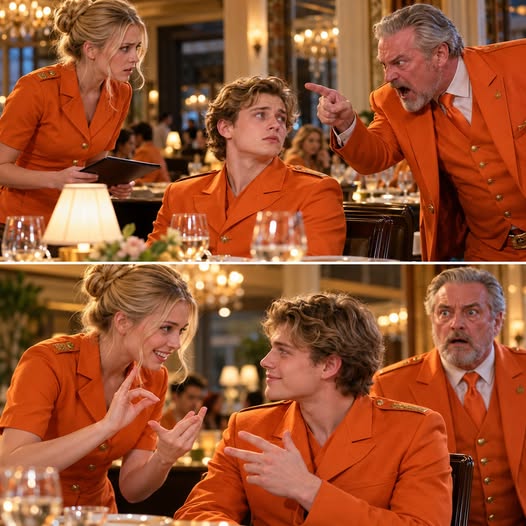
Vincent Rourke didn’t let go of my order pad.
His fingertips were thick and calloused, nails clipped short, the gold signet ring on his pinkie catching the low amber light of the chandelier above Table Four. He didn’t yank the pad away; he simply held it in place, applying just enough downward pressure to remind me that everything in this room—the linen, the silver, the floorboards beneath my sensible black work shoes—existed at his convenience.
“A sense of humor,” Vincent repeated.
His voice was a low, gravelly rasp that didn't belong in a dining room where the tasting menu started at two hundred dollars a person. He looked across the white cloth at his son. Adrian had already turned his face back toward the glass, his profile sharp against the dark reflection of Woodward Avenue. Snow was sticking to the corners of the windowpane, melting into long, slow tears under the warmth of the interior glass.
“He hasn’t spoken a single word to his own flesh and blood since the day we carried him out of the smoke in Charlevoix,” Vincent said, his eyes flicking back up to mine. They were pale blue, washed out, cold as slush on a curb. “Not to me. Not to his cousins. Not to the doctors who charged me three hundred grand to tell me his ears were ruined. But he’s telling jokes to the girl with the pepper mill?”
The bodyguard seated on Vincent’s right shifted his weight. The leather of his shoulder holster creaked beneath his tailored charcoal suit. At the adjacent four-top, the woman who had lowered her eyes earlier didn’t move an inch. Her fork remained suspended an inch above her salmon, her shoulders rigid as iron.
“He signed an order, sir,” I said, keeping my tone pitched to that neutral, pleasant frequency you learn after four years of dealing with downtown power brokers who think a fifteen-percent tip buys temporary ownership of your soul. “Medium-rare ribeye. Yukon potatoes. Black coffee. That’s what’s going into the kitchen.”
Vincent studied my face. He was looking for a tremor in my chin, a flutter in my throat, the small, involuntary flinch people usually gave him when he leaned in.
I gave him nothing.
When you spend your adolescence standing between your deaf little brother and schoolyard bullies who think quiet means defenseless, you learn how to stand your ground without blinking. Owen had taught me that before his heart gave out in the eighth grade. Silence isn't empty space; it's an armor plate. If you look scared, they hit you. If you look bored, they eventually get tired of swinging.
Vincent’s fingers slowly uncurled from the leather edge of my pad.
“Get the drinks,” he muttered, waving a hand toward the kitchen. “And tell the chef if that steak has been sitting under a heat lamp for more than sixty seconds, he can pack his knives.”
“Right away, sir.”
I turned on my heel and walked through the dining room. I didn't rush. Rushing looks like panic. I moved past the grand piano near the bar, past the wine displays glowing in their climate-controlled glass cases, and pushed through the double swinging doors into the white-tile roar of the kitchen.
The scent of garlic, clarified butter, and scorched cast iron hit me like a slap.
“Ticket in,” I said, sliding the slip into the brass rail above the line. “Table Four. One ribeye, medium-rare, Yukon mash. One bourbon, neat—Pappy if we have it, neat pour. One black coffee.”
Marcus, the floor manager, was waiting by the bread station. He was forty-two, perpetually damp around the collar, and carried himself with the nervous jitter of a man whose livelihood depended on pleasing people who never looked at his name tag. He grabbed my arm just above the elbow, his fingers digging into the cotton of my white shirt.
“What was that?” he hissed into my ear, his breath smelling of Altoids and sour espresso. “Tess, what were you doing out there?”
I pulled my arm free, not roughly, but with enough leverage to make him drop his grip. “I was taking their dinner order, Marcus.”
“You were waving your hands around like you were directing traffic at the airport!” His face was mottling into an ugly shade of plum. “Do you know who is sitting at Table Four? That is Vincent Rourke. He owns the firm that holds the master lease on this entire block. If he has a bad meal, he doesn't leave a bad Yelp review, Tess. He doubles our common-area maintenance fees until the owner has to sell the liquor license to pay the heat bill!”
“His son is deaf,” I said quietly, reaching for a clean black tray from the rack. “He couldn't read the print on the reserve menu because the lighting at that booth is thirty watts too low. I asked him what he wanted in ASL. He answered me. The kitchen has the ticket.”
Marcus stared at me, his mouth opening and closing like a carp in a bucket. “You... you know sign language?”
“My brother was deaf.”
“I don't care if your whole family communicates through smoke signals,” Marcus whispered, leaning in so close I could see the broken capillaries around his nose. “You don't engage with Adrian Rourke. Nobody engages with Adrian Rourke. Vincent brought him here for a reason tonight, and it isn't family dinner. Do you see the woman at Table Six?”
I paused, a chilled highball glass in my hand. “The one with the notebook?”
“Dr. Miriam Aris,” Marcus breathed, his eyes darting toward the service window. “Court-appointed evaluator for the Wayne County Probate Division. She’s been sitting there since seven-thirty with an open file. Vincent is filing for full, permanent conservatorship of the family trust on Thursday morning. He’s demonstrating to the state that his son can’t navigate a public setting without direct supervision.”
The ice scoop in my hand went still.
The pieces snapped together with a cold, sickening click.
*“Find out whether he wants beef, poultry, or something from the coloring box.”*
Vincent hadn't just been making a cruel, casual joke at his son's expense. He had been staging a scene. He had brought Adrian to the most visible restaurant in his portfolio, seated him ten feet from a state evaluator, and deliberately created a spectacle of Adrian sitting mute, detached, and unable to interact with the world around him.
And I had ruined the performance by asking him what he wanted for dinner.
“Get the bourbon,” Marcus muttered, wiping his forehead with a bar towel. “Take it out there. Drop it. Step back. If you move your fingers in front of that boy again tonight, Tess, don't bother coming in for Sunday brunch. You’re done.”
I didn't answer him. I picked up the heavy crystal tumbler of bourbon in my right hand and the steaming mug of dark roast in my left.
When I pushed back through the kitchen doors, the dining room had settled into an artificial hum. The other tables were talking again, but their voices were pitched slightly too loud, the laughter brittle and hurried. Everyone was performing normalcy while keeping one eye on the booth beneath the front window.
I approached Table Four from Adrian’s blind side, stepping into his peripheral vision so I wouldn't startle him.
I set the bourbon in front of Vincent without looking at him. “Bourbon, neat.”
Then I turned to Adrian.
He had removed his overcoat. Beneath it, he wore a dark charcoal crewneck sweater that looked expensive, simple, and slightly too large for his lean frame. Up close, I could see the pale, hair-thin scar that ran from the base of his left ear down into the open collar of his shirt—the physical trace of the lake house fire fourteen years ago.
I set the coffee down on his left. The porcelain clinked softly against the saucer.
Adrian looked up.
His eyes were gray, dark around the irises, extraordinarily clear. He didn't look at my face first; his gaze dropped immediately to my hands, watching my fingers to see if they would move.
Vincent was watching us both, his hand resting beside his bourbon, waiting for an excuse to tear the room apart.
I kept my hands flat against my sides, my posture completely professional. I gave Adrian a small, standard nod of customer courtesy.
Adrian’s right hand was resting on the white linen, half-concealed behind his cloth napkin.
He didn't lift his arm. He didn't make a large, theatrical movement that his father could intercept. With tiny, precise shifts of his fingers against the fabric, using only the space between his water goblet and his bread plate, he signed three words.
*Watch table six.*
My pulse jumped against my collar.
He knew.
Adrian wasn't sitting there staring at the snow because he was detached or broken. He knew the evaluator was sitting behind him. He knew his father was running a trap.
And then, his thumb flicked twice against his index finger, forming a single, urgent request that made the floor seem to drop an inch beneath my feet.
*Help me leave.*
---
Related Stories