Chapter 4: The Pressure in the Lines
The aircraft shuddered—a deep, structural groan that vibrated through the floorboards and rattled the ice in the galley carts.
From the cabin behind them, someone cried out as the plane dipped sharply five hundred feet, the autopilot disconnecting with a sharp, triple-chime alarm that sounded from the open flight deck door.
*BEEP-BEEP-BEEP.*
""Cabin crew, secure for landing immediately!"" the first officer’s voice barked over the PA, no longer attempting to soften the reality. ""Diversion to Pittsburgh confirmed. Runway two-eight right, emergency equipment standing by.""
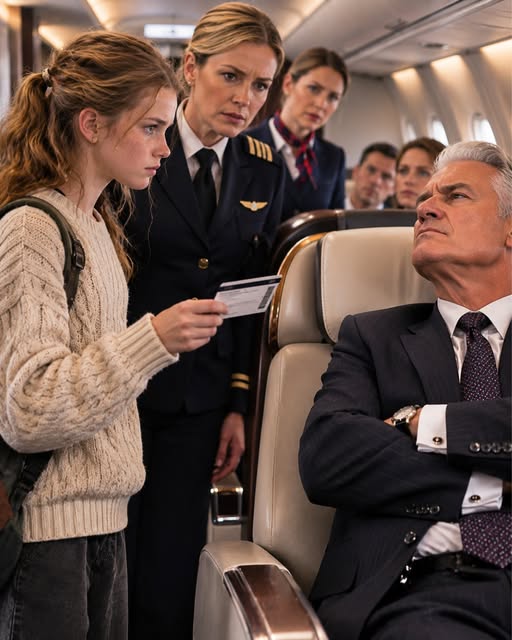
Sarah, the flight attendant, sprinted down the aisle, throwing herself into the jump seat beside the forward exit and strapping her five-point harness tight across her shoulders.
In Seat 2B, Richard Bennett was hyperventilating.
His fingers were clawing at the armrests so hard the seams of his leather loafers were tearing against the floorboard carpet. ""We're going to crash,"" he whimpered, all the money, the gold cards, the three-hundred-thousand-mile pedigree crumbling into pure, unadulterated terror. ""We're going to crash because of a fifty-dollar seal.""
""Shut up, Mr. Bennett,"" Zara commanded.
The voice was not that of a fourteen-year-old child.
It was the voice of Julian Coleman's daughter—clear, resonant, and hardened by the understanding that panic was a luxury nobody at twenty thousand feet could afford.
Zara leaned past Richard, looking straight at Captain Hart, who was gripping the edge of the bulkhead partition, steadying herself against the turbulent descent.
""Captain,"" Zara said, her voice cutting through the rising murmur of the cabin. ""Did the number two system bleed out completely?""
Captain Hart looked at her, startled for a fraction of a second by the precision of the question, before professional focus took over. ""The reservoir pressure gauge dropped to zero forty seconds ago, Zara. The right elevator is responding sluggishly. We’re on manual reversion for the secondary flight surfaces.""
""The cross-feed valve,"" Zara said immediately.
Captain Hart froze. ""What?""
""When my dad redid the hydraulic architecture for the 737 retrofits two years ago, he built an emergency cross-feed bypass into the secondary utility rack,"" Zara explained, speaking with the rapid, crystalline clarity of someone who had spent her childhood building model turbine assemblies in her father's study. ""It's not in the standard airline operating handbook because the FAA hasn't finalized the fleet-wide training bulletin yet. But this airframe has the physical modification. It was installed during the January overhaul in Seattle.""
Richard stared at her, his eyes wild, his chest heaving. ""What is she talking about? She's fourteen! She doesn't know how to fly a plane!""
""Captain Hart,"" Zara continued, ignoring the trembling man beside her entirely. ""There’s an auxiliary manual shutoff lever behind the first officer’s seat, beneath the circuit breaker panel on bulkhead P6. If you pull the yellow collar and lock the cross-feed, it isolates the breached manifold and channels the reserve fluid from the landing gear actuators directly into the elevator lines.""
Captain Hart didn't hesitate.
An airline captain with twenty-five years of commercial flying experience didn't take engineering advice from a teenager on blind faith—she took it because the girl in front of her was describing a proprietary mechanical modification with the exact part numbers and bulkhead locations that only the lead design engineer could possibly know.
""Stay strapped in, Miss Coleman,"" Captain Hart ordered.
She spun on her heel and lunged through the flight deck door, pulling the heavy cockpit curtain shut behind her.
The plane banked violently to the left as the pilots fought the uneven control surfaces, the gray clouds outside window 2A swirling in a dizzying, turbulent vortex.
Zara pressed her back flat against the leather cushions of Seat 2A.
Her knuckles were white where she gripped the armrest, but her breath remained slow, rhythmic, and controlled. She closed her eyes for three seconds, feeling the weight of her grandmother's silver watch resting in her pocket.
*Calmness isn't pretending nothing hurts, Zara. It's choosing who controls the room when the room is falling apart.*
Beside her, Richard Bennett had completely unraveled.
He had his head between his knees, his hands clasped over the back of his neck, sobbing openly into the gray carpet.
""I didn't want to sign the waivers,"" Richard wept, his voice muffled by his trousers. ""Marcus said... Marcus said the airlines would never catch it. He said the supply chain was too big. He said nobody checks the batch numbers on secondary hydraulic rings.""
Zara opened her eyes, looking down at the man who had told her she belonged in the back of the plane.
""My father checks,"" Zara said softly.
A sudden, sharp mechanical shudder ran through the fuselage.
Then, with a heavy, pressurized hiss that sounded like a massive pneumatic piston engaging beneath the floor, the violent oscillation of the wings smoothed out.
The nose of the aircraft stabilized.
The heavy, sickening drop in Zara's stomach gave way to the steady, controlled deceleration of an airframe settling into an established glideslope.
Through the forward curtain, the voice of the first officer crackled over the intercom, breathless, relieved, but completely professional:
""Cabin crew... three miles out. Prepare for immediate touchdown.""
Zara turned her face back to window 2A.
Below the breaking cloud deck, the runway lights of Pittsburgh International Airport stretched across the gray Pennsylvania landscape like two converging lines of golden fire.
Beside the runway, twenty emergency vehicles—fire trucks, ambulances, and police cruisers—sat waiting with their red and blue strobe lights flashing in silent, synchronized urgency.
Zara Coleman took a deep, quiet breath, smoothed the denim of her jacket, and watched the ground rise to meet her assigned seat.
---
Related Stories