Chapter 2: The Red Tab Folder
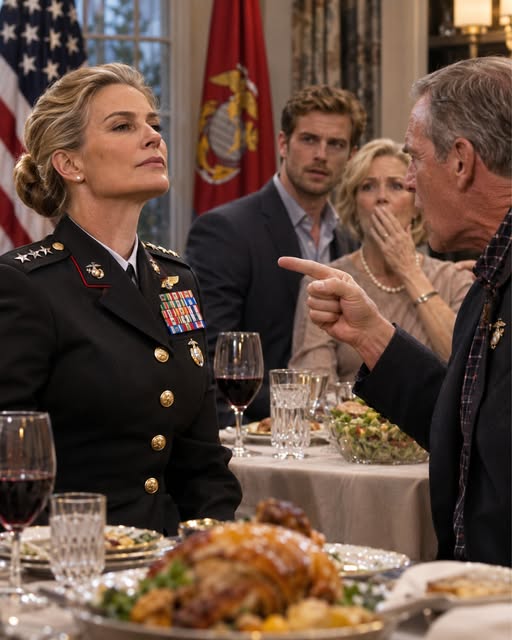
Arthur Harper didn't move.
For four long seconds, the only sound was the muffled laughter of a family two booths away and the wet slap of the river against the restaurant’s wooden pilings.
The color didn't drain from his face all at once; it retreated in patches, leaving his weathered, sun-spotted skin looking mottled and gray beneath the amber glow of the fake brass lantern overhead. His thick fingers, resting beside his plate, curled inward by an inch, the knuckles locking like rusted hinges.
Beside him, Evelyn let out a tiny, breathless gasp. Her hands flew to her mouth, her wire-rimmed glasses sliding slightly down the bridge of her nose as her eyes darted from my face to Daniel’s.
Daniel didn't say a word. He sat straight, his jaw unclenched, watching his father with a look that held thirty years of quiet, vindicated patience.
""You..."" Arthur’s voice failed him on the first syllable. It came out thin, dry, stripped of the gravelly, drill-field authority that had carried him through the last five minutes. He cleared his throat, trying to force his vocal cords back into alignment. ""You're Major General Vance.""
""Sarah Mitchell Vance,"" I said, holding his gaze without a flicker of anger. ""Daniel told you my first name. He simply omitted the billet.""
Arthur swallowed. His Adam's apple bobbed heavily against his open collar. In the Marine Corps, muscle memory is stronger than pride; his back involuntarily straightened against the red vinyl booth, his shoulders squaring as if an invisible drill instructor had just barked an order into his ear.
A retired master gunnery sergeant does not salute in civilian clothes in a seafood restaurant. But his eyes—those hard, combative eyes that had spent the evening looking down on his son’s 'admin' girlfriend—suddenly dropped six inches, staring at the empty space between our plates.
""Ma'am,"" Arthur muttered.
The word was short, clipped, and tasted like ash in his mouth.
""Eat your flounder, Arthur,"" Evelyn whispered, her voice trembling slightly as she reached out to pat his rigid forearm. ""Eat your dinner.""
The waitress arrived two minutes later, completely oblivious to the tectonic plate that had just shifted across table four. She slid platters of fried shrimp, blackened flounder, and hushpuppies onto the laminate, refilled our sweet teas with cheerful coastal banter, and hurried off toward the kitchen.
Nobody touched their food.
""I didn't know,"" Arthur said into his plate. He hadn't picked up his fork. ""Daniel told me—""
""Daniel told you what you needed to hear so you’d agree to sit at this table,"" I interrupted gently. ""Because he knew that if you saw the stars first, you wouldn't see the woman who loves your son. You’d see a policy debate you’ve been losing for twenty years.""
Arthur’s jaw tightened. The shame on his face was turning into something darker—a defensive, stubborn resentment that had calcified over decades of retirement.
""I served under Lew Walt in sixty-eight, General,"" Arthur said, his voice dropping into a harsh, defensive rasp, though he kept his eyes respectfully level with mine now. ""I watched eighteen-year-old boys bleed out in rice paddies because somebody in Saigon thought a spreadsheet was a substitute for artillery support. When I see the Corps today... the things they emphasize... it feels like we're forgetting how to fight.""
""Nobody is forgetting how to fight, Gunny,"" I replied, leaning back and picking up my fork. ""We’re learning how to keep twenty-year-old lance corporals alive in an environment where an enemy doesn't need artillery to kill them—just a commercial drone and an encrypted cell phone. The lethality hasn't changed. The terrain has.""
Arthur looked at me, his brow furrowing. He was looking for weakness. He wanted an academic buzzword, an administrative cliché, something he could dismiss as Pentagon speak.
Instead, he saw a fifty-two-year-old combat veteran whose posture was just as straight as his, whose hands were calm, and who had just named the exact operational reality keeping division commanders awake from Okinawa to the Baltic.
""Fallujah,"" he muttered, picking up the thread I had dropped earlier. ""What unit?""
""Second Battalion, First Marines,"" I said, tasting the fried flounder. It was hot, salty, and surprisingly good. ""Regimental Combat Team One. November two thousand and four.""
Arthur’s fork froze two inches above his plate.
""My old outfit,"" he whispered.
""I know,"" I said. ""Daniel told me you were with Two-One in Vietnam. Operation Pegasus. Relief of Khe Sanh.""
Arthur set his fork down entirely. The hostility didn't vanish, but it fractured. In the infantry, lineage is sacred. You can hate the modern world, you can hate the Pentagon, and you can hate social progress—but when someone names your battalion's bloodiest month in the sand and says they were there, the ground shifts.
""Who was your battalion commander?"" Arthur asked, his voice low, testing the seam.
""LTC Brandl,"" I answered without hesitation. ""He was wounded on day two. Major Zembiec took the operational lead on the southern advance. The 'Lion of Fallujah.' We lost fifty-four Marines in thirty days, Gunny. I signed the casualty evacuation manifests for thirty-eight of them before my own shoulder caught metal on Henry Street.""
The table went silent again.
Arthur stared at his hands—those massive, scarred hands that had cleaned M16s in the monsoon rain fifty years ago. A strange, conflicted tremor passed through his fingers. He looked at Daniel, then at his wife, and finally back at me.
""You're thirty years younger than me, General,"" Arthur said, his voice rough as gravel. ""You weren't even born when we crossed the DMZ. But you talk like an old grunt.""
""I am an old grunt, Arthur,"" I said softly. ""I just have a larger radio now.""
Evelyn smiled—a small, radiant burst of relief that lit up her lined face. ""Daniel told us you were remarkable, Sarah. He didn't tell us how brave you were.""
""She wasn't being brave, Mom,"" Daniel spoke up, reaching across the vinyl to touch my hand on the table. ""She was just doing her job.""
The dinner progressed in a strange, careful armistice. Arthur ate his fish in silence, occasionally asking short, technical questions about the new amphibious combat vehicles arriving at Courthouse Bay or the barracks renovations on main side. He addressed me as ""General"" three times, each syllable forced through his teeth like an extracted tooth, until I told him that outside the gate, ""Sarah"" was authorized for family.
He didn't use ""Sarah."" But he stopped using ""ma'am"" like an insult.
By eight-thirty, the check was settled. I insisted on paying; Arthur didn't argue, though his pride visibly winced when my corporate travel card took the bill.
We walked out into the cool evening air of the gravel lot. The coastal humidity had settled into a low, drifting mist that blurred the red neon sign of the restaurant against the dark pines.
""It was an honor, General,"" Arthur said, standing at the door of his battered Ford pickup, his back stiff. He offered a short, stiff nod that was as close to a formal salute as a retired master gunnery sergeant would ever give in a parking lot.
""Goodnight, Gunny,"" I replied, returning the nod cleanly. ""Take care of Evelyn.""
Daniel kissed his mother’s cheek, walked them to the truck, and then returned to where I was standing beside his crossover.
""Well?"" Daniel asked, wrapping his arm around my waist, pulling my back against his chest. ""Did you survive the gauntlet?""
""He's tough,"" I said, leaning my head back against his shoulder, letting out a long breath I felt like I had been holding since five o'clock. ""He’s stubborn, he’s bitter about how his war ended, and he thinks the modern world left him behind.""
""Did you change his mind?""
""You don't change fifty years of concrete in two hours, Daniel,"" I said. ""We established a truce. That's a good operational start.""
We got into the car. As Daniel pulled out onto Highway 24, the dashboard phone mount chimed with an incoming priority signal.
Not a standard call.
A red-flagged secure text from my executive officer, Colonel Thomas:
*CG: APOLOGIES FOR THE HOUR. WE HAVE A CIVILIAN DETAINMENT AT THE SNEADS FERRY GATE. SUBJECT REFUSING TO CLEAR THE PERIMETER, CLAIMING CLASSIFIED ACCESS. HE HAS A RED-TAB MANILA FOLDER WITH YOUR NAME ON IT.*
I tapped the screen, opening the duty log image attached to the message.
The man sitting in the holding annex of the gate house, cuffed to an iron bench with a military police officer standing over him, was not an intruder.
He was wearing an old Marine Corps veteran windbreaker, a faded utility cap, and holding an antique olive-drab personnel binder to his chest.
It was Arthur Harper’s older brother, Frank.
And the red-tab file resting on the desk before him bore the official seal of the Department of the Navy, dated August 19, 1968.
---
Related Stories