Chapter 3: The Ghost on the Deed
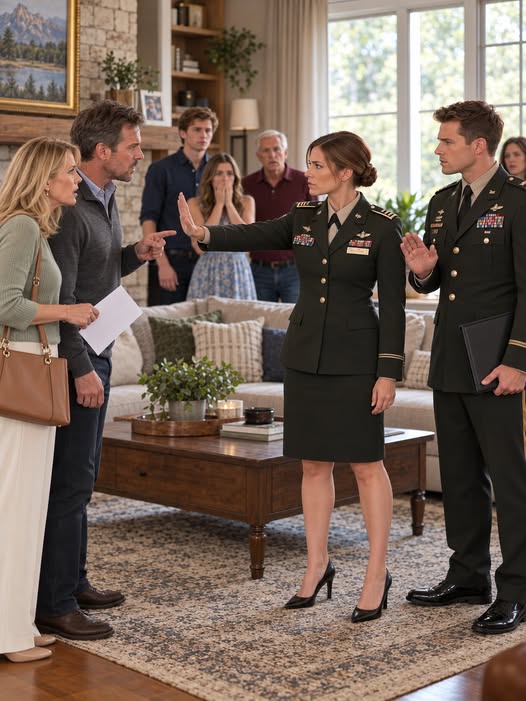
The dining room table emptied within three minutes.
Kyle grabbed his truck keys from the counter and vanished through the garage door without another word, the roar of his modified diesel exhaust vibrating through the kitchen floorboards as he sped down the quiet suburban street.
Marlene locked herself in the master bathroom upstairs. The sharp, rhythmic clatter of cabinet doors slamming and water running at full pressure echoed through the ceiling vents—a frantic, desperate soundtrack of someone trying to drown out the sound of their own ruin.
My father sat alone at the kitchen island, his back rounded like an old sack of grain.
The afternoon sun had vanished behind a wall of Carolina thunderheads, casting the room into a bruised, slate-gray gloom. The smell of the cold prime rib hung heavy in the air, greasy and unappetizing.
I pulled out the stool beside him and sat down.
On the granite counter between us, the Department of Defense audit memo lay face-up.
""Twenty-fifteen, Dad?"" I asked quietly.
Thomas didn't move. He kept staring at his own scarred, calloused thumbs, rubbing the rough skin over his knuckles.
""Your mother died in November of twenty-fourteen,"" Thomas began, his voice barely louder than the hum of the refrigerator. ""The medical bills from Duke University Hospital... the experimental immunotherapy wasn't covered by my municipal insurance, Claire. You were in Afghanistan. You were running convoys outside Kandahar. Every time you called on that satellite phone, you sounded so exhausted... your voice was like paper.""
A dull ache flared behind my eyes.
I remembered those calls. Standing on the gravel outside the tactical operations center at zero-three-hundred, shivering in my combat fleece, listening to the static hiss across five thousand miles of wire while my father told me everything at home was fine.
*“Just focus on bringing your soldiers back safe, baby,”* he had told me every Sunday. *“Everything here is taken care of.”*
""It wasn't taken care of, was it?"" I murmured.
""The outstanding balance was eighty-four thousand dollars,"" Thomas whispered, tears finally breaking over his lower lids and tracking through the deep creases around his mouth. ""The hospital was preparing to place a medical lien on the house. This house, Claire. The one your grandfather helped me frame with his own two hands in seventy-nine. Your mother’s garden. Everything she loved.""
He wiped his face with the back of his flannel sleeve.
""Marlene was working as an intake administrator in the hospital billing office,"" he continued, the confession spilling out like dirty water from a cracked cistern. ""She saw my file. She was kind to me, Claire. She brought me coffee in the waiting room. She said she knew how the system worked, that she could help me restructure the debt so the county wouldn't know.""
I closed my eyes for two seconds, letting the cold fury settle into place.
*The intake administrator.*
She hadn't met my father through church. She hadn't met him at a neighborhood barbecue.
She had harvested him from a hospital billing database while his wife’s body was barely cold in the ground.
""What did she make you sign, Dad?""
Thomas reached into his pocket, pulled out a small brass key on a worn leather fob, and laid it on the counter.
""The bottom drawer of the file cabinet in my workshop,"" he said, his chin quivering. ""Behind the old tax returns.""
I took the key.
I walked out through the laundry room into the detached two-car garage.
The workshop smelled of sawdust, motor oil, and WD-40—the familiar, comforting scents of my childhood. Beside his workbench stood a battered green two-drawer metal filing cabinet, its paint peeling at the corners.
I unlocked the bottom drawer.
Behind folders labeled *Property Taxes 2010-2015* and *Truck Maintenance*, there was an unmarked, heavy kraft envelope sealed with clear packing tape.
I brought it back into the kitchen, slit the tape with my pocket knife, and pulled out the contents.
It was an unrecorded Quitclaim Deed for 408 Whispering Pines Drive—the three-acre parcel and four-bedroom home we were sitting in.
Dated: March 12, 2015.
Three weeks before my father and Marlene were married at the county courthouse.
I scanned the legal description.
*Grantor: Thomas E. Donovan, widower.*
*Grantee: The Marlene Vance Irrevocable Family Trust.*
*Consideration: Ten dollars and other valuable considerations.*
My breath caught in my throat.
Under North Carolina law, if an unrecorded quitclaim deed is executed prior to a marriage and held in escrow, the property does not become marital property. It belongs entirely to the trust. The moment Marlene filed this document with the Mecklenburg County Register of Deeds, my father would become a tenant in his own home.
He would have zero legal claim to the roof over his head.
And attached to the deed was a secondary document: an application for an equity line of credit in the amount of one hundred and sixty thousand dollars, pre-approved, awaiting only my father’s death or ""certified medical incapacity"" to disburse the funds directly to the trust's primary beneficiary.
Kyle Vance.
""She told me it was an asset protection trust,"" Thomas wept from the counter, his head buried in his hands. ""She said if the hospital came after the estate for the remaining balances, the house would be shielded. She swore to me on the Bible that it would pass directly to you when I died.""
I looked down at the signature line.
My mother’s name had been on the original deed. When she died, her half of the property had passed to me under her holographic will—a document handwritten in her notebook, witnessed by her sister Lorna, leaving her share of the land to her only daughter.
Marlene had known that.
Which was why the quitclaim deed in my hands had a forged signature on the second grantor line.
*Claire M. Donovan.*
Spelled with an *i*.
Not my handwriting. A clumsy, looping imitation of a signature copied from an old high school graduation card.
""Dad,"" I said, my voice so flat and quiet it sounded like metal sliding across ice. ""Did you watch her sign this?""
Thomas slowly lifted his face.
His eyes were bloodshot, hollowed out by seven years of shame, silence, and willful blindness.
""I didn't watch her,"" Thomas whispered. ""I held the pen for her.""
---
Related Stories