Chapter 5: The Master Chief's Flag
By eight o'clock that evening, the rain had completely stopped, leaving behind a cold, sharp coastal fog that rolled off the Blackwater River and pooled around the tires of six federal vehicles parked in the muddy yard.
Portable halogen work lights illuminated the front lawn, humming with the steady drone of a diesel generator.
A technical recovery team from the Naval Criminal Investigative Service had spent two hours in the cellar with hydraulic jacks and pneumatic drills, carefully working through the concrete reinforcement around the ancient cistern.
I sat on the sagging front porch steps, a wool naval watch cap pulled down over my ears, holding a steaming paper cup of black coffee the state police liaison had brought me.
Beside me, Knox lay with his massive paws crossed over my boots, his chin resting on my knee, his dark eyes tracking the investigators moving back and forth between the trucks.
My parents were gone.
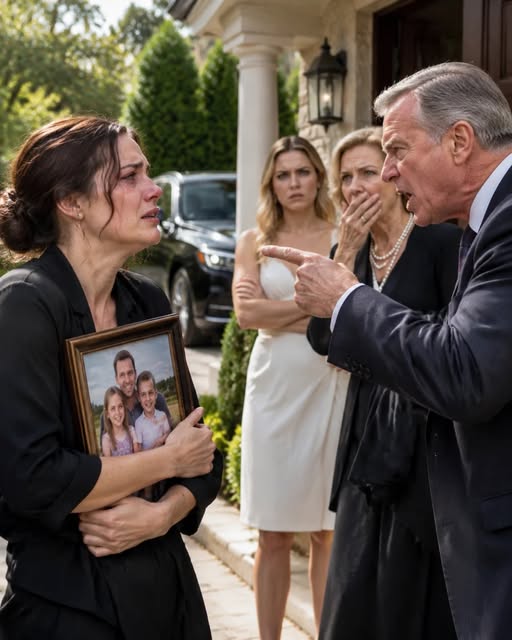
They had been escorted down the clay driveway in the back of separate cruisers two hours earlier—my father in handcuffs, his head ducked low to avoid the dashboard cameras, my mother sitting upright in the back seat of an unmarked sedan, clutching her pearls like a rosary while an investigator reviewed her bank records on a tablet.
The Commonwealth’s Attorney had already filed emergency forfeiture warrants against their home in Portsmouth, their bank accounts, and the commercial holdings Robert Carter had built on thirty years of dirty money.
The screen door behind me creaked open.
Special Agent David Vance stepped onto the porch. He was fifty, with graying temples, wearing a heavy tactical fleece over his NCIS field uniform. In his gloved hands, he carried a heavy, water-resistant steel ammunition container from the nineteen-seventies, its olive-drab paint chipped and stained with lime residue.
""Commander,"" Vance said, his boots clicking softly on the porch planks.
I stood up, my right knee groaning under my weight, but my spine snapping straight by reflex. ""Agent Vance.""
""The extraction is complete,"" Vance said, setting the heavy steel box on the porch railing between us. ""Your grandfather knew what he was doing. The seals held. Every metallurgical test sheet from ninety-six is intact. The core samples from the hull plates are pristine.""
He pulled off one of his leather gloves, resting his hand on the cold steel lid.
""The federal grand jury in Alexandria convened a special session forty minutes ago,"" Vance continued, his voice quiet, carrying the heavy sobriety of a man who had investigated dirty admirals and corrupt contractors for two decades. ""Three former shipyard executives were arrested in Norfolk and Newport News within the last hour. The procurement scandal Robert Carter was trying to bury... is about to reset thirty years of naval naval architecture oversight.""
I looked down at the steel box.
""Grandpa kept it for thirty years,"" I whispered, the wind off the river biting at my cheeks. ""He could have turned it in the day he took it. He could have ended it in ninety-seven.""
Agent Vance shook his head slowly.
""He couldn't, Evelyn,"" Vance said. ""We found his handwritten addendum taped to the underside of the inner lid.""
Vance reached into his vest pocket, pulled out a clear plastic evidence sleeve containing a single sheet of faded blue-lined notebook paper, and handed it to me.
I held it beneath the glare of the halogen work lights.
My grandfather’s handwriting was unmistakable—large, angular, the script of a man who had spent forty years writing deck logs with a stubby pencil:
> *To whichever naval officer breaks this seal:*
> *I took this steel from the yard because my son was too weak to carry the truth, and I was too proud to watch the Carter name dragged through a court-martial.*
> *I spent twenty years believing that protecting my blood was the highest duty a man had. I was wrong.*
> *Duty isn't about protecting the people who share your name. It's about protecting the people who trust you with their lives when the hatches are battened down and the water is coming in.*
> *If my granddaughter Evelyn is reading this: forgive an old master chief who took too long to learn that honor doesn't run in families. It's built one choice at a time.*
> *The farm is yours, Peanut. Tear the old oak down. Plant something that doesn't rot.*
> *— Arthur T. Carter, Master Chief Petty Officer, USN (Ret.)*
The paper blurred through the tears that finally broke from my lashes.
For twelve years, I had believed I was an exile.
I had thought that my family was something broken beyond repair, that my service was a lonely penance for failing to be the daughter they wanted.
Now, standing on the rotting porch of the house he had built with his own hands, I realized that Arthur Carter hadn't left me this farm as an inheritance.
He had left it to me as a relief of watch.
He had held the line in the dark for thirty years, waiting for someone with enough iron in their blood to take the burden from his aging shoulders.
""Commander Carter,"" Agent Vance said softly, interrupting my thoughts.
I wiped my face with the back of my wool sleeve, blinking through the wind. ""Yes, sir?""
Vance reached into his vehicle parked at the foot of the steps, pulling out a triangular wooden shadow box containing a folded American flag—the forty-eight-star ensign that had flown over Arthur Carter’s destroyer at Leyte Gulf, the one my father had stolen from his hospice room two hours after he died.
""The state police found this in the trunk of Kenny Miller's truck,"" Vance said, holding it out with two hands, his posture formal, respectful. ""It belongs to the commanding officer of this station.""
I took the wooden frame into my hands.
The brass corners were cold against my fingers, the glass unblemished, the blue field of stars bright beneath the work lights.
""Thank you, Agent Vance,"" I said.
The federal convoy packed their gear twenty minutes later. One by one, the diesel trucks rumbled down the red clay drive, their red taillights disappearing into the cypress mist, until the only sound left on Blackwater Creek was the wind sighing through the dying branches of the white oak tree.
I walked back into the dark, empty living room, Knox trotting quietly at my heel.
I didn't turn on a lamp. I set the wooden shadow box on the center of the pine mantelpiece where my grandfather’s certificates used to hang.
I stepped back to the front door, looking out through the open screen into the dark yard.
My phone vibrated in my jacket pocket.
I pulled it out, looking at the glowing screen.
A text message from an unlisted military directory number at the Bureau of Naval Personnel in Millington, Tennessee:
*COMMANDER EVELYN CARTER: PURSUANT TO THE ACTION OF THE SPECIAL PROBATE PROCEEDING IN PORTSMOUTH AND CONCURRENT WITH RECOMMENDATIONS SUBMITTED BY THE OFFICE OF THE JUDGE ADVOCATE GENERAL, YOUR REQUEST FOR VOLUNTARY RETIREMENT HAS BEEN SUSPENDED PENDING ADMINISTRATIVE REVIEW.*
I stared at the letters.
A second text arrived two seconds later:
*REPORT TO FLEET FORCES COMMAND, NORFOLK, AT 0800 MONDAY. YOU ARE BEING NOMINATED FOR SELECTION TO CAPTAIN (O-6) AS SPECIAL ADVISOR TO THE FLEET SHIPBUILDING INTEGRITY COMMISSION.*
My breath caught in the cold, salt-tinged air.
The court battle was over. The house was safe. My parents’ thirty-year lie had been dismantled into state prison dockets.
Yet as I looked at the dark silhouette of the dying oak tree standing over the open cistern in the yard, Knox stepped forward, his ears pinning back against his skull, letting out a sharp, sudden bark toward the swamp road.
A pair of headlights cut through the trees at the far gate.
Not police.
A single, unmarked black sedan had just turned off the highway, rolling slowly down the clay ruts toward the house, its high beams illuminating the porch with blinding, unblinking glare.
Related Stories