Chapter 3: The Ghost in the Holding Company
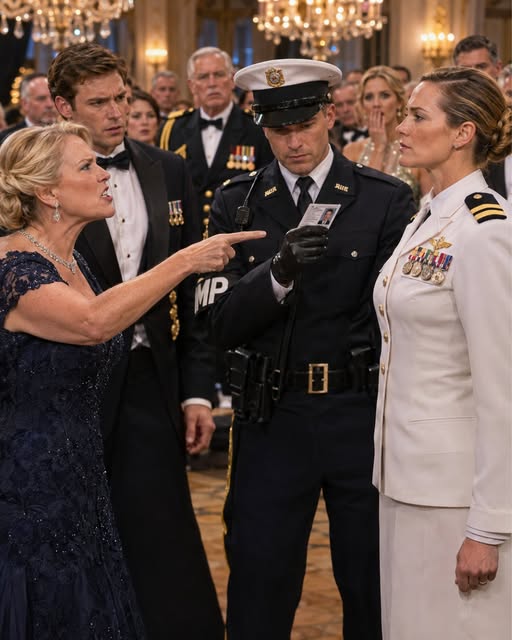
The air inside Conference Suite B was conditioned to a crisp, dry sixty-six degrees.
The room smelled of roasted coffee beans, leather armchairs, and the faint, chemical tang of high-speed laser printer ink. The heavy mahogany table was strewn with carbon-copy shipping manifests, blue-backed contract annexes, and a DoD-encrypted laptop glowing with an open forensic accounting ledger.
Special Agent Sarah Lin of the Naval Criminal Investigative Service sat at the far end of the table, her dark blazer unbuttoned, her gold federal shield resting flat beside a stack of red-flagged delivery vouchers.
Frank sat three seats away from her, his bow tie undone, his collar unbuttoned, his face buried in his hands.
Admiral Hargrove stood by the floor-to-ceiling window overlooking Connecticut Avenue, watching the late-evening rain streak the glass in jagged silver ribbons.
I walked in, closed the heavy soundproof door behind me, and took a seat opposite Frank.
The white fabric of my dress uniform was stark against the dark green leather of the conference chair.
Frank slowly lifted his head. His eyes were red-rimmed, his hair disheveled where his fingers had dragged through it for forty minutes.
""Evelyn,"" Frank whispered. ""I swear to God Almighty... I didn't know the rail cars were carrying live ordnance. When I signed the transfer waivers, the manifest descriptions read 'industrial maritime hardware.' The operations VP told me it was spare turbine casings from the Bath Iron Works overhaul.""
""Turbine casings don't require an explosive hazard classification placard on the side of a railcar, Frank,"" I said, keeping my hands folded flat against the table. ""You spent four years in commercial logistics at Georgetown. You know what an orange diamond placard means. You saw the Class-One hazard warning on the cover page.""
Frank didn't deny it. He slumped back into the leather, his chest heaving with shallow, ragged breaths.
""I had to sign them, Evelyn,"" he said, his voice dropping into a hoarse, broken rasp. ""Apex was facing a six-hundred-thousand-dollar liquidity shortfall on the fourth-quarter payroll. If the Navy canceled the secondary logistics contract, the bank was going to call the personal guarantees.""
""What personal guarantees?"" I asked.
Frank looked toward the window, then toward Agent Lin, who remained silent, her pen poised over an official interview worksheet.
""The bridge loans,"" Frank admitted, tears finally welling in the corners of his eyes. ""The loans that bought our townhome in Alexandria. The loans that paid for my corporate partnership buy-in three years ago. The loans that bought Mom’s condominium in Chevy Chase.""
I felt the temperature in the room drop another five degrees.
""Your mother told me that condominium was purchased with the proceeds from your grandfather’s estate sale,"" I said, each word falling cold and precise.
Frank let out a dry, bitter laugh that sounded like paper ripping. ""Grandfather didn't leave an estate, Evelyn. He left seventy thousand dollars in medical debt and a second mortgage on the house in Richmond. Mom fabricated the family trust out of whole cloth so she could maintain her seat on the symphony board.""
He reached out a trembling hand, pushing a manila document sleeve toward me across the mahogany surface.
""She didn't just push me into Apex, Evelyn,"" Frank said, his voice cracking into a dry, pathetic sob. ""She arranged the initial capitalization through an offshore entity in the Caymans. She told me it was private venture capital from her old country club connections. But when the partnership papers were filed with the Delaware registry, sixty percent of the voting equity was issued to a revocable trust.""
I opened the document sleeve.
There it was.
The corporate organization chart for *Apex Maritime Logistics Group LLC.*
At the bottom of the structure, owning the controlling interest that dictated every vendor decision, every demurrage claim, and every routing shortcut that had left two thousand tons of Navy munitions sitting vulnerable outside Baltimore, was *The Helen Donovan Whitmore Living Trust.*
Agent Lin tapped her pen against the ledger.
""Captain Whitmore,"" Agent Lin spoke up, her voice clinical and professional. ""The preliminary audit indicates that the demurrage payments billed to the Department of the Navy over the past eighteen months exceed three point two million dollars. Every dollar of that surplus was distributed as an executive dividend directly into that trust account.""
I looked across the table at my husband.
The man who had stood beside me for seven years. The man who had listened to his mother call me a desk clerk at Thanksgiving. The man who had watched me come home from eighteen-hour shifts at the Pentagon with my uniform smelling of exhaust and coffee, while his mother asked if my little job came with free parking.
He had known about the money.
He had known that the lifestyle Helen used to look down her nose at me—the designer dresses, the symphony box, the antique cufflinks, the condescending smirks across holiday tables—had been paid for by skimming federal dollars off the very fleet I had sworn an oath to protect.
""Did you know about the dividends, Frank?"" I asked softly.
Frank couldn't meet my gaze. His eyes drifted to the wood grain of the table, his fingers clawing at the seam of his trousers.
""Not at first,"" he whispered. ""I swear, Evelyn... not until six months ago. When the first audit notice arrived from Norfolk. I tried to pull the company back. I told Mom we had to restate the billing schedules. And she...""
He choked on the words, a ragged sob catching in his throat.
""What did she say, Frank?""
""She laughed at me,"" Frank wept, burying his face in his hands. ""She said nobody at the Pentagon would ever look at the secondary rail invoices because the logistics desk was run by paper-pushers who couldn't find their own offices without a map. She said... she said women like you were put in those positions precisely because you didn't have the stomach to ask hard questions.""
Admiral Hargrove turned around from the window.
His three silver stars caught the fluorescent light, his face set in an expression of cold, unvarnished disgust.
""Well, Mr. Whitmore,"" Hargrove said, his deep baritone cutting through the room like a broadside volley. ""It appears your mother fundamentally misunderstood the nature of the woman sitting across from you.""
He stepped up to the table, looking down at Frank with absolute, unyielding authority.
""Agent Lin,"" Hargrove commanded. ""Prepare an expedited material witness warrant for Helen Whitmore. I want federal marshals at the front doors of the Mayflower before she reaches the coat check.""
Before Agent Lin could stand, the frosted glass door of the suite opened.
Commander Miller—Hargrove’s aide—stepped inside, holding a high-priority dispatch folder bound in black leather with an amber flash-traffic indicator glowing on the binding.
""Admiral Hargrove,"" Miller announced, his face pale and taut. ""We have an emergency transmission from the Atlantic Fleet Operations Center in Norfolk.""
Hargrove frowned, reaching for the folder. ""What is it, Commander?""
Miller didn't hand the folder to Hargrove.
He walked past the three-star admiral, stopped beside my chair, and laid the dispatch flat before me.
""Captain Whitmore,"" the aide said, his voice tight with controlled urgency. ""The emergency message is addressed directly to you. An hour ago, an unauthorized commercial tug attempted to move the rail ferry carrying those munitions cars out of the Baltimore basin—and the captain of that tug is claiming he’s operating under direct written authorization from your office.""
---
Related Stories