Chapter 3: The Floorboards of the Tack Room
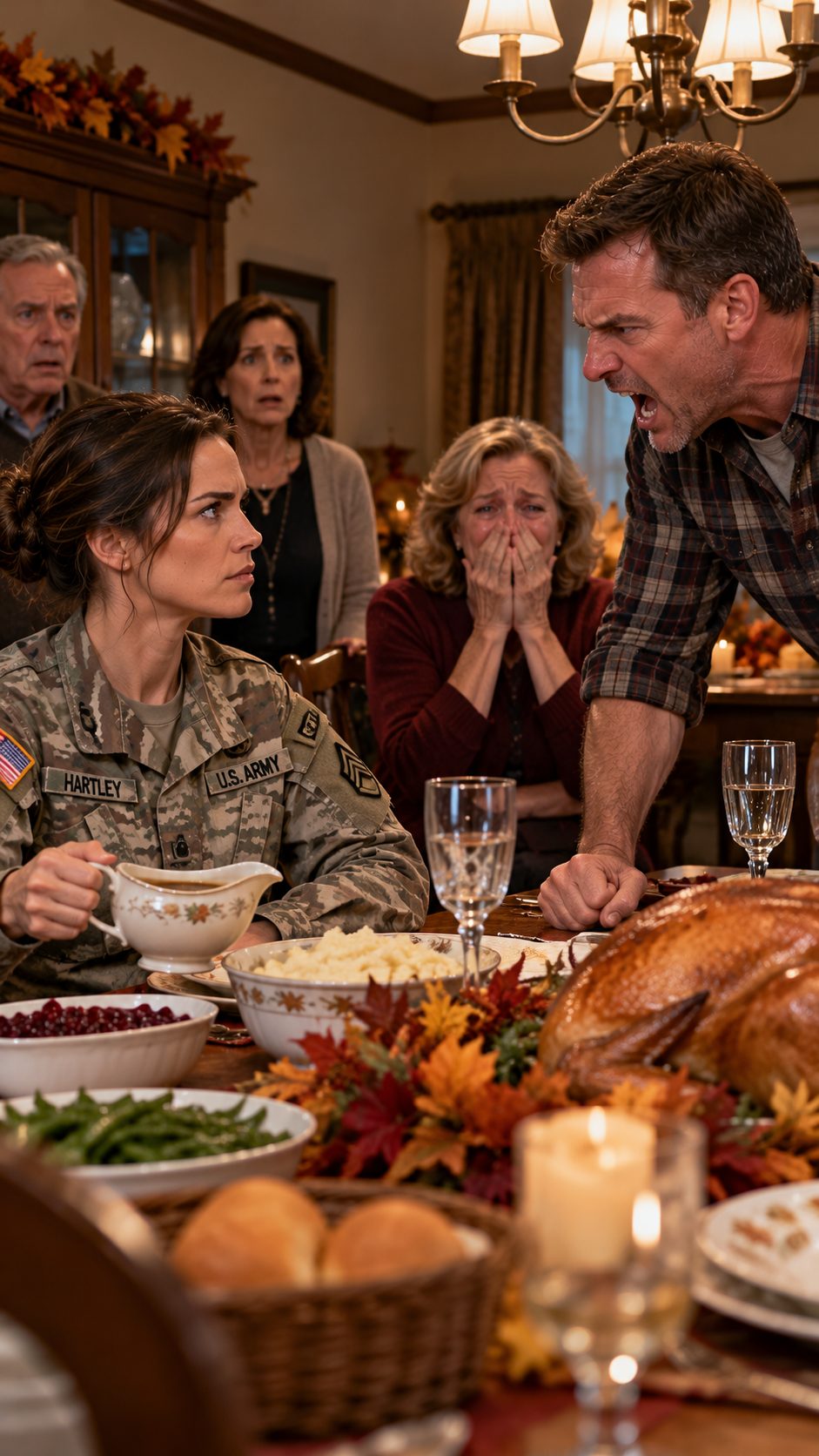
The iron bar cut through the freezing air with a sharp, whistling hiss.
He thought I was still the fourteen-year-old girl who cried in her bedroom when he stole her bicycle and sold it for gas money. He had entirely forgotten what fourteen years in the military does to human reflexes.
I didn't duck. I didn't flinch.
I stepped inside the arc of the swing, closing the distance before the bar could reach maximum velocity. My left forearm drove upward with bone-jarring force, deflecting the iron bar off course, while the heavy aluminum bezel of the tactical searchlight in my right hand struck the radial nerve on his right forearm with surgical precision.
Blake howled in agony.
His fingers went limp. The iron bar clattered harmlessly against the stone foundation of the barn, splashing into a puddle of freezing slush.
Before he could regain his balance, I pivoted, hooked my foot behind his ankle, and drove my palm into the center of his chest.
Blake hit the mud with a concussive thud that knocked every cubic inch of air from his lungs. He lay there on his back, wheezing like a landed catfish, the freezing rain pelting his face while he clutched his numb arm to his ribs.
""Stay down,"" I told him, not breathing hard, my boots planted firmly on either side of his hips.
Around the corner of the barn, Dad and Aunt Margaret came hurrying through the mud, their flashlights dancing crazily across the cedar siding. Mom trailed behind, slipping and stumbling, sobbing incoherently.
""Blake!"" Mom shrieked, dropping to her knees in the mud beside her fallen golden boy, wrapping her arms around his wet, trembling shoulders. ""Caroline, you animal! You broke his arm! Richard, look at what she did to him!""
""His arm isn't broken, Evelyn,"" Dad said, stepping past them without sparing his son a second glance. ""He’s got a bruised nerve. He’ll live. Which is more than he deserves after swinging an iron bar at his sister's skull.""
Dad pulled the key from my hand, turned the lock on the tack room door, and pushed it open.
The door glided inward on oiled hinges.
The scent that greeted us was like stepping backward twenty years in time: aged saddle leather, sweet alfalfa, neatsfoot oil, and the dry, powdery aroma of cedar shavings. It was Grandma’s scent. Clean. Unbroken. Untainted by the lies that had poisoned our dining room table.
I stepped through the threshold, sweeping the searchlight around the room.
The walls were lined with hand-carved saddle racks, bridle hooks made from bent iron horseshoes, and the small wooden desk where Eleanor used to keep her breeding logs. Above the desk, a framed black-and-white photograph showed a nine-year-old Caroline sitting atop Rosie, while a silver-haired woman stood beside the stirrup, laughing at something the camera couldn't see.
""Where is it, Richard?"" Aunt Margaret whispered, stepping into the room and closing the door behind her, shutting out the howling wind. ""Where did she tell you it was?""
Dad walked to the far corner of the tack room, where an antique cast-iron wood stove sat on a foundation of flat mountain flagstones.
He knelt on the rough-sawn pine floorboards, pulled a pocketknife from his trousers, and ran the blade along the seam between the third and fourth planks from the hearth.
""Your grandmother built this addition herself in nineteen-eighty-four,"" Dad murmured, his hands moving with quiet reverence. ""She told me that the only bank a rancher can trust is three feet beneath the frost line.""
He wedged the blade into a tiny notch in the pine. With a dull, dry groan of unyielding wood, a four-foot section of floorboard lifted upward, revealing a hidden compartment framed by dry river rock.
Resting inside the dark void was an olive-drab, heavy-gauge steel ammunition box, secured with a massive brass Yale padlock that bore the distinct pitting of fifty years of subterranean moisture.
Mom pushed her way through the doorway, her clothes dripping muddy water onto the clean pine floor, her eyes wide, glittering with manic greed.
""Open it,"" Mom demanded, her voice shaking. ""Richard, open it right now! That box belongs to the estate! I am Eleanor’s legal executor!""
""You were discharged as executor fourteen years ago when the probate closed, Evelyn,"" Aunt Margaret said coldly, blocking Mom’s path with her arm. ""And this box wasn't left to the estate. It was left to the person who holds the key.""
Dad reached inside his flannel shirt. From around his neck, he pulled a thin, tarnished silver chain. Hanging from the link was an old brass key, stamped with the number 42.
He looked up at me.
""Your grandmother gave me this key the night before she died at the hospice in Sheridan, Caroline,"" Dad said, his eyes swimming with unshed tears. ""She made me swear that I would keep it around my neck until you were old enough to stand your ground against your mother. I’m sorry it took me twenty-two years to find my courage.""
He unclasped the chain and laid the key in my open palm.
The brass was warm from his skin.
I knelt beside the open floorboard, my heart thumping against my ribs like a muffled war drum. I slid the key into the Yale padlock.
The mechanism was stiff, resisting for a fraction of a second, before the internal tumblers gave way with a clean, sharp *clack*.
I removed the lock and lifted the heavy steel lid.
Inside, protected by thick layers of oiled canvas and cedar blocks, was a stack of yellowed documents tied with green ribbon, a small black leather journal, and a heavy velvet pouch that clinked with the dull, unmistakable density of precious metal.
Mom gasped, lunging forward, but Dad caught her by both wrists, holding her back with an iron grip she couldn't break. ""Don't touch it, Evelyn! Don't you dare!""
I untied the green ribbon on the top document.
It was an original parchment deed, bearing the gold seal of the Territory of Wyoming, dated June 18, 1888. It wasn't a standard agricultural deed. It was a sovereign mineral and water-rights conveyance, signed by the territorial governor, granting the Whitcomb lineage unalienable, unseverable rights to the subterranean aquifer feeding the entire northern valley.
Beneath it was a certified commercial assessment from the State Department of Natural Resources, conducted two months before Grandma’s death in 2004.
I scanned the first page.
Then the second.
My breath stopped in my throat.
The commercial value of the water-rights lease wasn't eighty thousand dollars.
It was appraised at four point two million dollars.
And stapled to the back of the assessment was an unexecuted purchase contract from an international energy corporation based in Calgary, offering five million dollars in immediate cash for the drilling easements.
The contract had only two names listed on the seller's schedule:
*Blake Mercer.*
*Evelyn Mercer.*
---
Related Stories